
The meaning of the Sunday Mass Readings for November 2025 is made clearest by Catholic Doctrine. God speaks most clearly through Catholic Doctrine. Catholic doctrines are the essentially unchangeable clarifications of Revelation and Faith that only the pope and bishops have the God-given authority to make, that must be accepted as objectively true in order to be Catholic, and that not even the pope and bishops may contradict. I have written two columns explaining in more depth what doctrine is and why the Church needs it.
Let’s learn always-true doctrines in the Catechism of the Catholic Church that we can take away from this November’s Sunday Readings.[1]
November 2, Commemoration of All the Faithful Departed
There are two options for today’s Second Reading. A doctrine we should take away from the first option is: “By giving up his own Son for our sins, God manifests that his plan for us is one of benevolent love, prior to any merit on our part” (CCC 604[2]). So, first, Jesus’ death on the cross is “the unique and definitive sacrifice . . . that accomplishes the definitive redemption of [humans]” (CCC 613). Without Jesus’ death on the cross, no one could be eternally saved (CCC 617). Second, no one earned or deserved God the Son’s sacrifice for our sins. It can well be said to be the ultimate act of unconditional love.
An important doctrine about Baptism is supported by the second option: Baptism is “burial into Christ’s death, from which [the baptized person] rises up by resurrection with [Christ], as a ‘new creature’” (CCC 1214). We the baptized are new creatures in two ways: “even now by the justification of our souls,” and “one day by the new life [Christ] will impart to our bodies” (CCC 658). For more on justification, which is being in the state of grace or in right relationship with God, see CCC 1987-2029.
That just mentioned “one day” when Christ will impart new life to our bodies is the Last Day, about which He talks in today’s Gospel (CCC 989, 1001). So there are two phases to being in the direct presence of God: [1] At death “the separation of the soul from the body, [after which] the human body decays and the soul goes to meet God, while awaiting [2] its reunion with its glorified body.” (CCC 997). It might be helpful to use the term Heaven for that first phase of souls-without-their-bodies in the direct presence of God and to use the terms Kingdom, Kingdom of God, and Kingdom of Heaven for that second phase of souls-reunited-with-their-bodies in the direct presence of God, since the Church uses those terms interchangeably.
Today we commemorate the faithful departed. Let’s be clear what happens after death (CCC 1021-1050). Immediately after we humans die, our souls are immediately judged by God to receive eternal salvation or eternal damnation. Saved souls might immediately enter Heaven, or they might immediately enter Purgatory before they go to Heaven. Purgatory leads only to Heaven and the Kingdom; it does not lead to Hell. We should pray for the souls in Purgatory asking God to mercifully shorten their time there. All saved souls are ultimately reunited with glorified bodies and enter the Kingdom of God.
- From the Responsorial Psalm[3] (Psalms 23:1-3a, 3b-4, 5, 6): Ps 23:5 is cited in CCC 1293.
- From the Second Reading (Romans 5:5-11): Rom 5:5 is cited in CCC 368, 733, 1820, 1964, and 2658; Rom 5:8 in CCC 604; and Rom 5:10 in CCC 603 and 1825; OR (Romans 6:3-9): Rom 6:3-4 in CCC 1214, 1227, and 1987; Rom 6:4-5 in CCC 790; Rom 6:4 in CCC 537, 628, 648, 654, 658, 730, 977, and 1697; and Rom 6:5 in CCC 1694 and 2565.
- From the Gospel (John 6:37-40): Jn 6:38 is cited in CCC 606 and 2824; Jn 6:39-40 in CCC 989 and 1001; and Jn 6:40 in CCC 161 and 994.
November 9, Dedication of the Lateran Basilica
Today’s feast celebrates the dedication of the cathedral of Rome, the Basilica of St. John Lateran. With the centrality of the cathedral throughout the Catholic Church, it is appropriate that today’s Readings recall the centrality of the Temple for Jews and its ultimate meaning. “Jesus went up to the Temple as the privileged place of encounter with God . . . and he was angered that its outer court had become a place of commerce” (CCC 584). Jesus “even identified himself with the Temple by presenting himself as God’s definitive dwelling-place among [humans]” (CCC 586).
- From the Second Reading (1 Corinthians 3:9c-11, 16-17): 1 Cor 3:9c is cited in CCC 756; 1 Cor 3:11 in CCC 756; and 1 Cor 3:16-17 in CCC 797.
- From the Gospel (John 2:13-22): Jn 2:13-14 is cited in CCC 583; Jn 2:16-17 in CCC 584; Jn 2:18-22 in CCC 586; Jn 2:18 in CCC 575; Jn 2:19-22 in CCC 994; and Jn 2:21 in CCC 586.
November 16, Thirty-third Sunday in Ordinary Time
Today’s First Reading and Gospel anticipate the theme of next week and Advent, so let us focus on the Second Reading. It is referenced to teach “work is a duty . . . [that] honors the Creator’s gifts and the talents received from him. . . . Work can be a means of sanctification and a way of animating earthly realities with the Spirit of Christ” (CCC 2427). For more on Catholic doctrine about work, see CCC 2426-2436.
- From the First Reading (Malachi 3:19-20a): Mal 3:19 is cited in CCC 678.
- From the Second Reading (2 Thessalonians 3:7-12): 2 Thes 3:10 is cited in CCC 2427.
- From the Gospel (Luke 21:5-19): Lk 21:12 is cited in CCC 675.
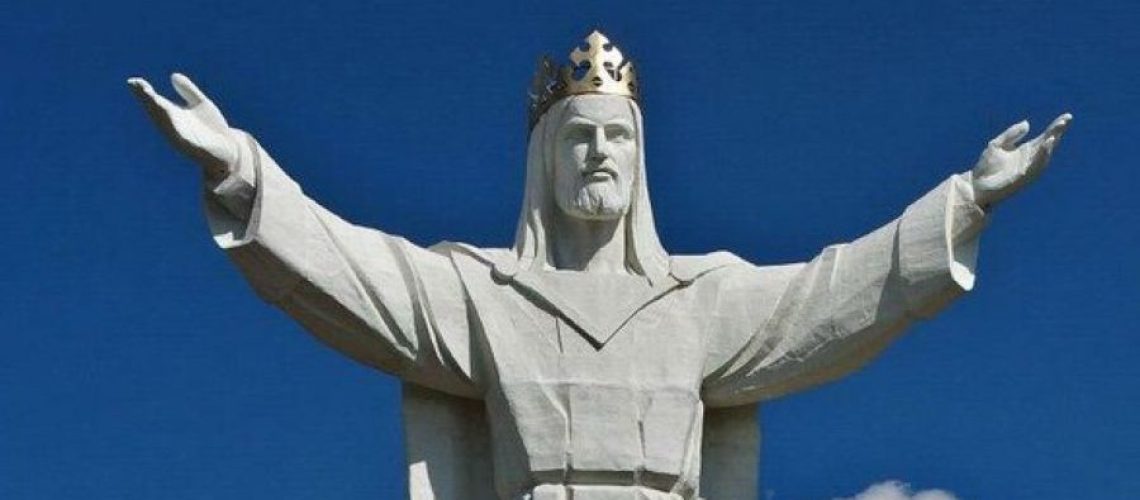
November 23, Our Lord Jesus Christ, King of the Universe
In today’s Gospel, Jesus granted the Good Thief admittance into what kingdom? Into what kingdom does Jesus transfer us from the power of darkness, mentioned in today’s Second Reading?
The Kingdom is the fullness of eternity since it includes body and soul, a new Heaven and a new earth, spiritual reality and physical reality combined in a way that transforms physical reality beyond space and time while not eliminating its physicality, with complete and eternal freedom from death as well as all other pain and evil (CCC 1042). The Kingdom restores Eden as it was before Original Sin (CCC 374, 1047) yet transcends Eden because the Kingdom is freedom even from the possibility of sinning (CCC 1045). In it there will be perfect relationships between each person and God, between each person and all other persons, and between each person and Creation (CCC 1043). It is the everlasting fullness of life (CCC 1044). Good news! The best possible news!
Jesus’ mission from the Father was to establish the Kingdom on earth (CCC 541). The Kingdom is the reason He was conceived, as Gabriel announced to Mary (Luke 1:31-33).
The Kingdom was the theme of Jesus’ preaching (CCC 543): the heart of His gospel (Mark 1:15), what He said to seek before seeking anything else (Matthew 6:33), what He taught us to pray for in the Our Father, and the subject of many of His parables (CCC 546). It was what He instructed His disciples to preach (Luke 10:8-11), and what He and the Apostles discussed between the Resurrection and the Ascension (Acts 1:3-8).
The Kingdom was the theme of Jesus’ actions. It was to reveal the Kingdom that He performed His miracles (CCC 547) – each miracle reveals something about human existence free from evil. Jesus began establishing the Kingdom by founding the Catholic Church (CCC 669), for example, by giving the keys of the Kingdom to Peter and his successors (CCC 553). In His most significant actions, Jesus died for our sins to allow us entry into the Kingdom (CCC 542), and He rose from the dead with a glorified body to reveal the glorified bodies we will have in the Kingdom (CCC 646, 655, 989).
Jesus will finish establishing the Kingdom of unlimited love and joy when He returns to earth on the Last Day (CCC 681) to judge the living and the dead (CCC 682, 1038). The final establishment of the Kingdom does not mean that everyone will enter it and that Hell will no longer exist (CCC 1035). When we think salvation, we should think the Kingdom.
We celebrate the end of the Liturgical Year by celebrating the end of time and history, the end of struggle and evil and death. Thy Kingdom come!
- From the Second Reading (Colossians 1:12-20): Col 1:12-14 is cited in CCC 1250; Col 1:13-14 in CCC 517; and Col 1:14 in CCC 2839.
- From the Gospel (Luke 23:35-43): Lk 23:39-43 440 is cited in CCC 2616; Lk 23:40-43 in CCC 2266; and Lk 23:43 in CCC 1021.
November 30, First Sunday of Advent
The First Sunday of Advent is the first day of the Catholic liturgical year. This year, Advent begins Year A in the three-year cycle of Sunday Readings. (The Weekday Readings are in a two-year cycle.) Year A emphasizes the Gospel of Matthew, whereas Year B emphasizes Mark, and Year C emphasizes Luke.
Advent observes both comings of Jesus Christ to earth (CCC 524). The purpose of His First Coming – as an infant – was to begin a New Covenant, a new relationship between God and humanity (CCC 73). The purpose of His Second Coming – His return to earth in glory – will be to bring the New Covenant to culmination (CCC 541).
In the ancient Near East, a covenant was a solemn pact or agreement which made non-relatives treat each other like relatives, began with a solemn ritual which often included the sacrifice of animals, and was so binding that someone who broke it deserved death. God made a covenant with Abraham and his descendants, the Jews, with iterations through Moses, David, and the prophets. The Jews are therefore both Abraham’s people and God’s people, the Chosen People (CCC 72).
Today’s First Reading means: “Through the [Old Testament] prophets, God forms his [Jewish] people . . . in the expectation of a new and everlasting Covenant intended for all [people]” (CCC 64). The Chosen People of the Old Covenant are “the preparation . . . the sign of the future gathering of all nations” into God’s People of the New Covenant, the Catholic Church (CCC 762).
The New Covenant takes form in the Kingdom of God (CCC 763, 2816). As we saw with last Sunday’s Readings, God the Son’s First Coming to earth was to begin the establishment of the Kingdom. He will complete the establishment of the Kingdom at His Second Coming to earth (CCC 1060). Today’s Gospel alerts us to the fact that the Second Coming of the Son of Man (which is one of Jesus’ titles) “could be accomplished at any moment” (CCC 673). Advent is the season to prepare for the celebration of Christmas, and it is the season to make sure we are always prepared for Our Lord’s Second Coming.
- From the First Reading (Isaiah 2:1-5): Is 2:2-5 is cited in CCC 762; Is 2:2-4 in CCC 64; and Is 2:4 is cited in CCC 2317.
- From the Gospel (Matthew 24:37-44): Mt 24:36 is cited in CCC 443; and Mt 24:44 in CCC 673.
[1] There are too many citations, or references, in the Catechism to the verses in a month of Sunday Mass readings to identify all the pertinent doctrines, so I will use my best judgment to select which verses and doctrines to cover in a column that may not exceed 2,000 words. The bullet points allow you to explore further the Biblical basis of Catholic Doctrine.
[2] CCC abbreviates Catechism of the Catholic Church. Any number after it is the number of a paragraph in the Catechism. For example, “CCC 604” means paragraph 604 of the Catechism.
[3] If a Reading is not listed, then none of its verses is cited by the CCC.


[…] References:The Sunday Readings & Catholic Doctrine for November 2025 – Marty Dybicz at Catholic StandDaily Readings: Novus Ordo Mass (U.S.) – United […]
[…] References:The Sunday Readings & Catholic Doctrine for November 2025 – Marty Dybicz at Catholic StandDaily Readings: Novus Ordo Mass (U.S.) – United States […]
[…] References:The Sunday Readings & Catholic Doctrine for November 2025 – Marty Dybicz at Catholic StandDaily Readings: Novus Ordo Mass (U.S.) – United […]
[…] References:The Sunday Readings & Catholic Doctrine for November 2025 – Marty Dybicz at Catholic StandDaily Readings: Novus Ordo Mass (U.S.) – United States […]
[…] References:The Sunday Readings & Catholic Doctrine for November 2025 – Marty Dybicz at Catholic StandDaily Readings: Novus Ordo Mass (U.S.) – United […]
[…] References:The Sunday Readings & Catholic Doctrine for November 2025 – Marty Dybicz at Catholic StandDaily Readings: Novus Ordo Mass (U.S.) – United States […]
[…] References:The Sunday Readings & Catholic Doctrine for November 2025 – Marty Dybicz at Catholic StandDaily Readings: Novus Ordo Mass (U.S.) – United States […]
[…] References:The Sunday Readings & Catholic Doctrine for November 2025 – Marty Dybicz at Catholic StandDaily Readings: Novus Ordo Mass (U.S.) – United States […]
[…] References:The Sunday Readings & Catholic Doctrine for November 2025 – Marty Dybicz at Catholic StandDaily Readings: Novus Ordo Mass (U.S.) – United […]
[…] References:The Sunday Readings & Catholic Doctrine for November 2025 – Marty Dybicz at Catholic StandDaily Readings: Novus Ordo Mass (U.S.) – United States […]
[…] References:The Sunday Readings & Catholic Doctrine for November 2025 – Marty Dybicz at Catholic StandDaily Readings: Novus Ordo Mass (U.S.) – United […]
[…] References:The Sunday Readings & Catholic Doctrine for November 2025 – Marty Dybicz at Catholic StandDaily Readings: Novus Ordo Mass (U.S.) – United States […]
[…] References:The Sunday Readings & Catholic Doctrine for November 2025 – Marty Dybicz at Catholic StandDaily Readings: Novus Ordo Mass (U.S.) – United […]
[…] References:The Sunday Readings & Catholic Doctrine for November 2025 – Marty Dybicz at Catholic StandDaily Readings: Novus Ordo Mass (U.S.) – United States […]
[…] References:The Sunday Readings & Catholic Doctrine for November 2025 – Marty Dybicz at Catholic StandDaily Readings: Novus Ordo Mass (U.S.) – United […]
[…] References:The Sunday Readings & Catholic Doctrine for November 2025 – Marty Dybicz at Catholic StandDaily Readings: Novus Ordo Mass (U.S.) – United States […]
[…] References:The Sunday Readings & Catholic Doctrine for November 2025 – Marty Dybicz at Catholic StandDaily Readings: Novus Ordo Mass (U.S.) – United […]
[…] References:The Sunday Readings & Catholic Doctrine for November 2025 – Marty Dybicz at Catholic StandDaily Readings: Novus Ordo Mass (U.S.) – United States […]
[…] References:The Sunday Readings & Catholic Doctrine for November 2025 – Marty Dybicz at Catholic StandDaily Readings: Novus Ordo Mass (U.S.) – United […]
[…] References:The Sunday Readings & Catholic Doctrine for November 2025 – Marty Dybicz at Catholic StandDaily Readings: Novus Ordo Mass (U.S.) – United States […]
[…] Analysis, Punditry, News, and References:The Sunday Readings & Catholic Doctrine for November 2025 – Marty Dybicz at Catholic StandDaily Readings: Novus Ordo Mass (U.S.) – United […]
[…] Analysis, Punditry, News, and References:The Sunday Readings & Catholic Doctrine for November 2025 – Marty Dybicz at Catholic StandDaily Readings: Novus Ordo Mass (U.S.) – United States […]
[…] Analysis, Punditry, News, and References:The Sunday Readings & Catholic Doctrine for November 2025 – Marty Dybicz at Catholic StandDaily Readings: Novus Ordo Mass (U.S.) – United […]
[…] Analysis, Punditry, News, and References:The Sunday Readings & Catholic Doctrine for November 2025 – Marty Dybicz at Catholic StandDaily Readings: Novus Ordo Mass (U.S.) – United States […]
[…] Reference Links:The Sunday Readings & Catholic Doctrine for November 2025 – Marty Dybicz at Catholic StandMassTimes.org – MassTimes.orgDaily Readings: Novus Ordo Mass […]