

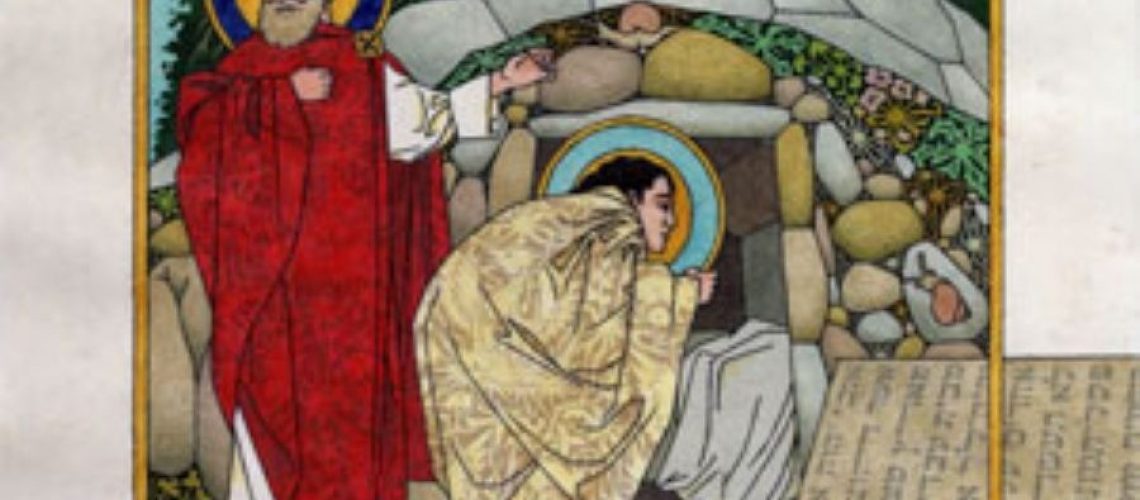
While traveling throughout the U.S. I often stop at Catholic churches to say a short prayer. Sadly, they are locked about half the time, but when I am able to enter I am often dumbfounded at how beautiful they are.
Some churches still have ornate communion rails in place that no one has renovated after Vatican II. Others display grand, high altars that parishioners long deceased hand carved. Others are modern but still adorn themselves with images fit for the Highest King.
Some churches date back to before the founding of the Unites States, like the Cathedral in St. Augustine, Florida. Others are less than 100 years old, like the National Shrine of the Little Flower in Royal Oak, Michigan. Others, such as the Oratory of Saint Mary Magdalene in Fort Wayne, Indiana, are less than a decade old.
Although Western European styles of architecture are typical, there are other architectural styles as well. The Cyrillic Eastern Style of Saint Josaphat Cathedral in Parma, Ohio or the Vietnamese Martyrs Parish in Phoenix, Arizona are wonderful examples of each style.
I’ve come to realize that, without a doubt, the United States has priceless treasures scattered throughout the country hidden in plain sight. With so much of the modern world promoting shapeless, meaningless forms of artwork, it is clear that Catholic and other Christian artists still thrive and create beauty.
Catholic Feudal Japanese Art
During a parish talk on Catholic art not too long ago, one speaker presented several pieces of art that included an image of St. Michael as a winged samurai warrior. Holding a katana, the archangel stood on a celestial dragon driving it out of heaven.
A second painting by the same artist portrayed the wedding feast of Cannan. The artist dressed Mary in a kimono and depicted her with white skin and halo. Jesus is at Mary’s side, directing a servant to fill jars with water.

The symbolism embedded in the work struck me. The glazing on the wine jars depicts the six days of creation. The Japanese-style partitions behind the figures show scenes from the Old Testament. The details are amazing.
Both paintings follow the style of old Feudal Japan in Ukiyo-e form. I was shocked to learn that the work was very modern. Moreover, an American created these works.
An American Artist of Japanese Descent
Daniel Mitsui is the artist responsible for both of these works. He is a full-time artist based in Northwest Indiana.
In his late teens, Daniel was looking to become a comic book or children’s book artist, or perhaps an animator for films. However, he found himself attracted to medieval art when he discovered illuminated manuscripts in High School .
As a child, Mitsui’s family were Chreasters, and he was never sacramentalized. While attending Dartmouth College, the Aquinas House at Dartmouth drew him towards Catholicism, and he began his faith journey. Mitsui was baptized and initiated into the faith at the age of 22.
As an artist, he felt a calling and renewed interest in religious art. He has focused on crafting intricate ink drawings that breathe new life into ancient traditions and stays faithful to the Second Council of Nicea. As explained by Father Phillippe Labbe, in his book “Sacrosancta Concilia Ad Regiam Editionem Exacta” this means, “The composition of religious imagery is not left to the initiative of artists, but is formed upon principles laid down by the Catholic Church and by religious tradition… The execution alone belongs to the painter; the selection and arrangement of subject belong to the fathers.”
A Full-time Artist
In 2010, Daniel chose to become a full-time artist. Although he sells lithographs and books, commissions provide Mitsui’s primary income.
One commission from a Marian priest who spent years as a missionary in Japan launched his series of works in the Japanese Ukiyo-e style. Since then, he has completed many works in this style, such as the “Dream of St. Joseph” and “Our Lady of Perpetual Help.”

After 15 years, Mitsui’s portfolio has expanded to include works depicting scenes in the Old and New Testament, saints, and angels. He composes his works using medieval European, Northumbro-Irish (usually referred to as “Insular Art”) and Ukiyo-e Japanese styles.
If one looks closely at the decorations adorning the edges of many of his pictures, one discovers New World flora and fauna. Borders may contain diatoms and single-cell life forms that reveal creation’s hidden order.
I had an opportunity to ask Daniel about this recently. He said he imagines it is what Renaissance artists might have done if they had known such wonders existed. So, although one will never find the Australian duckbilled platypus or South American tree frogs in the Illuminated manuscripts of medieval Europe, one sees them adorning pieces by Daniel Mitsui.
Looking ahead, Mitsui aims to finish what he calls his “Summula Pictoria” before the end of his career. It is a summary of the Old and New Testament in a series of drawings.
Religious Art Remains Alive
Daniel Mitsui joins many artists who prove that Catholic art pulses with divine inspiration still today. From ancient cathedrals to new perpetual adoration chapels, beauty still endures.
Part of the Catholic tradition is to teach the revelations of the Gospel in artwork, weather it be glowing stained glass, lifelike statues, murals, icons, or motifs. All of these artforms can be used to proclaim the one true Faith. Each bear witness and hand down the revelation of Christ. Even today, the Church’s visual voice speaks with splendor.
Visit danielmitsui.com to see glimpses of a vocation rooted in Christ.





3 thoughts on “The Splendor and Diversity of Modern Catholic Art”
Pingback: Artists in Our Midst – Catholic Stand
Pingback: FRIDAY LATE-AFTERNOON EDITION - BIG PVLPIT
Pingback: The Splendor and Diversity of Modern Catholic Art – Catholic Stand - LagacyNews