

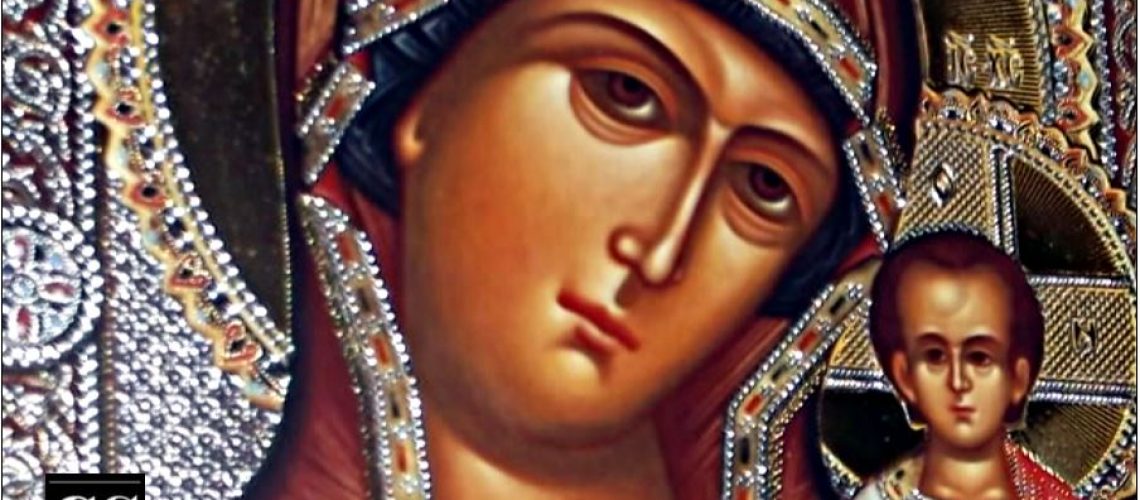
“One day, through the rosary and the scapular, Our Lady will save the world.” ~St. Dominic
Our Lady is forever encouraging her children to pray the rosary. At each apparition, she calls on us to make the rosary our most consistent daily devotion. But how many of us follow her direction? Too often our beads lay neglected at the back of the junk drawer or hang decoratively around the neck of a statue of the Mother of God. Despite our best intentions, the days pass and our beads grow dusty.
There are many reasons why we might be neglecting Our Lady’s call to prayer, but for some of us, it’s less neglect than uncertainty. The rosary seems to belong so much to the Latin Rite, what’s a devout Byzantine to do? For the universal Church’s millions of Byzantines, the rosary is often replaced by the chotki and the recitation of the Jesus Prayer.
The Jesus Prayer, while a beautiful prayer, is not a “Byzantine Rosary.” It’s a devotion in its own right, and definitely one that has shaped the Eastern Catholic spiritual life in a deep and nourishing way. But the true Byzantine rosary is the long-neglected Prayer Rule of the Theotokos.
What Is the Prayer Rule?
This ancient devotion is rumored to have been practiced by the later Egyptian monks, particularly those who lived in the 8th century. Tradition maintains that the Prayer Rule was given to a monk in the Thebaid who shared it with his community. The monks prayed 150 Angelic Salutations to the Mother of God:
Rejoice, O Virgin Theotokos Mary, full of grace, the Lord is with You. Blessed are you among women, and blessed is the fruit of your womb, for you have born Christ, the Savior of our souls.
Those Salutations were gathered into 15 groups of 10, just as they are in our modern rosary. After every 10 repetitions, an Our Father was prayed. Later, monks added another prayer between the decades:
Open unto us the door of your loving kindness, O most Blessed Theotokos. As we set our hope in you, let us not be confounded, but through you may we be delivered from all adversities. For you are the salvation of all Christians.
The similarities to the rosary as we pray it today are stunning. Full of beauty and simplicity, the prayers allow the Rule to become, like the Western rosary, a tool of meditation and reflection.
St. Seraphim of Sarov
Like so many soul-nourishing devotions though, the Prayer Rule gradually fell into disuse. Eastern Christians largely forgot about the Rule until the early 19th century when St. Seraphim of Sarov, the famous Russian saint and mystic, began to promote it.
Seraphim, whose life was filled with miraculous visions and a deep devotion to the Mother of God, is recognized as a Saint in both Catholic and Orthodox faiths. He taught all his spiritual children to pray the Rule daily. He emphasized Our Lady’s love of the Angelic Salutation and encouraged all Christians to entrust themselves to her through these prayers.
Growing Through the Years
In every iteration, the rosary is a living prayer. The mysteries we meditate on were added to the Dominican rosary in the 15th century. While it is the most commonly prayed rosary in the West, we also have the Franciscan Crown rosary (whose 7 decades commemorate the 7 Joys of the Virgin); the Servite Rosary (whose 7 decades commemorate the 7 Sorrows of the Virgin); and the Lourdes rosary (6 decades each of Sorrowful, Joyful, and Glorious mysteries).
Each rosary is a true rosary, and each rosary offers us an opportunity to entrust ourselves and our world to the Mother of God.
Like the Dominican rosary that we know so well, the Prayer Rule of the Theotokos offers the opportunity to meditate on mysteries while praying. But specific mysteries were not set to each decade of the Rule until Bishop Seraphim Zvezdinsky of Dmitrov in the early 20th century.
Bishop Seraphim offered meditations on mysteries beginning with the Nativity of the Mother of God and ending with her Glorious Crowning as Queen of Heaven.
The Mysteries
- Nativity of the Theotokos
- Presentation of the Blessed Virgin and Theotokos
- Annunciation
- Meeting of the Theotokos with St. Elizabeth
- Nativity of Christ
- Encounter of Our Lord with Simeon
- Flight into Egypt
- The Disappearance of the Child Jesus in Jerusalem
- Miracle at the Wedding in Cana
- The Theotokos Standing at the Cross of Christ
- Christ’s Resurrection
- Christ’s Ascension into Heaven
- The Descent of the Holy Spirit
- The Dormition of the Theotokos
- Crowing of the Queen of Heaven
As with all variations, these meditations focus on Christ: various aspects of His life, and His influence and graces bestowed on His people.
How to Pray the Rule
Like the rosary, the Prayer Rule can be prayed extremely simply: 150 (or just 50 at a time) Angelic Salutations, in clusters of 10. Each decade marked by an Our Father and an “Open Unto Us.”
Traditionally, the Rule begins with the Sign of the Cross, the Creed, and a “Glory to You, our God, Glory to You.”
In the past 200 years, it’s become common to add in another introductory prayer as well:
O Heavenly King, Comforter, Spirit of Truth, everywhere present and filling all things, Treasury of blessings and Giver of Life: come and dwell within us, cleanse us of all stain, and save our souls, O gracious One.
Then, like the Divine Mercy Chaplet, we pray three times:
Holy God, Holy Mighty One, Holy Immortal One, have mercy on us!
This is followed by a Glory Be, and a prayer for the Mercy of God. Some like to simply say “Lord have mercy, Lord have mercy, Lord have mercy,” as we do at the end of Divine Liturgy. But others prefer the longer prayer:
O Most Holy Trinity, have mercy on us. O Lord, cleanse us of our sins. O Master forgive us our transgressions. O Holy One, come to us and heal our infirmities for Your Name’s sake.
When the Introductory prayers are complete, move on to the Salutations and Our Fathers, with or without the mysteries.
Daily Prayers for Eastern Catholics
For Byzantine Rite Catholics, or Latin Rite Catholics interested in encountering Byzantine spirituality, the Prayer Rule of the Theotokos is an ideal way to obey the urgent requests of Our Lady at Fatima and Akita. Our Lady has asked us to pray the rosary daily, and the Rule provides an opportunity for Eastern Catholics to rightly cultivate our spiritual heritage.
As Pope St. John Paul II wrote in Orientale Lumen (Light of the East), “the venerable and ancient tradition of the Eastern Churches is an integral part of the heritage of Christ’s Church.” Let us embrace that tradition, and united, offer prayers to the Mother of God for the salvation of the world.


11 thoughts on “The Prayer Rule of the Theotokos”
Justin, it is certainly true, in my experience, that very many people “babble” when they recite the Rosary, perhaps most people.
Shakespeare had one of his characters say: “My words fly up. My thoughts remain below. Words without thoughts never to Heaven go.”
It’s very difficult for me to believe that these babblers are thinking what they are babbling.
And, if they are thinking of something else while they are babbling, how offensive is that to Our Lady ?
Is all prayer babble to you? It seems more like you are judging people without evidence. See to your own prayer.
The Prayer Rule of the Theotokos is a traditional Orthodox Christian devotion centered on the recitation of prayers to the Virgin Mary, seeking her intercession. This practice fosters deep spiritual connection and reverence for the Mother of God.
VERALUCIA:
The current pope has said things that contradict the Bible. He has entered into agreements with other religions that do not recognize Jesus as the gateway to salvation. He bows to graven images, and serves Mary, contrary to one of the Ten Commandments. Seems to turn a blind eye to the homosexual problem in the Catholic priesthood.
I agree with everything you said, except the “serves” Mary, as I’m not sure what’s your context to say that, hence, I pray for him. That’s the Pope God allowed to head the Church at this time. Looks like you’re not Catholic. We look at more than the Bible to follow Christ and we do love and honour Mary very VERY much, like Jesus did.
I am a Catholic, however, I question some of the doctrines espoused by the RCC and its priests when compared with the scriptures.
For instance, the Catholic Church has given many titles to Mary over the years, yet the Bible simply says that she was the mother of Jesus. None of the New Testament writers, who lived at the time of Jesus and Mary, conveyed any to her.
Another example would be the Church’s claim that Mary was assumed into heaven, yet none of the writers mention such an extraordinary event, including the apostle who cared for her.
However, Jesus taught his apostles how to pray. Again, nothing in the scriptures to suggest that we should pray to Mary, or the church-declared saints. In fact, Paul tells us that Jesus is our sole mediator with God. And we declare twice during mass that Jesus is seated at His right-hand.
Consequently, I am concerned about the increase in the devotions to Mary, especially by my parish priest.
Really enjoyed this article. I just started attending the Byzantine Catholic Rite and I am in love with the beauty and reverence of it. I will never stop saying the rosary but I love to know that there is such a devotion to Our Lady, like the rosary, in the Byzantine Catholic rite as well.
As a Catholic, what do I do when church doctrine or words from the pope or a priest contradict the sacred scriptures?
You pray for them. You offer sacrifices for them. And as Catholics, we look beyond Sacred Scripture. We look as well into Tradition and Magisterium. Anything taught outside Scripture, Tradition and the Magisterium. The Pope is entitled to his personal opinion and there were bad Popes throughout history. What we look for are statements made ex-cathedra. If he didn’t make one, you disregard what he said that is wrong and move on – pray for him.
Matthew 6:5-13
New American Bible (Revised Edition)
Teaching About Prayer. 5 “When you pray, do not be like the hypocrites, who love to stand and pray in the synagogues and on street corners so that others may see them. Amen, I say to you, they have received their reward. 6 But when you pray, go to your inner room, close the door, and pray to your Father in secret. And your Father who sees in secret will repay you. 7 In praying, do not babble like the pagans, who think that they will be heard because of their many words. 8 Do not be like them. Your Father knows what you need before you ask him.
The Lord’s Prayer. 9 “This is how you are to pray:
Our Father in heaven,
hallowed be your name,
10 your kingdom come,
your will be done,
on earth as in heaven.
11 Give us today our daily bread;
12 and forgive us our debts,
as we forgive our debtors;
13 and do not subject us to the final test,
but deliver us from the evil one.
You aren’t babbling when you pray the Rosary. Jesus was condemning merely repeating phrases and thinking that will make your prayers be heard and not praying with any real intention of offering sincere prayer. Bringing up the Our Father contradicts the nonsense you are peddling because it is a prayer mean to be repeated, and even Jesus repeated the same prayer in the garden before his Passion.
It sounds like you’ve been spending too much time listening to Protestant heretics and should seek counsel from an orthodox priest or spiritual director.