

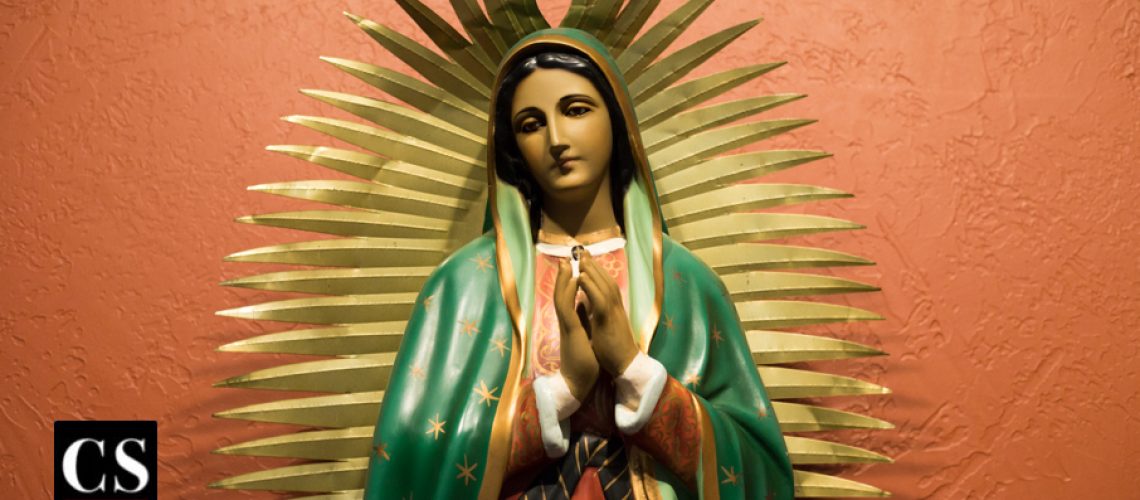
Catholics love to ask for the saints’ intercession, and no saint is called upon more often than Mary, the mother of Jesus. While every saint has at least some devotees within the Church, Mary is loved almost universally. Just about every Catholic has some sort of devotion to her, making her by far the most popular saint to whom to pray in times of need. However, this raises some questions for us: Why is she so special? Why is her intercession sought so much more than that of all the other saints?
The simple answer is that Mary’s intercession is more powerful than anybody else’s, but that just pushes the question back a step. If she is such a powerful intercessor, why is that so? Why are her prayers more effective than those of any other saint? There are a few ways we can approach this issue, but I want to focus on just one: Mary is our queen, and the Bible teaches that our king, Jesus, won’t refuse her.
Queen Mother
To understand what I mean, we have to go all the way back to the Old Testament. Specifically, we need to look at the ancient kingdom of Israel, the one ruled over by King David and his royal descendants. In this kingdom, the queen was the king’s mother, not his wife, and she was called the queen mother (1 Kings 15:13, 2 Chronicles 15:16, Jeremiah 13:18). Now, in case the title “queen mother” isn’t clear enough, Scripture drives this point home for us with a woman named Bathsheba, the wife of King David and the mother of his successor Solomon. When David was king, Bathsheba would bow down to him and call him “my lord” (1 Kings 1:17, 31), but her position changed after her son ascended to the throne. When Solomon became king, he bowed down to her and gave her a seat at his right side, indicating her royal authority (1 Kings 2:19).
It may seem strange to us that the queen was the king’s mother rather than his wife, but there’s actually a very good reason for it. Ancient Israelite kings often had more than one wife, so they couldn’t choose just one as their queen. However, they only had one mother, so choosing her solved the problem. Moreover, the queen mother served as a link between the current king and his predecessor. As one of the former king’s wives, she legitimated her son’s reign by proving that he really was the son of his predecessor. As a result, the king’s mother held a very important position in ancient Israel, one unmatched by anybody else.
The Queen’s Intercession
Now, if we look more closely at the queenship of Bathsheba, we find something very interesting. Towards the beginning of her son’s reign, one of his brothers came to Bathsheba and asked her to convey a request to the king. He wanted to marry a woman named Abishag the Shunammite, and when he asked this, he pointed out that Solomon would not refuse her (1 Kings 2:17). Then, when she went before her son and told him that she had a request to ask of him, Solomon reiterated his brother’s point that he would not refuse his mother (1 Kings 2:20).
However, the text takes an unexpected twist at this point. When Bathsheba told her son what exactly his brother wanted, he went back on his word and refused her, saying “And why do you ask Abishag the Shunammite for Adonijah? Ask for him the kingdom also” (1 Kings 2:22). So what happened? Why did Solomon all of a sudden change his mind, and why did he seem to equate asking for this woman with asking for the entire kingdom? The key here is to understand that Abishag was part of the king’s harem, and having sex with a member of the king’s harem (let alone asking to marry of them) was considered an act of disloyalty to the king (2 Samuel 3:6-8, 16:20-22). More specifically, since the royal harem was passed down from king to king (2 Samuel 12:8), asking to marry one of its members was tantamount to asking to be king.
That’s why Solomon refused his mother even though he had said that he would not do that. Under normal circumstances, he would never refuse her, but this was different. This was essentially a request that he hand over his kingdom to someone else. As a result, even though he refused her in this specific case, we can still surmise that whenever she asked for something good, Solomon (and, presumably, his successors) would do anything the queen mother wanted, just like he said he would.
The New Queen Mother
So what does this have to do with Mary? What connection does she have with the queen mothers of ancient Israel? Simply put, she is our new queen mother. When we say that Jesus is our king, we mean that he is our Davidic king. The Old Testament prophets said that God would one day raise up a new descendant of David to take up his throne once more (for example, Ezekiel 37:24-25). The New Testament identifies Jesus as that king. When the angel Gabriel told Mary that she would be the mother of the Messiah, he identifies his royalty as that of David, “the Lord God will give to him the throne of his father David” (Luke 1:32).
This implies that Mary, the mother of the new Davidic king, is our queen mother. However, we have to go further than this, because not every single detail of the kingdom in the Old Testament transferred over to the Church, the new Davidic kingdom. We have to look more closely to see that Mary really is our queen mother. The Visitation provides a subtle indication. Mary’s cousin Elizabeth, after finding out that Mary was pregnant, cried out in surprise:
And why is this granted me, that the mother of my Lord should come to me? (Luke 1:43)
At first, this line may not seem to have much to do with our topic, but take a look at the title that Elizabeth gave to Mary. She called her “the mother of my Lord,” and that’s significant. We usually take the title “Lord” to refer to Jesus’ divinity, but in this context it means something else as well. Remember, back when David was king, his wife Bathsheba addressed him as “my lord” (1 Kings 1:17, 31). This was a common title that other people in ancient Israel used for the king (for example, 2 Samuel 3:21, 1 Kings 2:38). This is significant because Jesus was called the new Davidic king in the immediately preceding story (Luke 1:32). Thus, in this context, the title refers to his kingship, not just to his divinity.
Once we realize that, Elizabeth’s words take on a whole new meaning: she was surprised to be visited by the mother of the Davidic king. More than that, her words also convey a sense of unworthiness to be in this woman’s presence. This raises a question for us: Mary was her younger cousin, so why would she feel this way? The text doesn’t tell us, but given everything we’ve seen so far, it has to be because Mary was the queen. If that’s not the case, then Elizabeth’s reaction is difficult to explain. On the other hand, since she wasn’t used to being visited by royalty, it makes perfect sense that she would be surprised to be visited by the new queen mother and feel unworthy to be in her presence.
The New Queen’s Intercession
With that background in place, we can finally get to the question with which we started. Mary’s intercession is so powerful because she is our queen mother, and the king will never refuse the queen. Just like Solomon, Jesus too will never refuse his mother (unlike Bathsheba, she won’t ask for anything bad), and we actually see this play out in the New Testament. In the famous story of the Wedding at Cana, Mary noticed that the wine had run out, and mentioned it to Jesus (John 2:3). After this, the text becomes a bit vague and difficult to understand, but two points come through clearly enough.
First, Jesus’ initial response implies that he didn’t want to grant her request. He said, “O woman, what have you to do with me? My hour has not yet come” (John 2:4). While his exact meaning is tough to pin down, it seems clear that at the very least, he didn’t want to help the situation because his “hour has not come yet.” Secondly, he did eventually grant her request (John 2:7-11), and because the text does not tell us what changed, we have to attribute his action here to Mary’s intercession. Even though at first he didn’t want to help out, he acquiesced and granted his mother’s request simply because she asked for it.
And with that, we see clearly that just like the Israelite kings of old, Jesus won’t refuse his mother. Like Solomon in the Old Testament, Jesus will do whatever she asks. However, we have to be careful here. Praying to Mary is not magic, so we should not expect everything we ask through her to be done for us. God does not grant our requests, if he has something better in mind, and Mary’s intercession is not a loophole to get around that. Mary is on the same spiritual wavelength as her son, so if he knows that not granting a request would be better for our eternal salvation, so does she. Consequently, when we pray to Mary, we cannot expect a 100% success rate from our limited perspective . Nevertheless, she is a powerful intercessor with her son, the most powerful one there is, and we should take advantage of that intercession as often as we can.





20 thoughts on “The Power of a Queen: Mary’s Intercession”
The difference between Mary making a request to Jesus at the wedding, and her making a request to Him now; is that they were alive.
Mary is deceased. We should not call on, consult, or pray to the dead- that alone is problematic (Deut 18:10-12). Jesus is alive and at the right hand of God with all authority. He is our only intercessor.
As for the example of mother queen in the old testament; remember that the Bible says “may Your will be done on earth as it is in Heaven.” Heaven doesn’t conform to what happens on earth- it’s the other way around. So if God wanted to tell us there is or will be a mother queen in Heaven that we pray to, Jesus would have established that in the Gospel.
To say that anyone other than Jesus can go to God on our behalf, is to make them equal with Jesus. Keep in mind that Mary and the apostles were born with sinful nature due to their conception. The birth, death, and resurrection of Christ is what saves us. Just because Mary found favor with God and was chosen to carry the Messiah, doesn’t change the fact that she had a sinful nature, lived, DIED, and is waiting to see the Father just like the rest of us. And because she is still dead we definitely should not be praying to her, or anyone else you all pray to.
1) If you are a Christian you should know that none of us die. Our physical bodies die, our souls live forever. 2) Yes, Jesus is our one true mediator with God, but asking the saints to pray to Jesus for us is not necromancy or divination (Deuteronomy 18:10-12). We are instructed to pray for one another in 1 Timothy 2:1. We also know the saints in heaven are in the presence of God and that they pray to Him (Rev 5:8). Why then, is it wrong to ask the saints in heaven to pray to God/Jesus for us? 3) Mary was without sin. She was conceived “full of grace” as the Angel of the Lord says (Luke 1:28-30). And, as has been pointed out, St. Luke uses the perfect passive participle, kekaritomene when referring to Mary. This word literally means “she who has been graced” in a completed sense. So she was born filled with grace – without sin. And if Enoch and Elijah were taken up to heaven body and soul, why is it so hard to believe that God would not also have brought Mary, His Mother, to heaven body and soul?
Great explanation of Mary’s unique role! I appreciate how you connected the Old Testament queen mother tradition to Mary’s powerful intercession today. This deepens my understanding of why praying to Mary, as our queen mother, holds such a special place in Catholic devotion.
Had they known who Jesus truly was, would they have gone to Mary?
This whole queen mother thing really puts a twist on the typical family dynamics, huh? I mean, if my mom could just bend my will like that, I’d never hear the end of it!
I really admire your writing style and how you break down complex topics in such a digestible way. Thanks for sharing this insightful post
You always know how to motivate and uplift your readers! This post was packed with helpful advice, and I’m definitely going to implement some of your tips
This insightful piece explores the unique and powerful intercession of Mary, our Queen Mother, shedding light on the biblical roots that make her role unparalleled, affirming her influence in the spiritual realm
Truly inspiring read! Mary’s intercession holds a unique power that transcends time. This article beautifully captures the essence of her influence.
We have the best leather clothes at the best discount. If you need any product so Click the Above link. Thank you!
That is not biblical basis for,
1. Praying TO Mary
2. Asking for her intercession
This is practice is not based on scripture but tradition that has been implemented and developed over time. The apostles never proclaimed to go to the mother first, that is usurping Jesus’s authority and manipulative to try and bypass The Father’s will. Regardless of her being a queen, we are called to go directly to Jesus and no other intermediates. Having someone pray for you is not the same as praying TO them. As is the context when praying TO saints and asking. I don’t need to pray to my friend to pray for me, that is counterproductive. If these saints in heaven can hear and see us, their is no need for us to pray to them, as they will know what we need and will oblige in praying for us. So again, no need to pray to them. Anyway you spin it, this practice is deceitful and steal the glory and role from Jesus. It is dangerously close to blasphemy, and I urge you all to repent.
If you want to be aware of the latest fashion trends in winter, I have collected some information for you. Chicago Cubs Blue and White Varsity Jacket I would suggest you to use it which is very good.
great
you left out an extremely important part of the magnificat. Mary says I rejoice in God my SAVIOR. How can Mary be a queen if she also needs a savior.
https://onthisrockapologetics.com/2018/11/01/why-does-mary-need-a-savior-if-she-was-sinless/
This is a great question. Thinking about it, I researched a bit after reading your question and found this explanation, so far. Could potentially shed a some light on some answers. Peace.
Pingback: A 21st Century Christian: Chess Player, Samurai, and Doctor - Catholic Stand
Mary as an intercessor is unbiblical. The only intercessor we need is our Lord Jesus Christ. He died on the cross for our sins. He alone earned the right to intercede for us. Never does it say Mary is Queen of Heaven or the mother of God. Never does it say Mary intercedes for us! If Christ is our intercessor and Christ is God, then why do we need Mary as an intercessor? We do not.
You are absolutely correct in saying Jesus alone is the way to Heaven. Catholics also believe Jesus alone is our salvation and he alone is the way to Heaven. As peaceful clarification on the catholic perspective, it is important to understand that catholics do not view Mary or the saints as a way to salvation through themselves. Catholics view that Mary and the Saints are praying to Jesus for us, much like you would ask a friend, or your pastor to pray for you—which was illustrated in the author’s article. When your pastor or friend is praying for you, this is an intercession—not through themselves but to Jesus through their prayers to Him. And the Bible does say Mary is the Mother of God. Luke 1:35. Jesus is the son of God, (the word of God made flesh, second person in The Holy Trinity), and Mary is of course is His mother. Mary is shown to intercede for us (once again, through Jesus, the only way to Heaven), even in what seems the most mundane instance—the wedding at Cana. In the second chapter of John at the beginning. Mary is asking Jesus to demonstrate a miracle, turning water into wine. So given that catholics believe Mary and the saints pray for us to Jesus, and Jesus is shown to listen to His mother as the Davidic King, and Mary’s intentions are believed to be in line with Jesus’s, she would surely pray for us to her Son as well. Again, she is not interceding for us through herself. As for her title of being Queen of Heaven, this can be seen biblically in revelations 12:1-3. For additional reading, we can refer to these documents. https://en.m.wikipedia.org/wiki/Queen_of_Heaven#:~:text=It%20states%20that%20Mary%20is,the%20Queen%20Mother%20of%20Israel.
https://en.m.wikipedia.org/wiki/Intercession_of_saints
Peace, my friend.
It is the same scripture that calls us to pray for one another. Paul is quoted in his letters asking for prayers from those he ministered to. The prayer of a virtuous person has great effect. How much more will the prayer of the mother of our Saviour have effect on us who has recourse to her?
The concept of Queen Mother is explained here so beautifully. Thank you for this article.
Just another question: Would you have in mind some historical event/s that occurred primarily due to mankind’s prayers for The Blessed Virgin Mary’s intercession? Thanks again.
-Ed Mortel
Pingback: SVNDAY EDITION: – Big Pulpit