

Even as the Cardinals meet in the Conclave to elect the next pope, misunderstandings about the nature of the papacy abound.
For example, many people believe that the pope wields a strong and potentially tyrannical power over his flock. The concept of an infallible teacher leads them to imagine a dictator (even if benevolent) who can force doctrines upon Catholics at whim, leaving the faithful either anxious and uncertain about what dogmatic changes will come next to disturb their lives, or ready to run like lemmings off whatever cliff the Supreme Pontiff decides to lead them. Sure, maybe one pope is mentally and emotionally stable, but what of the next? And the next? Think of the havoc he could wreak! Who in his right mind would put his life under the pope\’s authority?
In reality, however, the pope is not quite as powerful as one might think.
For example:
They say: \”The pope has forbidden Catholics to use contraception!\”
The reality is: For twenty centuries, the Church has taught that contraception is wrong. No pope in any era has the authority or power to reverse a teaching of the Deposit of Faith.
They say: \”The pope won\’t allow women to become priests!\”
The reality is: For twenty centuries, the Church has never admitted women to the priesthood. No pope in any era has the authority or power to reverse a teaching of the Deposit of Faith.
They say: \”The pope says women can\’t have abortions under any circumstances!\”
The reality is: For twenty centuries, the Church has taught that any and all abortions are intrinsically evil (even when there\’s been debate over the issue of \”ensoulment\”). No pope in any era has the authority or power to reverse a teaching of the Deposit of Faith.
They say: \”The pope won\’t approve pre-marital sex or homosexual activity!\”
The reality is: For twenty centuries, the Church has taught that sexual activity outside of marriage is gravely sinful. No pope in any era has the authority or power to reverse a teaching of the Deposit of Faith.
They say: \”The pope won\’t let people defraud the poor!\”
Wait… what? Dissenters and Church-bashers don\’t take issue with that part of the Catholic Faith? Well then, they might be happy to hear this:
For twenty centuries, the Church has taught that defrauding the poor is evil. No pope in any era has the authority or power to reverse a teaching of the Deposit of Faith.
Are you seeing a pattern here?
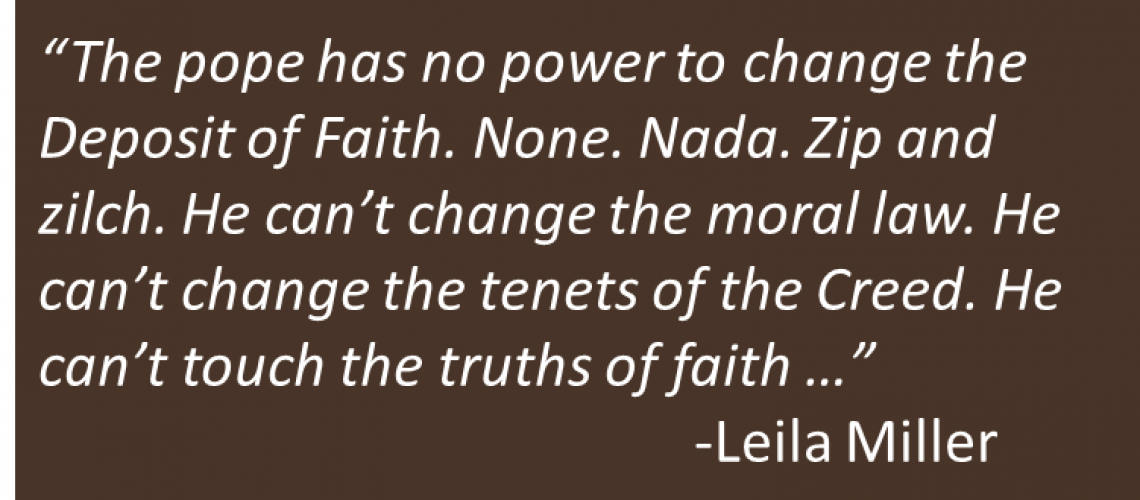
The pope has no power to change the Deposit of Faith. None. Nada. Zip and zilch. He can\’t change the moral law. He can\’t change the tenets of the Creed. He can\’t touch the truths of faith and morals because he has no authority to do so. If any pope were to get the inclination to change Church teaching, the Holy Spirit Himself would stay his hand, ensuring that he never got that far.
As my friend Kim relates in her conversion story (a must read!), infallibility doesn\’t give a pope carte blanche to invent any doctrine he wants to make up; instead, infallibility is actually a highly limiting doctrine. Jesus\’ teachings are preserved and protected, leaving them intact throughout the centuries.
Thank God that our next dear pope, just like all his predecessors, will be powerless to change a single one of Christ\’s truths.
© 2013. Leila Miller. All Rights Reserved.


Go methodists catholics are annoying
yeah
[…] Miller reasonably asserts The Pope Is Not As Powerful As You Think. On the other hand, perhaps Pope Francis is more powerful than many […]
[…] The Pope is Not as Powerful As You Think by Leila Miller at Catholic Stand […]
[…] The Pope is Not as Powerful as You ThinkEven as the Cardinals meet in the Conclave to elect the next pope, misunderstandings about the nature of the papacy abound. For example, many people believe that the pope wields a strong and potentially tyrannical power over his flock. The concept of an infallible teacher leads them to imagine a dictator (even if benevolent) who can force doctrines upon Catholics at whim, leaving the faithful either anxious and uncertain about what dogmatic changes will come next to disturb their lives, or ready to run like lemmings off whatever cliff the Supreme Pontiff decides to lead them. Sure, maybe one pope is mentally and emotionally stable, but what of the next? And the next? Think of the havoc he could wreak! Who in his right mind would put his life under the pope’s authority?In reality, however, the pope is not quite as powerful as one might think.…more […]
It is just agonizing to hear a “catholic” on somewhere like Foxnews talk about the prospect of female priesthood and marriage issues as if these topics are up for consideration everytime a new Pope is chosen. It so stinkin lazy of them to go on the air and say that without knowing and even lazier for the reporter/host to not challenge or question if that’s correct. You would find 100 times greater factual scutiny from sports casters talking about the infield fly rule in baseball. Disproportionately Amazing compared to other things the media screws up.
I think one of the greatest proofs for Christ founding the Church is that fact that the original deposit of faith is still there after 2k years. That somehow I’m taught the same understanding about the Eucharist or forginess that Justin Martyr believed is really a miracle after all the centuries/wars/politics/corruption/bad men. Most founding charters dont last 10 yrs never mind 20 centuries. All as He promised his followers. Just a miracle
One more note: The pope can unilaterally define doctrine ex cathedra if he feels it is necessary, and of course that is part of his charism of infallibility, by virtue of his office. But that ex cathedra definition or pronouncement would never be in conflict with nor would it ever reverse any teaching of the Deposit of Faith. That is what infallibility means: The Supreme Pontiff is protected by the Holy Spirit from teaching error when he does speak “from the chair”.
He has all the power in the world (and beyond) to speak the revealed Truth, and to govern the Church, and to bind and loose the faithful. But he has no power at all to change the moral law or the tenets of our creedal Faith.
John, I’d be happy to! The pope certainly has many powers and privileges in governing the Church by virtue of his office. He is able do everything mentioned above in the Canons you cite. (Canon Law is part of Church discipline, and he can “bind and loose” disciplines as he sees fit, among other things.)
But what he can never do is change the moral law or the tenets of our Faith. The Deposit of Faith cannot be added to, subtracted from, or reversed. It’s objective Truth, handed down from Jesus to the Apostles for safekeeping throughout all time — so that the faithful may never be led astray.
Surely you can understand that no pope could ever come in to office and declare that the moral law is null? That stealing and lying are now moral? That adultery or fornication are now licit and holy? The same goes for tenets of the Faith. For example, the pope has no power to declare that Mary is Divine, or that baptism is not actually regenerative after all, or that the Eucharist is merely symbol and remains bread and wine in substance.
The Deposit of Faith is irreformable, and the Holy Spirit protects the Holy Father from teaching error on any point of faith or morals.
Praise God.
Would you please comment on how your statements align with the Code of Canon Law found at http://www.vatican.va/archive/ENG1104/__P16.HTM where the following Canons are published, especially Canon 331, which may suggest the Pope is more powerful than you think?
THE ROMAN PONTIFF
Can. 331 The bishop of the Roman Church, in whom continues the office given by the Lord uniquely to Peter, the first of the Apostles, and to be transmitted to his successors, is the head of the college of bishops, the Vicar of Christ, and the pastor of the universal Church on earth. By virtue of his office he possesses supreme, full, immediate, and universal ordinary power in the Church, which he is always able to exercise freely.
Can. 332 §1. The Roman Pontiff obtains full and supreme power in the Church by his acceptance of legitimate election together with episcopal consecration. Therefore, a person elected to the supreme pontificate who is marked with episcopal character obtains this power from the moment of acceptance. If the person elected lacks episcopal character, however, he is to be ordained a bishop immediately.
§2. If it happens that the Roman Pontiff resigns his office, it is required for validity that the resignation is made freely and properly manifested but not that it is accepted by anyone.
Can. 333 §1. By virtue of his office, the Roman Pontiff not only possesses power offer the universal Church but also obtains the primacy of ordinary power offer all particular churches and groups of them. Moreover, this primacy strengthens and protects the proper, ordinary, and immediate power which bishops possess in the particular churches entrusted to their care.
§2. In fulfilling the office of supreme pastor of the Church, the Roman Pontiff is always joined in communion with the other bishops and with the universal Church. He nevertheless has the right, according to the needs of the Church, to determine the manner, whether personal or collegial, of exercising this office.
§3. No appeal or recourse is permitted against a sentence or decree of the Roman Pontiff.
Can. 334 Bishops assist the Roman Pontiff in exercising his office. They are able to render him cooperative assistance in various ways, among which is the synod of bishops. The cardinals also assist him, as do other persons and various institutes according to the needs of the times. In his name and by his authority, all these persons and institutes fulfill the function entrusted to them for the good of all the churches, according to the norms defined by law.
Can. 335 When the Roman See is vacant or entirely impeded, nothing is to be altered in the governance of the universal Church; the special laws issued for these circumstances, however, are to be observed.
[…] tyrannical power over his flock. The concept of an infallible teacher leads them to imagine a …read more Source: Catholic […]