

Trust neither the cognitions of the theologian who holds mysticism in disdain, nor the intuits of the mystic who has no time for theology. The mind, acting without the aid of the heart, is a potential menace equal to that of the heart acting without the aid of the mind. In the search for truth, staying in one’s own lane is an inadequate precaution; recognizing the limitations of one’s own lane, however, is monumental.
Such are my thoughts as I read The Truth About Purgatory: And the Means to Avoid It, by Fr. Martin Jugie (1878-1954). The subject of purgatory, when restricted solely to dogmatic considerations, offers a limited field of discussion. Dogma, however, does not exist to limit discussion, but to be an unfailing guide to both the speculations of the theologian and the vast, beautiful world of the Christian mystic.
Fortuitously, Fr. Jugie’s book was simply the next on my list of serial reads without regard to the pending feast days of All Saints and All Souls. As I write, and those liturgies loom in the immediate future, I was struck by his words:
The liturgy of Purgatory! The expression is a suggestive one, lifting for us, as it were, a corner of the veil. St. Paul in the Letter to the Hebrews and St. John in the Apocalypse give us a glimpse of the splendors of the liturgy of Heaven. Purgatory should have its liturgy too. Is it the same as ours? Certainly these souls benefit in a great measure from our liturgy. Our Masses are their most potent alms, and we may surely suppose that they associate themselves with our Masses in a fervent spirit of grateful love. They are remembered in every Mass, and the Holy Sacrifice is often celebrated for one or some or all of them. At every moment of the day and night, the Holy Sacrifice is offered for their help and their deliverance. Those souls for whom a Mass is specially offered must surely know it and assist thereat in an invisible manner, with tremendous sentiments of adoration, of contrition, of reparation. It is our Masses which at every moment sound the trumpet for the departure of the holy souls to Heaven. From the sorrow-draped exile of expiation, the newly elect rise like brilliant stars to the splendor of the heavenly Jerusalem, where the welcoming applause of Heaven awaits them. These continual departures cast a ray of joy on those who remain, for Purgatory is the realm of the most delicate fraternal charity, where the ecstasy of one is the joy of all.
In an earlier article, I explored Padre Pio’s devotion to the poor souls in purgatory; how, as depicted in a recent movie about him, his priestly vocation became an apostolate to the poor souls. It was, in fact, in my research for that article that I took interest in my current read. It seems to me that the contemplation of purgation is the missing link in post-Conciliar spirituality.
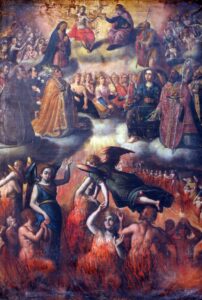 I have written about the post-Conciliar tendency to downplay the so-called “passive” virtues in favor of the “active” virtues; that is, in placing corporal works of mercy (especially, it would seem, those social programs that we can vote for) above prayer, fasting, contemplation, mortification, and intersession. That paradigm falls flat when we consider the souls of our brothers and sisters suffering purgation, because those supposedly-passive spiritual practices are the only form of works available for ending their suffering—a suffering that, while not corporeal, is nonetheless temporal, and if the mystics are correct, far more intense than any bodily torture.
Concerning the poor souls’ interaction with their brothers and sisters in the Mystical Body, Jugie references Aquinas:
St. Thomas does not deny…that the souls in Purgatory pray for us; but he declares that, “from a certain viewpoint, namely inasmuch as they suffer the chastisement of divine justice,” they are our inferiors; and therefore — always from that viewpoint — they are constituted in a state where they plead for prayer rather than intercede by prayer. And, from this viewpoint, all that is very accurate. A poor person, in as much as he is poor, is not in a position to help others, nor is a sick person, in as much as he is sick, in a position to heal others…If therefore we consider the souls in Purgatory as suffering and given over to divine justice, it is evident that they are not in the position of the blessed in Heaven, who, having abundance of all good things and no need to ask anything for themselves, think only of the good of those they love. These latter are truly in a position to intercede for others, for they possess an assured and perfect happiness which asks only to communicate itself.
St. Thomas would be the first to recognize the limitations of speculative theology, and the last to ignore the lessons of mysticism. Fr. Jugie goes on to say that the theology of St. Thomas does not impose any sort of exclusivity of action upon souls in purgation, rather it opens “new fields of vision,” urging us to contemplate those holy souls not solely as “prisoners of Purgatory” wearing “the mourning of penitents,” but as hopeful souls wearing the “nuptial garment of charity.”
Their temporary position in the anteroom of Heaven is unique within the Mystical Body. They are powerless to improve their own lot. However, theirs is a powerful position of absolute humility.
Among the reason for which a soul may go to Purgatory, Jugie lists three: Venial sins not remitted here on earth; habits/inclinations to sin; and incomplete atonement for sins already remitted. He explains that, according to St. Thomas, the inclination to sin does not survive the separation of body and soul that takes place at death, “for the soul in a state of grace, once it finds itself in the presence of God, strains toward Him with ardor and hates intensely all that displeases Him. This violent turning away from sin suffices to detach the soul from every inclination to commit sin and gives to it a perfect moral rectitude.” (Of course, “find[ing] itself in the presence of God” is not the same as beholding the beatific vision).
At this point of the soul’s journey, hope and faith are certain and, therefore, given that certainty, can hardly be called hope and faith. What remains is an all-encompassing charity, a charity so intense that it is, simultaneously, the souls ultimate end and its ultimate torment, amplifying its remorse for having offended infinite charity—charity personified.
“Our God is a God of drama!” declares a dear friend of mine. Wrongfully imprisoned in Mexico for a crime he could not have committed (no one can be in two places at once) he remains upbeat, convinced that God has him there for a reason. For nearly two years he has been there leading a bible study group and teaching his fellow inmates the fine art of oil on canvas. Through tears over the loss of time with his children, he continues to see his situation as a beneficial purgation, a gift of sorts.
I am reminded of his situation in my contemplation of Purgatory, for I cannot imagine a more intense drama than that which plays out within the soul of the self-expurgating.
Fr. Jugie explores the writings of Protestant theologians, particularly those who found reason to disagree with the anti-Purgatory stances of their founders. He quotes, for example, German Lutheran theologian K. Hase:
The greater part of those who die are, it must be admitted, too good for Hell: but it is nonetheless sure that they are too bad for Heaven. It must be frankly admitted that there existed at this point, a certain obscurity in the doctrine of Protestants. The new science has, for a long time now, testified to this.
Jugie goes on to quote philosopher, Joseph de Maistre:
One of the grand motifs in the 16th century confusion was the doctrine of Purgatory. The insurgents held doggedly to a single and a pure Hell. However, when they developed the implications of their thought, they were driven to deny an eternity of pain. They invented a Hell of time, solely for good policy…But a temporary Hell is nothing else but Purgatory. After having embroiled themselves with us in their denial of Purgatory, the Protestants have embroiled themselves with us anew because they will now admit Purgatory only. What an extravagance!
Can it be denied that post-Conciliar Catholic practice places less emphasis on purgation? —An effect of misplaced ecumenism? And what a great sadness, when one considers the position of both the mystics and the theologians; that is, that the majority of souls will pass by this way, and that some, perhaps many, will spend more than a little time in this state. Will not a decrease of interest in, and promotion of, intersession ensure the extension of that stay?
I am encouraged by what I see happening in some parishes. Children are being spared the spiritually empty experience of a secular Halloween by partaking in an All Saints/All Souls parish party in saintly or angelic costume, learning, in the process, about the sacrificial works of their chosen saint.
These feasts have clearly not gotten their due as everyone’s feast—the party of parties—wherein everyone is a winner. And yet, these feasts are but iconic celebrations of the everyday—that is to say, that the celebration of every Mass is the party of parties, the feast of all feasts.
The mystics among us have many stories to tell in this regard. They have witnessed the extravaganza that every Mass becomes: Guardian angels coming to escort their fully expurgated spiritual charges to the bosom of their Savior; great saints coming to escort those for whom they courted favor before God; and, yes, even the Blessed Mother and Our Lord Himself.
Fr. Jugie opines that, with Purgatory “being the antechamber of Heaven, it would be inconceivable that there should be no communication between the two regions.” Purgatory may well be, for many of us, the place of our first extraterrestrial unification with deceased family and friends. What a drama! To be reunited in such of fusion of unspeakable joy and unspeakable sorrow! Jugie defines joy as “pleasure in a good possessed.” Yes, there is joy in Purgatory, for the soul possesses God, but not yet fully, wherein lies the unspeakable torment.
And what if our relatives and friends have already ascended to Heaven before us?
By God’s permission, Purgatory must surely speak to Heaven, that the souls in exile may speak, may plead for powerful intercession. What is the nature of this intercession of the saints for the souls in Purgatory? What is its efficacy? The existence of such intercession cannot be doubted, for why allow it in favor of earth, and deny it to Purgatory? Private revelations lead us to believe that the elect can pay visits of consolation to the suffering souls, can sweeten their pains, just as the sight of a friend can sweeten a hospital hour. The most frequent visitor must surely be Our Lady, Queen of Purgatory no less than Queen of Heaven and earth: and after her, the Guardian Angels, patron saints, relations, friends. Many private revelations attest the visits of the Guardian Angels to Purgatory…What is here revealed of the Guardian Angels can be piously conjectured of the other inhabitants of Heaven, even of those placed highest, and even of their King and their Queen, Jesus and Mary. Does not St. Thérèse tell us that Our Savior visited Purgatory that He might bring a certain Jesuit lay brother to Heaven?
Every Holy Mass is a vast, multigenerational, extra-temporal, intra/extraterrestrial family reunion, and the feast day Masses of All Saints and All Souls Days are spiritual extravaganzas beyond our meager powers of imagination or appreciation.


[…] at 1 Peter 5The Vigil of All Saints 2024 – Gregory DiPippo at New Liturgical MovementThe Masses of All Saints and All Souls Days: Extravaganzas – Jerome German at Catholic StandWhere is All Saints Day in the Bible? – Philip […]