
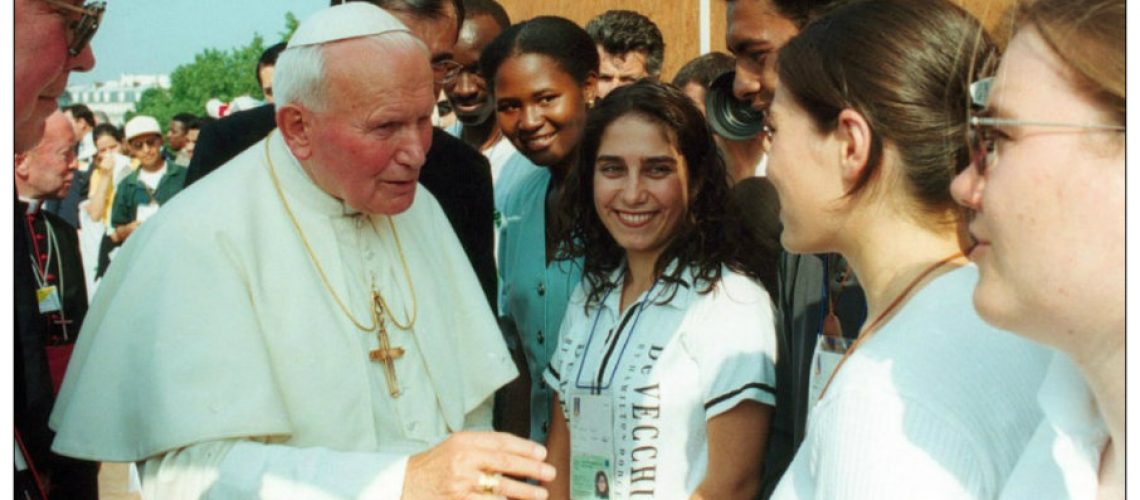
We know that the Church honors saints because they give us an example of how to follow the will of God and seek perfection, even in the midst of challenges and difficulties. On October 22nd, we celebrated the feast of a great saint who was and is an example to many: Pope Saint John Paul II.
Although most saints are celebrated on the day of their death (or birth into heaven, as it were) October 22nd is the day in 1978 when John Paul II began his Petrine ministry. Interestingly, however, he had actually been elected the week before, on the evening of October 16th. The question arises, then: what did John Paul II do for that week between being elected and officially starting his work as Pope?
On one hand, we know certain of his activities: he went to visit his friend, the Polish Cardinal Andrzej Deskur, who had suffered a stroke before the conclave. In fact, then-Cardinal Wojtyla had to be pulled away from Deskur’s bedside in order to enter the conclave. Also, the Pope had an informal dinner with several of his Polish friends. As was tradition, he probably celebrated Mass in the crypt of Saint Peter’s three days after his election. Certainly, too, he spent a great deal of time in prayer.
Time of Preparation
In short, we could say it was a time of preparation before that glorious moment on October 22nd when the first Slavic pope would famously proclaim to the Church and to the world:
“Brothers and sisters, do not be afraid to welcome Christ and accept his power. Help the Pope and all those who wish to serve Christ and with Christ’s power to serve the human person and the whole of mankind. Do not be afraid. Open wide the doors for Christ.”
However, we would be wrong to think that preparation for becoming Pope was the work of one week. It’s true that God gives us the grace for our challenges when we have need of it, but John Paul II prepared himself for becoming Pope throughout his entire life, by living at every moment in obedience to God and to His will and providence.
John Paul’s preparation for becoming pope was a constant attitude of seeking to find and do God’s will. In fact, the same Cardinal Deskur recalls that in the diocesan seminary, when he and the future Pontiff were studying, someone wrote on John Paul’s door, “Karol Wojtyla: future saint.” It wasn’t meant as a joke, but rather in all seriousness: Karol Wojtyla was a man seeking and striving after holiness, and he did so day in and day out.
Desire for Holiness
This overwhelming, all-encompassing desire for holiness is the defining mark of all the saints, and it is this desire for supernatural life that provides a basis for true fraternity. Even people from the most diverse backgrounds can become close friends on the basis of the desire to become a saint.
For instance, there’s a lot that can be said about Saint Peter Claver, the Jesuit who for forty years ministered to the slaves who were transported into the Colombian city of Cartagena. It’s estimated that he personally baptized some 300,000 slaves who passed through what was then Spain’s most important slave port.
However, one part of his fascinating life is his friendship with Saint Alphonsus Rodriguez, a Jesuit lay brother who worked as a porter at the College of Majorca, where Claver would study. When Claver first arrived at the College, he greeted his superiors, and then headed off to find Rodriguez, whose reputation for holiness has already spread far and wide. Although Rodriguez was in his seventies, the two became fast friends, and, with the permission of their superiors, they would spend time each day talking about the things of God.
The two of them grew in holiness together to such an extent that, despite the difference in their ages, their life histories (Rodriguez was a widower), and offices (one was to be a priest, the other a lay brother), the two were canonized together in 1888 by Pope Leo XIII.
Company of Saints
If we look further, we find that saints are seldom alone: usually we find them in pairs or groups, like Saint Joseph Cafasso, who was Saint John Bosco’s spiritual director, who in turn worked with Saint Maria Mazzarello and Blessed Michael Rua, among others. Or, Saint Philip Neri, who was the spiritual director for Saint Camillus de Lellis, worked with Servant of God Caesar Baronius, and many others.
This company of saints can be found in the life of John Paul II: there are many well-known images of his visits with Saint Mother Teresa and Blessed Stefan Wyszyński, but the causes of canonization have also been opened for his parents, Karol and Emilia Wojtyla. Jan Leopold Tyranowski, who introduced the future pope to Carmelite spirituality, was declared Venerable, and the founder of the Discalced Carmelite monastery in Wadowice, Fr. Rafał Kalinowski, was canonized by John Paul II.
The Beauty of Catholicism
This is part of the beauty of being Catholic and being part of a community: people from very different backgrounds come together and work to become saints. Each offers the other what they need. This sometimes takes the form of a word of encouragement, sometimes real help or consolation, but sometimes – probably most of the time – it’s just the daily living together and the opportunity to practice virtues. It’s the opportunity to grow in humility and in charity with people who we might not have chosen to live with otherwise. Yet, God in His mercy calls us all to work together for that purpose: to become saints, here, in this time, with these people.
In a particular way, this growing together in holiness is true for married couples, and this, too, is a reality of which the late pontiff was aware. Before he was elected Pope, Saint John Paul II wrote a great number of poems and plays. One of those plays, which even today is fairly unknown, is entitled The Jeweler’s Shop. In this particular play, the jeweler sells wedding rings, and the play follows the lives of three couples who purchase their rings from him.
At the play’s peak, one of the couples goes through a difficult period, and the wife decides she’s had enough; she wants to sell her ring. She heads to the shop, presents her ring, and the jeweler weighs it. Much to the woman’s surprise, he promptly hands it back and replies, “This ring does not weigh anything, the needle does not move from zero, and I cannot make it show even a milligram. Your husband must be alive – in which case neither of your rings, taken separately, will weigh anything – only both together will register. My jeweler’s scales have this peculiarity that they weigh not the metal but man’s entire being and fate.”
The Value of Faith
Taken separately, wedding rings weigh nothing; they have no value. Yes, certainly the store and the jeweler were paid something for them, but their real worth, their value, isn’t determined by their price in dollars, but rather by what it costs, and the cost of those rings is really the life of the married couple.
There are certain things in life that only come in pairs: a pair of pants, for instance, or a pair of scissors. One pant leg or one blade of a scissors isn’t worth anything because it doesn’t fulfill its purpose. Wedding rings are like that too; alone, they aren’t worth it because they don’t achieve their purpose, which is to get both husband and wife to heaven.
In a broader sense, “it is not good for man [or woman] to be alone”: we all need that community to help us reach perfection. For us as Catholics, that includes the Church on earth, those in purgatory, and those in heaven. As we think of the legacy of John Paul II, we can thank God for his example, and seek to form part of the communion of saints along with him.


[…] of the Devil: Spiritual Warfare Highlights Ancient Fight in New Way – P. Armstrong/Register The Feast of Saint John Paul II – Fr. Nathaniel Dreyer at Catholic Stand 8 Powerful Ways to Combat the Grave Evil of Abortion […]