
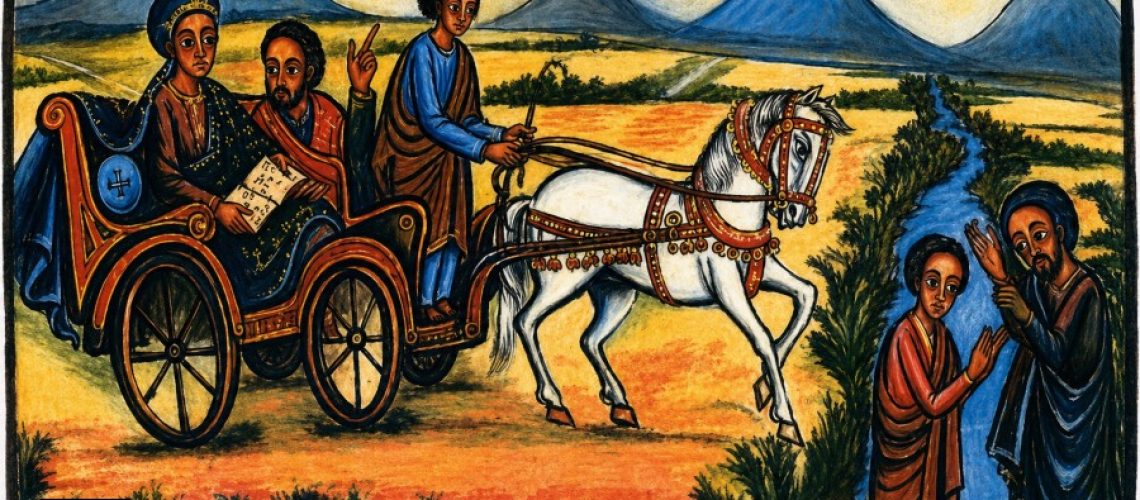
I had a dream one night. It was weird and out of place. At least for me as a Swedish guy, with deep Nordic and European roots. I dreamt about a bunch of Ethiopian women. I recognized them because I had previously seen East African women dressed like that: in all-white garments, with head cloths and hair braided partly in front. They were all singing in a language I don’t speak, and yet I understood every word that they sang. In a language foreign to me, they sang “happy birthday”. I woke up to the immediacy and realness of the dream. After a while, I fell asleep. Once I did, I had the exact same dream again.
The day after, the dream lingered with me. I did some research, and I checked the date. Timely enough, it was the night of the 6th of January, just when the Ethiopian tradition celebrates the birth of Christ. Why had God put me there, in that context? I started to reflect on my life and go through old memories with this Ethiopian clue in mind. Baffled, I realized I had recurringly at some point in my life, all the way from childhood to adulthood, found myself in what seemed like a random company with Ethiopians and Eritreans. It hit me like lightning that God had, unbeknownst to me, pushed us together.
The occurrences are too many to mention here, but they were too many to be counted as coincidence. Then I started to look at my own family, my parents, their physical appearance, our ancestral names, and so on. To get a definite answer – as a white Nordic man with Swedish roots – on what this meant, I even went to an Orthodox Ethiopian church and showed them a picture of my mom. The women all looked astonished, somewhat stunned by the anomaly of this story just as much as me, until a small girl, out of curiosity, came up, looked at the picture and yelled: “She is Habesha!” “Habesha” is a cultural and historical identity used to describe people of Ethiopian and Eritrean descent. It bridges ethnic groups rather than naming just one.
This took me down a biblical rabbit hole. On the way, I came across old themes and claims, such as French Israelism and Merovingian mythologies, to Mary Magdalene and Africa, and eventually to my own Vikings, their heritage and intermarriages, and subsequently to Ethiopia. So, how do we begin?
Well, first we must address the method used here because I simply cannot fit footnotes and references into a mere three-thousand-word article. The more academically rigid will simply have to excuse me. We must also – since we will end up at the Ethiopia in question – address some of these concepts in the earlier forms. To be an “Ethiopian”, for instance, meant something before the nation state of Ethiopia today. Before the nation Ethiopia, to be an “Ethiopian” was not only an ethnic designation but also a part ethnic, part ontological-structuralist one, as supposed to a nationality. That doesn’t mean that the Ethiopians of today aren’t Ethiopian; no, we are not taking away anything with this article – we are rather adding to the concept of Ethiopians. So, if any Ethiopians are reading this, we are not questioning their authenticity or authority on the subject of Ethiopians; we are simply showing that the Ethiopian family might be larger than what we once thought.
Let’s start at home, with the Vikings. It is no secret that the later Messianic Jews of ancient Europe married into Nordic royal houses after the death of Christ. Even before that, there are Hebrew and Israelite references among the Vikings. On the famous runestone Rökstenen, in the south of Sweden, we, for instance, see a depiction of a tent with a sun in it. Not only, at a glance, a reference to the tent of the meeting but also to the actual first word of the Bible itself: beresheet. If we deconstruct the word beresheet, we see that it starts with beyt – tent, and then follows with alef – light. A clear Biblical reference in the context of an otherwise idiosyncratic depiction (Vikings didn’t live in tents).
We also find a bunch of etymological correlations within the scope of the Viking identity. For instance, the Hebrides, outside of Scotland, famous for being Viking settlements, literally share etymological roots with the word Hebrew. Not to mention the word Scot itself, found not only in ancient Irish Scotia and of course Scotland, but in the early Viking kings of Sweden (Olof, the second king of Sweden, was a “Scotking”, for instance [keep this in mind, it is extremely relevant]). So to trace Viking heritage to Hebrews and Israelites and royal Jewish bloodlines, before the Babylonian and Talmudic claim to that identity, is not particularly hard.
So, what about the Israelites? The Israelites are, as we all know, the tribes named after Jacob, subsequently Israel. They all had sort of different characteristics, different insignias, emblems and symbols, and eventually also different destinies. As told by Jacob/Israel before his death. In the mythology of early French kings and the so-called Merovingians, the tribe Benjamin is often mentioned. Perhaps the most peculiar and strange of the tribes. Because not only was the tribe of Benjamin known for its left-handed people, it also had the Wolf as a symbol, prophesied by Jacob to be ravenous, and later had the first king of Israel come from their tribe, namely Saul. With the second king of Benjamin is where the plot thickens because his name was Kush, and Kush is in Africa. More precisely, next to Ethiopia of today but the wolf has its home in the North… Let’s continue.
Another epithet of the Merovingians is either “fisher-“ or “rowing kings”. When we combine these elements, like the act of rowing, the wolf, the reference to taking loot, and the area around France, things seem to look awfully Viking-ish. Not only that, but the reference to rowing seems to bear onomastic traces. We have, for instance, famous people like Lisa Kudrow, the actress, J.K. Rowlings, the author of Harry Potter, and Kelly Rowland, the singer, who all have a reference to rowing in their last name. All left-handed… S0, what about the African reference? Besides Kelly Rowland, J.K. Rowlings and Lisa Kudrow don’t really seem to play the part of looking particularly African. Here is where the Ethiopians come into play.
“The Ethiopians”? In a biblical context, sort of mythological and elusive, with the oldest version of the Gospel, the Ark of the Covenant, and churches in clifftops. When scholars mention Ethiopia, there’s almost this implied whisper embracing the conversation. Surely something is there. The Ethiopia of today – if we trace it back to Biblical times – what is missing from public canonical and historical discourse? We clearly have historical testimonies that contradict the current view of Ethiopians. Pomponius Mela, for instance, in his work De situ orbis, ca 43 AD, writes about a people he calls “White Ethiopians”.
Then in North Africa. Pliny the Elder (23-79 AD) writes, in his Natural History, in his turn references a people called Leucæthiopians, in other words a reference to white or shining Ethiopians but also suspiciously close to the Greek Lekythos (λήκυθος), a reference to oil and anointment of the dead. Furthermore, in Apuleius’s The Golden Ass, written somewhere close to 100 AD, the goddess Isis, the Egyptian conceptualization of Mary, mentions two races of Ethiopians. This leads us to the last point: Heliodorus’s Aethiopica, written sometime between 200 and 300 AD, in which the princess, Charicleia, is presented as a white-skinned Ethiopian. With these references in mind, we can seal this implicit proposition in place with the Bible itself:
Can the Ethiopian change his skin, or the leopard his spots? then may ye also do good, that are accustomed to do evil (Jeremiah 13:23).
As supposed to popular belief, Jeremiah here isn’t exemplifying the impossible by saying that brown-skinned people cannot change their skin; on the contrary, he is referencing something that used to be common sense: Ethiopians can change skin, because their people are two. Related, yes? A part of the same family and bloodline, yes? Except now one half seems to be missing.
Why is this relevant for the Catholic, besides coming closer to a general historical truth, for what it’s worth? I would like to propose that it has huge implications. Not only, as mentioned, did the Ark of the Covenant go to Ethiopia- not only an Israelite artifact but also a metaphor of an intimate and genetic relationship with God. However, here is a fundamental point to be made about the origins of the Hebrews in general. If we go back to the days of Moses and the Exodus, which the historians place around the 18th dynasty Egypt, we come to find that some of the female pharaohs have a very peculiar title. Namely that of “Tiye”, and Tiye in its turn comes from the Amharic or Ethiopian language. The word is Eteye, and it means Queen.
Yet, the Egyptians weren’t in the habit of having Kings and Queens; this was a Hebrew tradition. A tradition that we now can tie together with Ethiopia. And if we look around among the statues and paintings of 18th dynasty Egypt, we come to see that there are at least two appearances of women inhabiting this title. One traditionally Ethiopian-looking, with deep brown skin, brown eyes, and obvious features; one that looks more to the white. Here is where it gets interesting; there is another Tiye as well, a Tiye Tephi, an Egyptian-Ethiopian princess who colonized Ireland once upon a time, then under the name of Scota, and subsequently gave name to Irish Scotia and Scotland. In the depictions of her, she has huge, voluminous curly hair and pale skin.
Scota shares etymology with Skott, in Swedish. This means sprout or branch. Not strange, since she seems to have “branched off” from Egypt. In Hebrew, sprout is nasar. Now we have a foundation for the word Nazarene and the epithet “the sprout” or “the branch”, famously applied to Jesus. Hardly insignificant coincidences. We also have a bunch of people, both mummies and depictions, statues and murals, from 18th-dynasty Hebrew Egypt, via Greece – the roots of Orthodoxy and Catholicism, with people that look distinctly so-called black, so-called white and so-called Asian. In other words, the “goy” of today.
My Nordic Ethiopian-looking mother, for instance, originally has a Jewish last name that is both a reference to the Aaron, the covenant, and has a diminutive that is only found in Finland and Ethiopia but she is not considered a Jew, nor an Ethiopian. Why is this important? Well, first and foremost, the so-called “goyim”, found among the Christians and non-jews, might actually be the real Israelites and Hebrews.
This is not a wild speculation; no, it’s rather informed. In the Kebra Negast, the early 14th-century Ethiopian record of ancient kings and how God favored the Ethiopians over Israel, since they are supposedly better people, we literally read how Solomon has a child with an Ethiopian Queen and that the Ark of the Covenant went to Ethiopia instead. Meaning that the bloodline of the covenant with God is redirected to Ethiopia, here unraveled as not only present in Africa but also in Europe. In the Kebra Negast, we also learn how “Ethiopia” is a place that is snowy, cloudy, and has water so abundant that you never have to drill for wells. Which, for obvious reasons, does not sound like Africa. We also find out that the Ethiopians in the Kebra Negast go from worshipping the sun to worshipping the Creator of the sun. Implied in the name itself: athein + ops, to have Aten, the Egyptian name of their object of sun worship, in your face – ops. Which also broadens this ancestral epithet to be applied in general to sun-worshipping tribes. Which of course, if we tie this together with Christ, is the ontological structure of a Nasir or a Nazarene: someone that stands precisely in light, under the sun, like a receptacle or a moon of sorts, casting no shadows.
So, Ethiopia could as well be Europe, the bloodline of the Covenant be in both Europe and Africa, among the non-jews, and the Vikings might have been Israelites. Not too far-fetched, the latter, since both a DNA relation between Tutankhamun and about half of European men exists, as well as commonalities and genetic traces between the Vikings and Hamites.
Viking ships, for instance, are only really present in the Nordics and as a variation with the ancient Egyptian state. Furthermore, we see from the example with the so-called white Ethiopian that a Benjaminite king from Kush, with its corresponding people, might actually have been quite diverse, as opposed to those parts of Africa today, and at the same time traveled to the North to become ravenous wolves. Because this is the common problem: if we mention Europe and Africa, in ancient Biblical times, we tend to look for certain phenotypes. But this observation, that of trying to picture solely brown people as African and pale people as European, becomes an anachronistic retrojection the moment we scratch the surface a bit. It becomes even more complicated when throwing the Falasha into the mix. Because the Ethiopians of today also have their own Jews, called just that. A tribe of unclear origin: sometimes said to come from the aforementioned marriage with Solomon; possibly descendants of the Alanic tribe from China, via Persia, that migrated into Africa and flew the banner of a serpent (Dan). But to not complicate things too much, let’s leave the Falasha out of it for now.
To wrap it up, we can conclude that the Ethiopian identity is more dynamic and sophisticated than what meets the eye. We both have an ethnic and national identity, that of the Ethiopians of today, and also a more obscure pre-national proto-form of Ethiopians. And the latter seems to be more akin to an ontological or religious-structural identity, also containing a vast diaspora outside of the Ethiopian identity of today.
What are Ethiopian descendants of Moses and Aaron doing being Nordic, for thousands of years in a Christian and European context? This hints not only to past migrations but also opens up wider questions: are the native Europeans and subsequently the seat of Orthodox Catholicism counted in the context of the epithet Ethiopian? As it applies to ancient texts. Are the people of Europe, of the Nordic, Britain, France, etc., all a part of the old form of the Ethiopian and/or Egyptian identity and really Hamitic-Semitic peoples, Israelites? Furthermore, and here is where we really go off the edge with speculation, are the so-called white Ethiopians truly the origins of a people referenced as “the dead”?
Remember, the epithet given to these Ethiopians both corresponds to death and white, and remember Christ is the Lord of the dead (and living), a firstborn of the dead and risen from the dead. We also have books made by the “dead” in various places, like the Egyptian book of the dead and the Tibetan book of the dead. Both include pre-formations of what later came to be the Christian fate.
We also remember that God brings his Son out of Egypt, drawing genetic heritage from there, and that it is the Egyptians that are “God’s people”; Israel is but the inheritance. Could Christ have come from the so-called white Ethiopian Jews? The ones who settled in Europe, together with brown-skinned people, Cushites, pre-Arabic Moors, basically whoever was in Northern Africa before Muslim colonization? Furthermore, are the so-called “goy” truly the real Israelites, the dead risen by Christ and His resurrection? In times like these, questions worth asking.
So, what does this have to do with Catholicism? Well, the collective form of Catholicism and its practice, liturgy and structure, is directly Ethiopian in the proto-, pre-national form of that concept. Remember, Christ was lifted up as a serpent in the wilderness, as a sun in times of darkness and confusion, and when we go into the church we always face him, the image of Him. We, in other words, partake in the exact dynamic structure upon which the Ethiopian epithet was once constructed. Just like an Ethiopian faces the sun, we face Christ in all his glory, light, and suffering. And just as the sun can, He might burn our face and facing side a bit when standing in His direct presence. Both his light that contrasts our sin but also in his past suffering, burning away whatever is not suitable for heaven. But it gets deeper than that. Because if we deconstruct our immediate presence with the image of Christ, as a soteriological function of reflection and negative theology, we find ourselves in an epistemic dynamic with that object. We observe the image of Christ in church and draw knowledge from it – we “eat” from his flesh with our minds – which in its turn is the exact method of a scientific endeavor.
In order to measure something, like the sun or the character of Christ, to extract meaning and form ourselves, elevate in understanding and spirit, we have to distance ourselves from it and face it. Meaning that, outside of a religious context, the secular scientific endeavor could be conceptualized as Ethiopian too. With that said, what is extremely important to note is that when ancient texts talk about how a Covenant is lost for Israel and by God handed over to Ethiopia, it is talking about how the Covenant went away from the Jews and ended up in the hands of the Christians. A motion congenial with the early AD intermarriages into royal Nordic and European houses.
We can also draw a parallel to the structure of Christian aesthetic-dynamic liturgy to that of a Nazarene. Since the Nazarene, just as the Ethiopian and the scientist, stands in the light of something, facing light, just as the Catholic does in a provincial, liturgical, and phenomenal topology when entering a church. As opposed to Israel, in this dichotomy of different approaches and identities, the concept of an Ethiopian is congenial to that of a Nazarene. And both are, in their metaphysical form prior to tribal or national identity, congenial to that of a Christian practice. To say that Christ would have been an Ethiopian, Catholic or Christian, or to say that Vikings were Israelites, are of course anachronisms since they didn’t historically exist at the same time. Saul, the first king of Israel, was probably not a Viking just because Benjamin ventured to the north, forming a description best fitted for Vikings. Nor was Christ or the Nazarenes Catholic or Christian. But they had to start somewhere.


[…] Catholic UnscriptedThe ‘Where Would You Live?’ Map – Rod Dreher at Rod Dreher’s DiaryThe Ethiopian Key to Jesus & Israelite Vikings – Kristoffer Ehrnstrom at Catholic Stand […]
[…] UnscriptedThe ‘Where Would You Live?’ Map – Rod Dreher at Rod Dreher’s DiaryThe Ethiopian Key to Jesus & Israelite Vikings – Kristoffer Ehrnstrom at Catholic Stand […]