

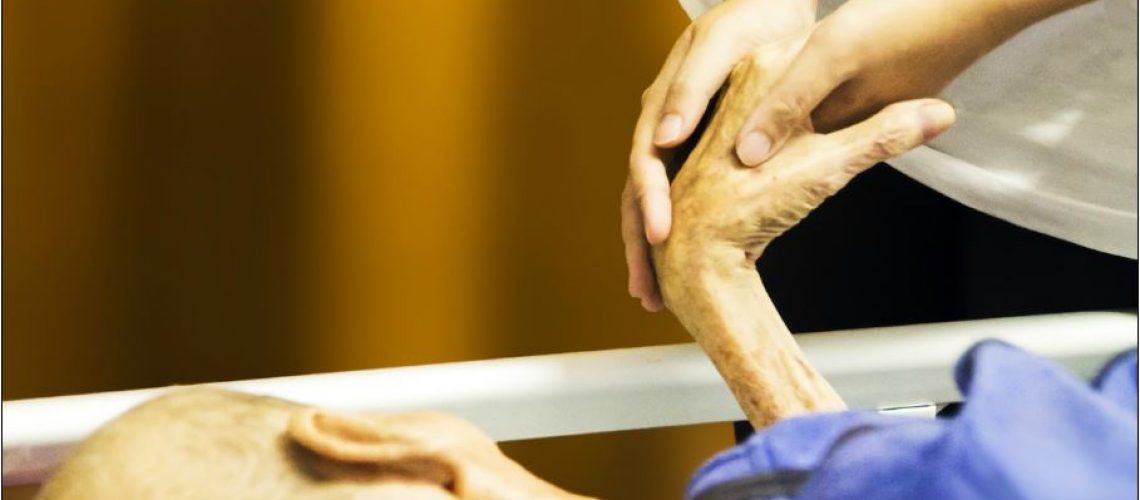
The pretty brunette nurse perched on her stool, carefully reading her computer screen. Then she glided over to the incomprehensible apparatus at the head of the bed and quietly disconnected it. I regarded her gravely, and she gazed back, her exquisite composure mottled by a stung look in her eyes.
“Do you want any more chairs?” she asked.
“Chairs?” I echoed stupidly.
“Is anyone else coming?”
“Do you think they should—I mean—”
“They don’t usually last the night after the blood pressure medicine is turned off,” she explained gently.
I babbled something about chair numbers, and she turned away, leaving me with the dozing old man in the bed. It had been less than thirty minutes since I had been sitting with two doctors, the head nurse, the palliative care specialist, my mother, and a kind friend from the old neighborhood, hearing the decision that our family friend of decades would no longer receive the dialysis that could prop him up for a few more years. At 90, Carl had decided that he had had enough.
Usually, these meetings involve family members, those who have been specially designated to sign off on end-of-life decisions. But though the hospital staff were depending on my mother to say the final word, it was especially difficult for her to do this. Carl was not related by blood to our family. He and my father had met many years ago at a Catholic college on the East Coast.
After my parents’ marriage, he showed up in our tiny town just in time to be named godfather to my oldest brother. As I was growing up, Carl was a regular presence in our house, sometimes walking over from his apartment to wash dishes or sit in the kitchen, drinking coffee with my dad and driving my busy mother crazy. My mom occasionally characterized Carl as an insufferable snob—and I’m not sure she was wrong–but he always accorded her a willing respect for her ability to make a proper cup of coffee.
Once, my rambunctious younger sister attempted to pull off Carl’s fingernail with a pair of pliers. He had let her do it, he later said, because he wanted her to learn about consequences. He bore the scar to the end of his days. I was not given to such violent experiments, but I did like to snatch his handkerchief out of his suit pocket to see if his reflexes were faster than mine. More than anything, I liked to put on impromptu plays with my friend Jenny, and once we drafted Carl to play the “Mean Old Rooster” in our epic production of A Roomful of Chickens. He gamely tied a kids’ winter hat under his chin and gabbled in a senile fashion, as all villainous poultry are expected to do.
When my father died during my college years, it was Carl who made the three-hour trip to give me the sad news and take me back home for the funeral. I filled my arms with spring blossoms from campus (my father had been an avid perennial gardener) and climbed into the car. I don’t remember that Carl had much to say on the return journey. He couldn’t fix anything, but he was there.
As Carl grew older, our family tried to be there for him as well. When he developed digestive troubles, I found recipes for gluten-free cookies so that he could still enjoy the sweet treats he craved. During the pandemic, we moved him into our house, and I scalded the skin off my fingers with hydrogen peroxide, trying to make sure that he didn’t pick up a stray germ from the Fed Ex guy. He’d made it through the quarantine-time unscathed, just to go down now with a virulent C. diff infection.
Since the ambulance trip to the ER a week ago, various members of our family had been in and out of the hospital to see him. To distract him from the discomfort of the near-constant blood draws and the indignity of the external urinary catheter, I had fired up “The Blue of the Night” on an album of Bing Crosby classics. My oldest brother, Carl’s godson, had tempted him with pints of strawberry Häagen-Dazs. Occasionally Carl nibbled a Pringle from the can my mom had brought him. She had also donated a foil-wrapped Christmas tree which toppled over on the bedside table. The wall clock had permanently stopped at 12:15, which rankled our patient, but the problem could be mended with a small portable alarm clock. The situation was miserable, yes, but it had not been dire.
Until now.
When the young nurse told me that our friend was actively dying, I knew that I must somehow swallow the panic that was welling up inside me. I could not imbue his last hours with the fierceness of my grief. I sent a quick text message to one sister, giving the gist of what had just happened. It was not long before the unreality of it all clenched me by the throat. This is not real, a voice said to me, You are merely the ingenue in some old-fashioned play, sitting a death watch. I waited in dread for our friend’s last breath like an anxious mother who lies awake, ears anxiously attuned to a sick child’s anticipated cough.
I did not realize that the watch was only beginning. Over the next week, Carl visibly deteriorated and rallied many times. He attempted to crunch a Pringle here and there, but before long, the cardboard tube stood neglected on the table. I offered him sips of water, but he was too weak to disengage his lips from the straw in time, and I nearly choked him.
For several days he suffered from debilitating insomnia. “I need to be repositioned,” he would murmur plaintively, and I would push the call button for the nurse, hoping that this time the adjustment would work, and that we could both get a little sleep. It rarely did. One evening the nurse told me that there was nothing they could do with pillows to ease the discomfort. If he wanted to feel better, Carl would have to have stronger painkillers. Nine times out of ten he refused hydrocodone, preferring to make do with Tylenol. Even in his extreme weakness (he was slowly starving), he had enough fight in him to want to show up for his own death.
But I was not so brave. In the thick of it, I could not stand to see him suffer. Once, with dazzling clarity, the thought popped into my mind, “If only someone would just give him a shot of something and let him die!” I recoiled from this desire, knowing the wrongness of it. Nevertheless, the thought was there. And if it was there in me, steeped in the ethic of life’s sacredness from cradle to grave, how could I trust that some doctor or nurse might not secretly help our friend to this “merciful” way out?
As the week wore on, physical and mental exhaustion took its toll. After my shift at the hospital, I would go home and collapse in bed, dreading the thought of going back the next day. I could not banish from my mind the stench of the hospital room. My sister insisted that it was the smell of death, but I was convinced that it came from the unchanged catheter bag dangling against my ankle as I sat by the bed–mingled with the scent of the vanilla pudding Carl preferred to help his meds go down more easily.
I never wanted to go back there, but when I did go, there were moments of something I can’t call joy. Maybe it’s enough to say that they were moments when the sorrow lightened. I played him some Tony Bennett, and he shook an emaciated arm in time with “The Lady is a Tramp.” We spent half the day on the golf channel, and he told me that 3-5 yards is the hardest distance to putt.
Maybe death is that way too. I struggled, seeking the right way to address his approaching end, that implacable elephant in the room. He had never been a demonstrative man. Should I tell him that I loved him? Should I ask him if he was scared? Should I pray aloud? For Carl, his faith was never something he trumpeted to the skies. Sometimes when I had gone to visit him at home, I could hear him quietly saying his Rosary. But I didn’t know how to approach the subject of prayer there in the hospital. When a deacon friend of my husband’s stopped in and pointed out the Divine Mercy picture leaning on the window, I felt relieved that he had come. And I felt momentarily refreshed. I did not have to have all the conversations. All that needed to be said would be said–in some mysterious way that I didn’t have to fully understand.
On the last afternoon, Carl asked me to scratch the dry skin touching his eyebrows. I attempted to follow his instructions but I must have been going the wrong direction. “Like windshield wipers,” he patiently explained. I told him that I was pretty sure no one had ever said that in the history of the world before. I think he liked that, and I mentioned it to my sister when she came to relieve me.
That night, my brother was due to fly into town from Kansas and take over the night shift for the rest of us, who were thoroughly exhausted. Since I would be home all night, I volunteered for a five-hour stint beginning at 9 the next morning. As I drifted in and out of sleep that night, I saw Carl lying naked in a bathtub, shriveled as a raisin. He was surrounded by doctors. Among them skulked a man whom I knew to be the notorious Jack Kevorkian…and he stood poised over Carl, wielding a syringe. It was like a holy card of Maximilian Kolbe in the starvation bunker, but without any of the victory of martyrdom. I was begging the doctor not to do it, not to inject the drug, but he went on with his infernal work, and no one lifted a finger to stop him.
When my alarm went off, I was lying flat on my back. As I bent my head to pull myself up from the mattress, my neck and shoulders wrenched painfully. I could barely sit up. “I can’t do this!” I wailed. I could barely turn my head. Somehow, I stumbled out of bed and downstairs into my husband’s arms. Despite his sympathy, I knew he wasn’t going to take over for me at the hospital that morning. I picked up my cell phone to get an update from my mom, who had been scheduled for the early morning hours. I noticed immediately that my phone was choked with messages.
Our dear friend had left his earthly shell that morning around the hour of Divine Mercy, while my brother sat praying the Chaplet in the hospital room. I wordlessly handed the phone to my husband.
“When someone we love is hurting,” said the priest at the funeral, “We do what we can to help. We want to fix things. But sometimes, we cannot fix it. We can only be there. That’s what we mean by a ministry of presence.”
Carl must have known that I could not last another day. Always chivalrous, he had given me that last gift, I thought. Deep down, there was something that strangely could only have been gladness. We never left him alone, said my heart. He was never alone.
The coffee at the funeral luncheon was perfectly hot and strong. I watched as the brown radiance of it flowed into my mug, waking up my January-cold fingers…
Some names have been changed in this piece to respect the privacy of those involved.





4 thoughts on “The Cup Filled: A Reflection on Being There”
With all due respect to the previous posters, everyone is different. Some things we may never know until the other side. Being born into this world is delicate-as is leaving this world. No two births or deaths are exactly the same. This article is not an opinion piece; it is a testimony of love. God bless us all; may He keep us humble.
Having dedicated five years as a Hospice volunteer, I read with interest about the vigil you kept until passing. It reminded me of a patient and family I had the time to become quite close to over the month of my service. Part of the training we receive involves how to subtly encourage the patient to let go. It is well known that for many, the timing and will
to pass is more in the hands of the loved one than you think. One case related to me by a member of the team involved a family who hovered over the person to the point where they tried to discourage the intensity of the ‘watch’. Finally, he sent them out for a quick errand and when they returned an hour later, he had passed. Such was the case of my Josi who slipped away before anyone could return
Thank you for your compassion for the dying. Eternal rest to Josi, O Lord.
I do think most people want to be alone at the moment of death. Animals are like that too. We should respect that.