

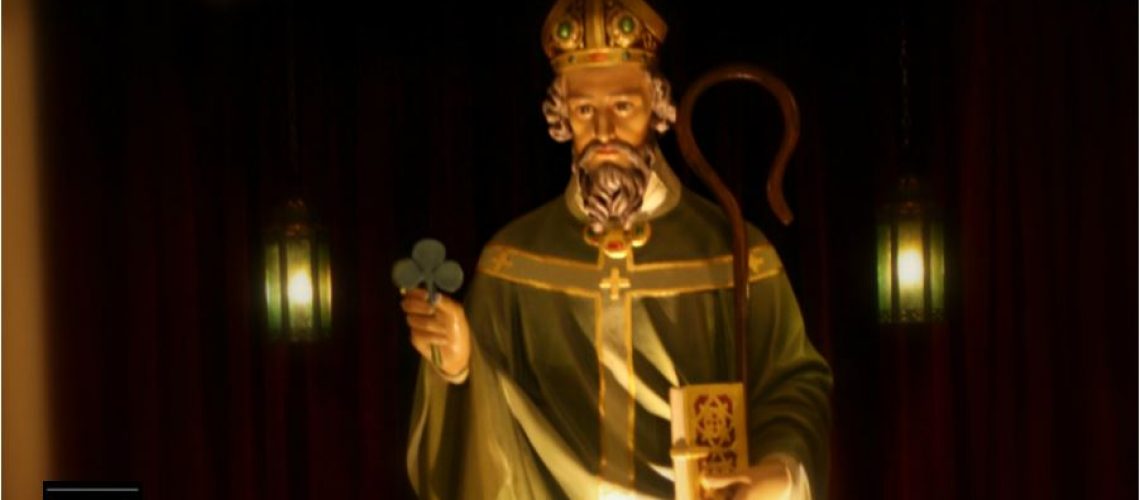
Saint Patrick’s Day is one of the most widely known saint’s feast days along with Saint Valentine. There are many different aspects to Saint Patrick’s Day. There is the remembrance of his holy, pious, and courageous service to God and the Church. For this we are called to emulate him and ask for his intercession. Then, there is the broad Irish heritage celebration resonating around the world for anyone with any Irish ancestry. There is also the wild and almost Mardis gras aspect, which makes it essentially a theme party for some. And then there are the wildly exaggerated tales, tenuous truths, and pure fiction mixing myth and legend.
One might be tempted to write-off “celebrating” or observing Saint Patrick’s Day, because some stories about him are fiction and the revelry can at times cross the line of good taste. However, the pure facts of Saint Patrick’s life and work are fascinating and powerful enough to demand a place in the top tier of Saints to celebrate. In fact, the exaggeration and fictional tales of Saint Patrick actually reinforce and spotlight the extraordinary and historic aspects of his life.
Both, And
The Catholic Faith is the Church of “both and,” not “either or.” We believe in scripture and tradition, faith and reason. We believe Jesus is God and man. God offers us mercy and justice. Sacraments are symbols and they convey the actual Grace they symbolize. Many Catholic writers and theologians have made this point from Saint Pope John Paul II in Fides et Ratio, (Faith and Reason) to Bishop Barron and his book Vibrant Paradoxes.
Saint Patrick is no different. His story is filled with fact and fiction. This is not necessarily a bad thing. People who are larger than life in their time and significantly impact the course of history often develop outsized legends after their passing. Think of Saint Nicholas and the myth of Santa Claus. This is one common explanation for so many prominent Old Testament figures being said to live 500 years or more. The longer the Old Testament writer credits an individual with life, the more importance they are placing on them. This is a way of elevating the figure and signifying their importance that modern culture has trouble understanding.
The true exploits of Saint Patrick are as adventurous and frightening as they are profound and spiritually inspiring. He was so revered by the Irish after his passing that his legend began to grow. The word “legend” did not always have the fictional connotation that it does today. According to the New Advent Catholic Encyclopedia, “that which was understood by the word legend, at the time when the concept arose, included both truth and fiction.”
However, as human nature and the pitfalls oral transmission transformed the stories of the saints, the fictions began to arise. These fictions were meant to honor the saint not diminish him. By explaining something as an accomplishment of Saint Patick; the story teller gives misguided but well intended honor to the saint. We see similar fictions arise around Padre Pio and Joan of Arc, in addition to their truly miraculous actions. The same happens with non-religious figures like George Washington and Abraham Lincoln. These added fictions are the modern-day equivalent of saying someone lived 500 years or more in the Old Testament.
The Truth
The true stories of Saint Patrick are amazing on their own. At the young age of 16, in the late 300s, in what is Scotland today, he was captured by pagan Irish raiders and taken to Ireland. There he was sold into slavery and forced to herd sheep and mistreated by his master. For six years he lived and worked outside night and day in the harsh weather with little to no food or shelter. This time of suffering as a slave sparked in him a deep spiritual awakening that brought his faith alive.
According to his own words in Saint Patrick’s Confession, “many times a day I prayed—the love of God and His fear came to me more and more, and my faith was strengthened. And my spirit was moved so that in a single day I would say as many as a hundred prayers, and almost as many in the night, and this even when I was staying in the woods and on the mountains; and I used to get up for prayer before daylight, through snow, through frost, through rain, and I felt no harm, and there was no sloth in me—as I now see, because the spirit within me was then fervent.”
At age 22, in a dream, he was guided to escape captivity and flee Ireland back to his home on a ship. That he walked for weeks some 200 miles to the sea and was able to negotiate his way onboard a ship was a testament to the work of The Holy Spirit. He went with the crew onto shore and struggled for a few months almost starving until his prayers brought him and his companions an abundance of food. Upon his return to Britain with his friends and family, he received another dream calling him, as he understood it, to bring the word of God to Ireland. He quickly entered the seminary. It took significant time and effort, but he rose to the office of Bishop and received approval to go to Ireland.
There were already some Christians in Ireland from previous missionaries, but they were scarce an unorganized. Ireland was still a pagan land with druid priests and clans ruled by local kings. Saint Patrick went from Clan to clan preaching the Good News of Jesus Christ, converting pagans, setting up Churches, and ordaining Bishops. He was often not welcomed and sometimes imprisoned, but he persisted. He is reported to have baptized thousands, ordained hundreds. He built hundreds of physical churches and won over the people and the land. The mere fact he chose to return to the place of his brutal captivity, was amazing. That he could convert the entire Island was miraculous.
After Saint Patrick’s death in 461, his fame and legendary status grew even more. Over a few hundred years, the embellishments and fictional aspects of the legend grew in tandem with the true history and legacy.
The Myths
As noted, it is not uncommon for historical figures both religious and secular to have fiction added to their historic legacy over time. The greater the historical figure, the greater the myths is often the case. Perhaps the most common myth is that Saint Patrick drove the snakes from Ireland and into the sea with a sermon while standing on a hill. This myth functions both as a primitive explanation for the absence of snakes and an allegory for driving out the pagan religion. It also elevates Saint Patrick as someone to be respected and emulated. Another myth has Saint Patrick taking two half mile long strides or steps from one island to another to reach the mainland. This myth is conflated with an older myth about a giant using the island chain as stepping stones. Again, the myth seeks to explain natural history and elevate the status of the historical figure.
One story with unknown credibility that is often attacked by Christian apologists is the idea that Saint Patrick used the shamrock to explain the Trinity to the pagan Irish. Three leaves, one plant, you get the idea. These apologists are eager to point out the deficiencies in the shamrock analogy. However, the nature of analogies is such that you are comparing two things that are more different than they are similar.
Clearly, there is no perfect or even good analogy for the mystery of the Trinity. But there many mediocre analogies. And many analogies taken together as a whole can give one a sense of some truth of a mystery, or at least some aspects of it. While there is no record of Saint Patrick using the Shamrock analogy, arguments from silence are inherently weak. There is greater confidence that throughout history, parents and teachers have used the shamrock analogy because of the Saint Patrick legend. And that weak analogy along with 100 others gives us a small glimpse into the mystery of the Trinity. This itself becomes a truth thanks to Saint Patrick, whether he was directly responsible or not.
Why it Does and Does Not Matter
Pope Francis wrote in his book, Let Us Dream: The Path to a Better Future, that we often “see as contradictions what are in fact contrapositions, as I like to call them. A contraposition involves two poles in tension, pulling away from each other… These are contrapositions because they are opposites that nonetheless interact in a fruitful, creative tension.” The fiction and fact of a legend can also relate to each other in this type of tension. The historical facts are to be preserved, taught, cherished, and emulated. The fictional myths growing out legend reinforce the importance of the historical figure and their status in the culture.
On one level, there is truth in saying something is so great that Saint Patrick must have done it. Like the shamrock and the Trinity, these ideas are more dissimilar than similar; but taken as a whole; they work together to make a point. So, Saint Patrick can be both an amazing historical and Holy person who we ask to pray for us, and a larger-than-life legend difficult to comprehend. Clearly, God was both at work in Patrick’s life and using Patick as an instrument. Such are the mysteries of the faith, true and yet incomprehensible.





2 thoughts on “The Both, And, of Saint Patrick”
It is interesting, that the historical facts preserved, no way reflect the historical facts in situ.
Pingback: The Both, And, of Saint Patrick MEK Enterprises Blog - Breaking News, SEO, Information, and Making Money Online!The Number 1 Online Blog Worldwide!