

Death has been on my mind a lot lately. This week I heard about the deaths of two people, one from my graduating class in high school, the other the mom of a longtime friend.
I can’t say that death is ever very far from my mind. As I get closer to turning 50, I’m feeling my mortality in new and ever-present ways. The process of dying creates a bit of unease in me, but death itself does not terrify me. There’s no way to avoid death so we can either fear it and do all we can to fight it…or live loudly and stay ever-ready.
The mystery of the transition from life to death induces anxiety. Long-suffering scares me and the toll of my death on my loved ones weighs heavy. But like labor pains, the end result will bring me to the moment I’ve been waiting for my entire adult life: I will meet Jesus face-to-face. This is the paradox of death – the deepest darkness followed by all-consuming light.
Our perspective on death can affect how we live. Midway into my career, I was faced with an unexpected resignation. My husband and I learned we were expecting our fourth child (surprise!) and decided the best thing for the family would be for me to leave my 9-5 and stay home. I loved my job, maybe a little too much, and leaving was painful. A day or two after I’d left, I was lying in bed thinking and praying. In a moment of clarity, it hit me. I could focus on what I’d left behind or look ahead and what I now had the freedom to do. One mindset would keep me stuck; the other gave me freedom.
Within the context of contemplating our own death, we can ruminate on what we’re leaving behind or we anticipate what lies in wait around the corner. The way we think of our own death can help liberate us to us live with more intentionality so we don’t get stuck and waste the time we’ve been given.
I visit one of the local nursing homes monthly to take the homebound communion. I love engaging with them and hearing their stories. They value seeing people from the community because it reminds them of their dignity and position in society. They are still here and they still matter. We’ve all heard about the loneliness epidemic and our elderly are a large portion of this constituency.
When I bring my youngest daughter, Rosemary, she is the belle of the ball, not only because there are at least a half dozen “Rosemarys” at the facility at any given time, but also because children seem to break down walls that we adults don’t always see. Even the curmudgeonly old men who rarely speak to me will get a spark in their eye and ask my daughter what grade she’s in.
Last week when I visited, as I was packing up, I asked the group to tell me something they missed about “the good ole days.” Their responses were priceless.
“I miss the days when children would behave in church or in restaurants,” one cute old man wearing a black tracksuit tells me. “Nowadays, parents just let their kids run around.”
“I remember when people would dress up to travel…we’d wear our nicest clothes to take a train or a plane ride,” Marge, the lady next to him, says.
The cute old man adds, “I told a lady the other day when I was out to lunch that she should keep a closer eye on her child. That kid was running all over the dining room, making a racket.”
“How’d she take that advice?” I ask.
“I got a dirty look. But a few minutes later the manager came up to my table and whispered a ‘thank you’ for speaking up because he didn’t feel he was in a position to say anything.”
Other times, the mood isn’t so lighthearted. It’s challenging to come into the community room and notice people missing, only to learn they’d passed away between my visits. “They don’t even tell us when it happens!” residents often complain.
Another part of this outreach is taking communion to the sick and dying in their homes. A few months ago, I met Bob, a man who just recently came back to the church after 60 years of being away. Bob had 6 weeks to live and his wife and hospice were caring for him at home. As he situated his blanket and pillow, his wife put Grace, their 120 lb Golden Retriever, on the back patio and then said she’d give us some time alone.
I pulled up a chair beside his bed. “That dog bullies me into giving her whatever she wants…and I love it.” Bob’s eyes gleamed. Grace stood at the glass door, tongue hanging out, staring at Bob’s every move. A thought flitted through my mind of how hard Bob’s passing will be on this sweet pup.
Over the course of our visit, Bob would wipe away errant tears from his beautiful green-blue eyes. Each time he’d apologize, explaining that he no longer had the ability to contain his emotions. I reassured him that his tears didn’t make me the least bit uncomfortable.
“I’m so grateful that you brought me communion. People have been so good to me, the nurses at the hospital, the volunteers who come to my home….”
Bob was in Vietnam and smoked for 48 years. He told me he’s thankful for the life he’s lived, that God has been so good to him, that he doesn’t deserve such kindness after the things he’s done. I hold back my own tears, and we sit silently.
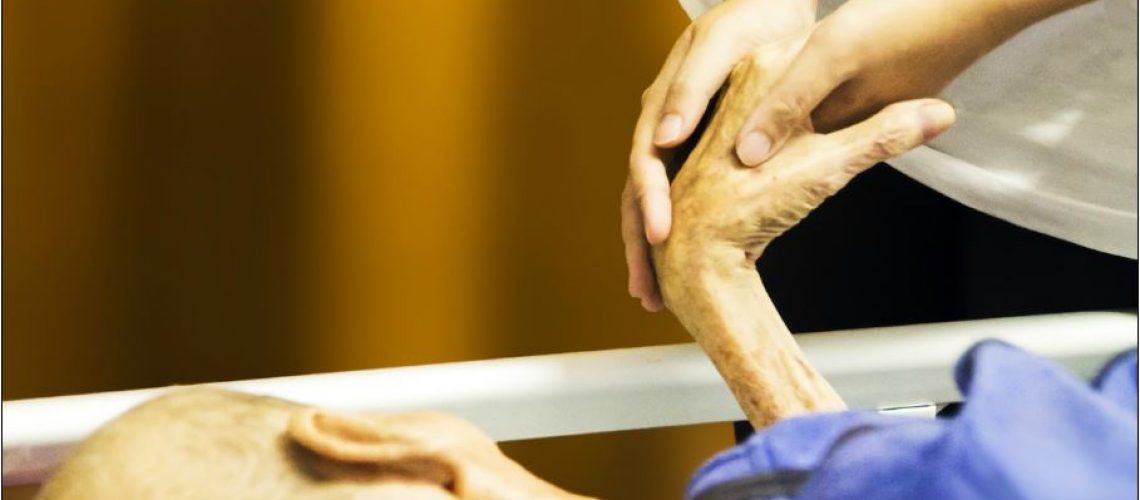
I pulled his hand into mine. The texture of his skin felt dry and papery, but his grip was strong. He then placed his other hand atop mine. “I don’t feel that bad,” he said. “I’m just waiting for the end to come.” Sometimes in a conversation, coming up with a response just isn’t necessary.
After I declined his wife’s offer of coffee, she walked over to us with his cup and held it to his lips. He thanked her. “She’s not Catholic, but she respects where I’m at. She’s a good woman.”
Time spent with those near death doesn’t only provide them with the gift of time but also gives the one visiting the gift of perspective. Visitors still have time to make adjustments in their lives so they carry less guilt or regret when their end comes.
Bob taught those around him how to die well. He slowly slipped into a quiet place in his spirit where gratitude and love pulsed with every beat of his heart. When that heartbeat finally came to a rest, I don’t think Bob was looking back on a life of regret, but I imagine him leaping into the arms of his Savior, who does not keep a record of our failings.
May we all reach a place at the end where we have nothing but gratitude for the lives we lived. May we have no regrets and be surrounded by those we love and who love us. May we not fear what we can’t see, but trust in the One who reminds us that He could never forget us. “Behold, I have inscribed you on the palms of My hands…” (Isa 49:16, NASB). May we embrace this transition because we know Who is eager to embrace us on the shores of this mysterious transition into ever-lasting life so that those who come to see us on our own deathbeds will remark that our gratitude inspired them to use the time they had to be more loving and stay focused on what was to come.
† In memory of Rita, Rob, Anna, Rose, Chickie, Bob, Tony, and Ethelene.




5 thoughts on “Teach Us How to Die”
Pingback: What Does the Virtuous Life Look Like, West Point Grad Ordained a Catholic Priest in Minnesota, and More Great Links! - JP2 Catholic Radio
Pingback: FRIDAY EVENING EDITION | BIG PULPIT
If we die in this life before we physically die, this takes the sting out of physical death. Casting all of our care on God is all that is necessary (cf. 1Peter 5:6-7).
Thank you for your comment. God is good.
Great article; we should not be afraid of death , when its time we will know how, its taken care of. My wife and I visited Mother Teresa’s place here in the Philippines and knew many of the dying; some extraordinary transformations take place in between their arrival and death. Beautiful works of grace. God is good.