
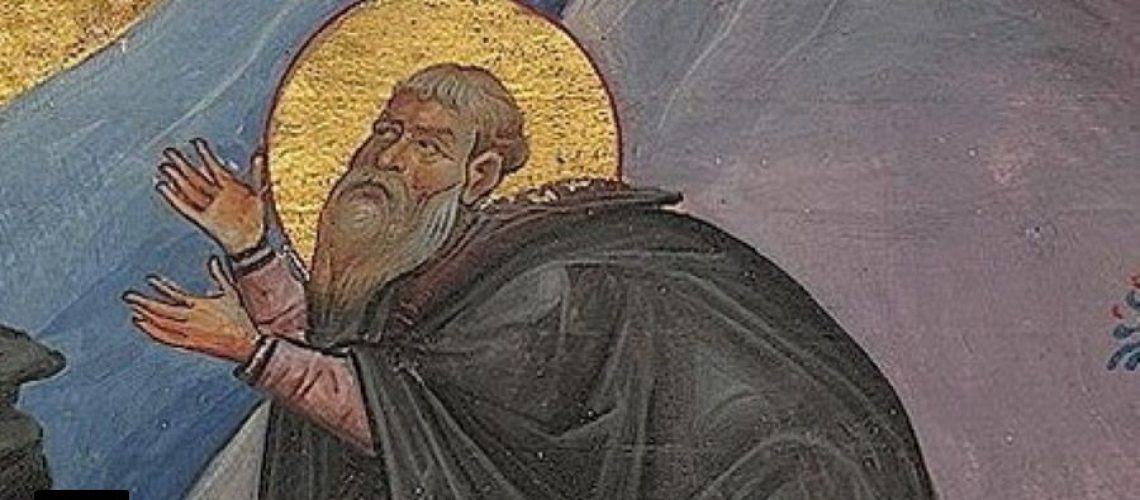
Monk, Mystic, Miracle Worker
He was a man who ran from the very thing his holiness could not escape: the hungry, hurting crowd. Born in fourth-century Palestine, St. Hilarion sought only the silence of God, yet his gift for healing and his radical asceticism made him a spiritual magnet. This lyrical testimony retraces his restless flight from Gaza to Egypt, Sicily, Dalmatia, and finally Cyprus, where fame pursued him like a shadow. After his death, his body astonished witnesses with its incorrupt beauty and heavenly fragrance. For ordinary Catholics, Hilarion is not a distant legend but a heavenly friend, a signpost for anyone burdened by visibility, misunderstood in their desire for quiet faithfulness, or tempted to confuse being known with being holy. His life whispers a liberating truth: you do not have to be seen to be loved by God.
He was born in Tabatha, a small village south of Gaza, around 291 AD. His parents were pagans, and they sent him to Alexandria for a fine education. But while his mind drank in the wisdom of the Greeks, his heart was being quietly captured by another Teacher. In that bustling Egyptian city, the young Hilarion met a man whose name was already legendary: St. Anthony the Great, the father of the desert. Anthony lived in a way that made little sense to the world. He owned nothing, ate almost nothing, and spoke with God as a friend. Hilarion saw in him the one thing his schooling could not provide: purity of heart. He stayed at Anthony’s side, learning the beautiful, demanding disciplines of fasting, vigil, and prayer, until the old hermit finally sent him home. Go to Palestine, Anthony said in effect. The desert there is waiting for you.
So Hilarion returned to Gaza and did something no one in that region had done before. He built a tiny hut in the wilderness near Majuma and became the first hermit of Palestine. He wore a hair shirt and animal skins and ate nothing until sunset. He wove baskets with his hands while his heart wove prayers without ceasing. He was not performing for anyone. He simply wanted to be alone with the God who had stolen his heart.
But God had other plans. The first miracle came quickly. Three sons of Aristaenete, the wife of Elpidius, lay gravely ill in Gaza, and their mother begged Hilarion to come. He prayed, and they recovered. Word spread like fire through dry grass. Soon came the blind, the lame, the possessed, and the desperate. He cast out demons and healed the sick. He even calmed a great sea disturbance on the Dalmatian coast, commanding the waters to return to their bounds. His reputation grew so quickly that crowds gathered wherever he went. They did not come to hear him teach, for he had not set himself up as a teacher. They came simply to touch him, to be near him, and to seek healing through the power that seemed to cling to him like a fragrance.
And Hilarion was terrified. Not of demons, which he faced with startling courage, nor of the sea, which he rebuked like a child. He feared praise. It was the one thing that could poison the well of his devotion. He understood something most of us spend a lifetime learning: human approval can be a sweet poison, and the soul that lives on it slowly starves. So he did the only thing he could think to do. He ran.
He fled to Egypt, hoping to disappear into the vast desert that had formed Anthony. But the crowds followed him there, too, flocking to him “as to a new Antony.” He crossed the sea to Sicily and became a woodcutter, carrying bundles of wood to sell in the market. For a little while, he was nobody. Then a man he had once freed from a demon recognized him, and his secret was out.
He sailed to Dalmatia, where, according to the traditional account, he slew a dragon ravaging the countryside and saved a city from the waves. The people called him a saint. He considered himself a fugitive. As the historian Sozomen wrote, “It was no joy to him to live among those who praised him.” Hilarion wanted to remain unnoticed and repeatedly moved from place to place to escape the fame that pursued him.
Finally, he sailed to Cyprus and settled near Paphos, hoping to find peace. But even there, the inhabitants guarded the passages so carefully that he could not escape them. He died in 371 AD, at about eighty years of age, still a captive of his own renown.
His death was not the end of the story. About ten months after his burial, his devoted disciple Hesychius secretly opened the tomb to bring his body back to Palestine. What he found astonished him. The saint’s tunic, cowl, and cloak remained intact, and his body was as well-preserved as if he were still alive. From his unwashed, unembalmed body rose a fragrance so sweet that witnesses said it seemed to have been anointed with precious ointments. It was as if heaven could not bear to let him decay, as if God were saying, “You spent your life trying to hide from the world, but I will make you a sign for the world.”
Hesychius carried the body to Majuma, and a curious contention arose between the Palestinians and the Cypriots, each claiming a part in the saint’s legacy: one his body, the other his spirit. The monastery Hilarion founded near Gaza, at Tell Umm Amer, became an important centre of monastic life in the Holy Land. His feast is celebrated on October 21 in both the Catholic and Orthodox calendars.
What makes him unique? He was not a martyr, though he lived through persecution. He was neither a bishop nor a theologian. He was a hermit who wanted nothing more than to be forgotten by the world. Yet his flight from fame made him famous. He is a signpost for anyone exhausted by visibility, for anyone who has wanted to do good quietly but found that the world would not let them. He is a heavenly friend to those who understand that holiness is not about being seen but about being transparent.
Hilarion’s life poses a gentle yet piercing question to every Catholic and everyone who reads his story: Why do you want to be known? In a world that measures worth in followers, likes, and titles, this fourth-century hermit stands as a quiet rebel. He did not build an empire, write a book, or seek a platform. He sought God alone, yet God made him a light to others.
May we learn from him that the soul’s deepest desire is not to be admired but to be hidden in Christ. And may we, like Hilarion, turn away from the world’s praise and run straight into the arms of the Father.
Hilarion ran from fame and found himself famous. He sought solitude and found crowds. He wanted to hide but found himself on display. Yet he remained transparent: a window through which Christ’s light could shine.
If you feel abandoned in darkness, Hilarion reminds you: God sees you. If you feel enslaved, he reminds you that God is stronger. If you feel small and overlooked, he reminds you that God cares about the little things. If you feel as though you are fleeing your own life, he reminds you that God will meet you along the way if you trust in Him. God is still working, healing, casting out demons, and calming storms.
St. Hilarion’s Intercessory Prayers
First: The Desert Prayer (Troparion, Tone 8)
By a flood of tears you made the desert fertile,
and by your longing for God you brought forth fruits in abundance.
By the radiance of miracles you illumined the whole universe!
Our Father Hilarion, pray to Christ God to save our souls!
Second: For Humility
O blessed Hilarion, you fled from the praise of men and found the praise of God. Teach me to seek no applause, to fear no obscurity, and to rest in the knowledge that I am seen by the Father who sees in secret. Amen.
Third: For Peace in the Hidden Life
Heavenly Father, guide me to seek peace in Your presence, just as St. Hilarion did. Help me embrace the quiet moments of my day and feel Your love and grace. Grant me the wisdom to find joy in simple things, and let Your peace fill my heart. Amen.
Fourth: The Prayer for Resilience
Lord God, we learn the value of solitude from St. Hilarion. May his intercession commend us to You, so that through his merits we may obtain what we cannot accomplish by our own efforts. Through our Lord Jesus Christ, Your Son, who lives and reigns with You in the unity of the Holy Spirit, God, forever and ever. Amen.
Fifth: The Prayer for a Transparent Heart
O Hilarion, rampart of ascetics and unfading light of the Spiritual Sun, you illumined those in darkness and led them to the heights of God. Pray that I may become a transparent instrument of grace, so that others may see Him who dwells in me. Amen.