

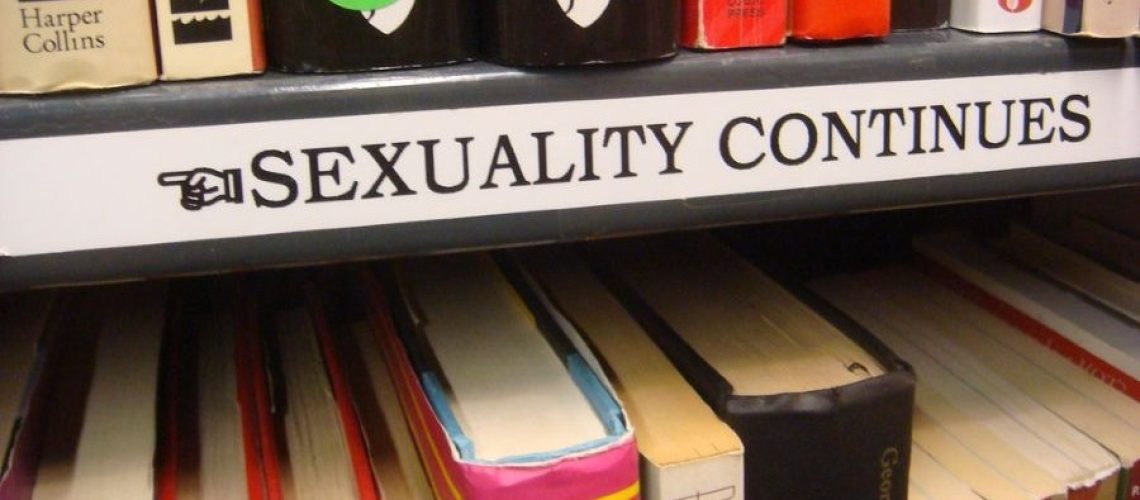
In “Catholics: You Don’t Have to Feel Bad about Reading Romance Novels,” Jill Rice asserts that the ultimate destination of these wildly popular books is the ‘“free, total, faithful, fruitful” love’ articulated in JPII’s Theology of the Body (AMERICA MAGAZINE, February 10, 2023). It is a surprising premise for which she offers some tantalizing support: independent protagonists choose their life partners, make personal and financial sacrifices for them, abstain from sex when the situation demands it, and even demonstrate pro-life convictions (after the inevitable birth control failures). However, a closer analysis of the compact between reader and writer reveals deep problems with this superficial line of reasoning.
I am a voracious devourer of light fiction. Yesterday at work, over my half-hour lunch, I opened my current summer read, a 1948 gem by British novelist Elizabeth Goudge. Propping it up against the napkin holder while I speared some chicken salad, I sped through the following passage:
The water was amber in the sunlight, red-brown in the shade, tinged with iron, but crystal clear so that one could see all the pebbles on the bottom. The stream was a wide one and in the center of it was an island fringed with loosestrife and bog myrtle, with a clump of thorn trees and sloes in the center of it. It was reached by a bridge made from the fallen branch of a tree overgrown with clumps of fern.
Chronically impatient with descriptive writing, I absorbed nothing of what I read, hurrying on my way to the dialogue and the impending action. After only a few more paragraphs, though, I got distracted. Eventually, lured by my Facebook page, I put down PILGRIM’S INN for the rest of lunch.
Later that evening, I threw myself down on the living room couch and opened the book again. Since I never remember exactly where I have left off, I ended up picking up at the same place in the reading. In a state of exhaustion, I found myself dwelling on the words of this passage much more closely than usual and the image of the forest began to ripple into my ken. Unexpectedly I had wandered into the very wood of the author’s imagining. The lingering scent and sound of the iron-tinted water bubbling through gaps in the rocks carried me momentarily away from the physical soreness and mental daze that had engulfed me. It was a good place to be.
Nevertheless, the encounter startled me. I reflected, in a singularly new way, that words on the page can possess astonishing latent power—and that that power imposes a duty on us. When we come to a meeting of the minds through the medium of prose, there are two critical, and inseparable, questions worth asking—whose mind are we wandering into anyway? And how will the unveiling change us?
When we consider graphic sexual fiction, these questions are of extreme significance. The most basic reality about sexually charged prose is that it provokes arousal in the reader. I confronted this uncomfortable truth as a young teenager when I began reading QUO VADIS, Henryk Sienkiewicz’s 1905 epic about Nero’s bloody persecution of Roman Christians. The main narrative introduces us to Roman officer Marcus Vinicius and his lustful pursuit of a virtuous young woman named Lygia, who has secretly become a member of the new sect. Eventually, Vinicius is wholeheartedly won over to faith in Christ, but in the meantime he’s only interested in one thing.
In no manner of speaking can this Nobel-prize winning novel be considered trashy. But there was something undeniably titillating to me in the description of Nero’s feast, which relates Vinicius’s attempt at seducing the innocent Lygia. I found myself rereading those pages out of order, getting excited at what I was reading, and feeling utterly ashamed afterwards. I had a very similar experience with the exquisite JANE EYRE, required summer reading as a high school freshman.
Should we banish the classics, or expurgate problematic passages for the sake of decency, as did Thomas Bowdler in his 1907 work THE FAMILY SHAKESPEARE? By no means! However, as we are asking our middle and high school students to read books that explore adult concepts of sexuality, we would do well to augment our teaching of Theology of the Body (though that is a subject for another column!)
At the same time, we need to stop exposing ourselves to the commercial values of authors who do not respect the truth and goodness of sexuality. Romance fiction (as well as graphic sexual content in more general literature) presents a unique stumbling block to the reader, who is, perhaps unwillingly, drawn from being a passive observer to being an active third party to a sexual encounter between two people. Quite frequently, the same author who is comfortable recording intimate details of the sexual embrace has no qualms about depicting sex with ugliness and brutality.
As a young college student, I camped out one night in my good friend’s dorm room. Faced with the dilemma of having nothing to read, I happily accepted a historical romance set in the medieval era and immersed myself in the enthralling tale of an unwilling bride, newly arrived at the castle.
About fifty pages in, I stumbled upon the graphic description of what was probably marital rape. The words simultaneously horrified and mesmerized me. I don’t remember whether I shut the book immediately or skipped a few pages before attempting to continue on. Ultimately, by the grace of God, I put the novel aside. It is significant that almost twenty-five years later, I still remember a few of the exact words that the author used in this chapter. The things that are burned into our brains have an impact on us, whether we like it or not.
When I read graphic sexual content, I am willingly stepping into the labyrinthine forest of an author whose worldview, in all likelihood, has been shaped by a disregard, if not a contempt, for the sacred veil which covers the intimacy between husband and wife. That’s strike one. In setting myself up for sexual arousal, I am surrendering to fictitious characters and situations the right of initiating intimacy which is the prerogative of my spouse. Strike two. Finally, I am (consciously or unconsciously) inviting the author to dictate the terms of my sexual life with my spouse. This third point is perhaps the most frightening.
The true effect of absorbing someone else’s version of bedroom behavior is to stifle the creative individual impulse implanted by the Creator Himself in bestowing his joyful gift of sexuality. It robs the marital embrace of its native spirit of playfulness founded upon trust, the forgotten legacy of our time in Eden. When a couple’s sexual joy flags, the only remedy is complete patience and vulnerability, which is terrifying. That’s where the danger lies.
Feeling they don’t really know how to “do” sex, spouses may feel compelled to imitate the words and gestures they have picked up from ubiquitous examples in soft-porn episodes from books and movies, if not the hard stuff. They cease to authentically surrender themselves in the marital act and assume the gimmicks and tricks of carnival magicians. Gone is the tender awkwardness and secret delight, to be replaced by a babel of deranged voices with recommendations on how to “spice up your love life.” We can reasonably say, along with the Cheshire Cat, “We’re all mad here.”
Psalm 126:4 beseeches, “Restore our fortunes, O Lord, like the torrents in the southern desert.” In the face of the strident exposures that seem to pop up between the covers of every library book, it is very difficult to cultivate a spirit of true wonder and mystery about our sexuality. But by firmly closing the communicating door to the summons of disordered fiction, we can become more truly receptive to the third party Who should always be present in our lovemaking—the One Who established it in the first place. Then, and only then, can the parched ground of marital intimacy be refreshed.




3 thoughts on “Sex and the Third Party”
Pingback: VVEDNESDAY EVENING TOP-10 - BIG PVLPIT
They adopt the gimmicks and tricks of carnival magicians and stop genuinely giving themselves up in the marital act.
I’m sure if you could somehow document the erotic intimacy between married couples under and over the covers, it would put any novel to shame. Conversely, in a strictly patriarchal societies where the husband dominates with his will, the lack of reciprocity would bring one to tears.