
The first recorded words Jesus spoke in scripture are expressed in the Gospel of Mark, chapter one:
After John had been arrested,* Jesus came to Galilee proclaiming the gospel of God: “This is the time of fulfillment. The kingdom of God is at hand. Repent, and believe in the gospel (Mark: 14-15).
The above proclamation by Jesus at the beginning of his public ministry speaks to the essence of the gospel message and continues to resound in the hearts of the faithful throughout the world. From the early days of the Church until the present day, turning away from sin and turning toward God have been at the core of Christian life. A sequence and progression is leading to God’s mercy that is outlined in the following foundational parable, illustrated in the Catechism:
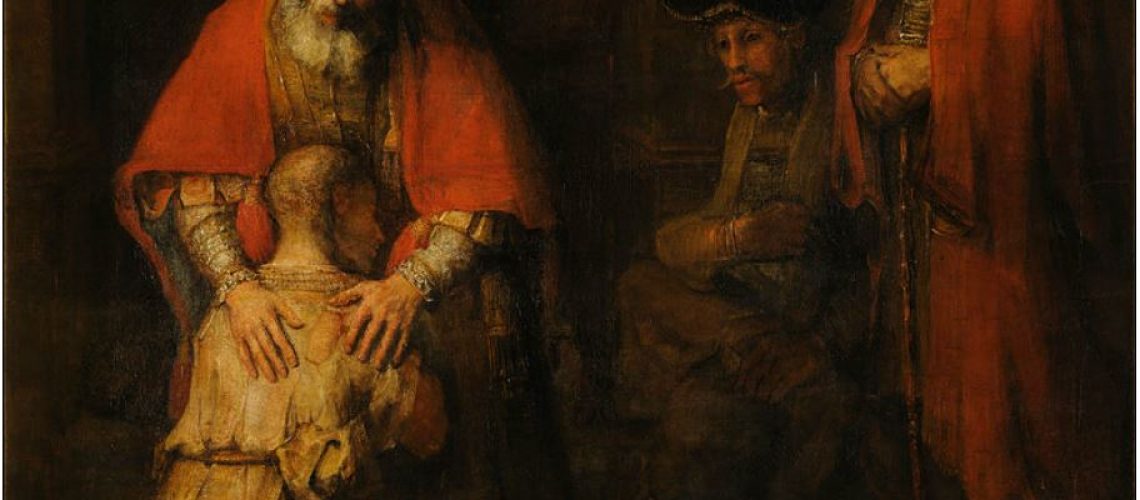
The process of conversion and repentance was described by Jesus in the parable of the prodigal son, the center of which is the merciful father: the fascination of illusory freedom, the abandonment of the father’s house; the extreme misery in which the son finds himself after squandering his fortune; his deep humiliation at finding himself obliged to feed swine, and still worse, at wanting to feed on the husks the pigs ate; his reflection on all he has lost; his repentance and decision to declare himself guilty before his father; the journey back; the father’s generous welcome; the father’s joy—all these are characteristic of the process of conversion. The beautiful robe, the ring, and the festive banquet are symbols of that new life—pure, worthy, and joyful—of anyone who returns to God and to the bosom of his family, which is the Church. Only the heart of Christ who knows the depths of his Father’s love could reveal to us the abyss of his mercy in so simple and beautiful a way. (CCC 1439).
Conversion and repentance are woven throughout the parable, ultimately leading to forgiveness and reconciliation. The expression “rock bottom” adequately describes the condition of the prodigal son. He squandered his fortune and found himself in the equivalent of a street gutter, longing for the food meant for the pigs he tended. His dire circumstances served as a point of true humiliation that ultimately led to his return to the “bosom of the family”. The father already anticipated the sorrow that the son was prepared to express upon his return. The celebration that ensued proceeded from a place of charity that could only issue forth from a loving father’s heart. The repentance and forgiveness that is exemplified in the parable are available to every Christian for the asking. The catechism explains:
The interior penance of the Christian can be expressed in many and various ways. Scripture and the Fathers insist above all on three forms, fasting, prayer, and almsgiving,31 which express conversion in relation to oneself, to God, and to others. Alongside the radical purification brought about by Baptism or martyrdom they cite as means of obtaining forgiveness of sins: efforts at reconciliation with one’s neighbor, tears of repentance, concern for the salvation of one’s neighbor, the intercession of the saints, and the practice of charity “which covers a multitude of sins (CCC 1434).
The two great commandments, love of God and neighbor, are effectuated through “tears of repentance” and the “practice of charity” in the citation above. As followers of Christ, we can avail ourselves of the grace that proceeds from the Agape love of God in the time it takes to pray to the Holy Spirit in the sacrament of Reconciliation. The prodigal son’s words speak to contrition and the joy that followed:
Father, I have sinned against heaven and against you; I no longer deserve to be called your son.’ But his father ordered his servants, ‘Quickly bring the finest robe and put it on him; put a ring on his finger and sandals on his feet. Take the fattened calf and slaughter it. Then let us celebrate with a feast, because this son of mine was dead, and has come to life again; he was lost and has been found.’ (Luke15:21-24).
May we be found in the abyss of God’s mercy and love celebrating the feast that is the Mass as we approach the season of Lent.

