

Launched in 2013 by the Catholic Charities of the Diocese of Arlington, the St. Lucy Food Project, located in Manassas, Virginia, is an extension of the charitable works of Catholic Charities. The focus of Catholic Charities is to serve the poor, protect the vulnerable, and welcome newcomers to the 21 counties and seven cities of the diocese through a number of ministries. Among these are providing food assistance to hungry families and individuals, especially those in rural underserved areas; emergency assistance, which helps families avoid homelessness or disconnection of utilities; free medical and low-cost mental health care; housing and workforce development to homeless men and mothers with children, as well as educational classes and refugee resettlement.
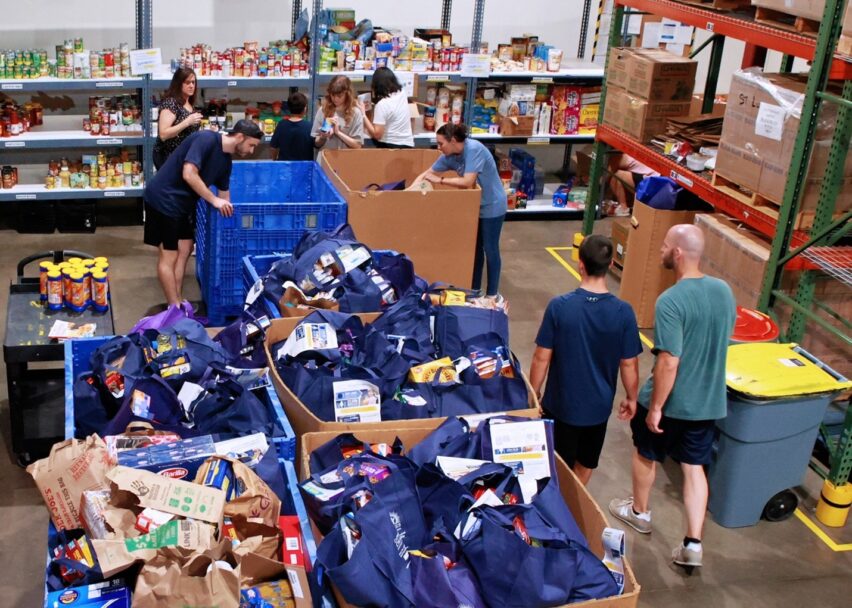
According to Vincent Cannava, program director for the St. Lucy Food Project and who began his role with it as a volunteer, “By 2012, with the help of parishes and volunteers, we collected and distributed about 90,000 pounds of food at the Old Town Alexandria location.
“As the food collection momentum and organization grew,” he said, “an anonymous donor donated money to secure a warehouse in Manassas that would be accessible to highways I-95 and I-66. We also had to hire a modest staff to store and stage food deliveries.”
The warehouse opened and was blessed by Bishop Paul Loverde in 2014. As Mr. Cannava explained, with the help of volunteers, the warehouse staff helps to store and sort food for the three Catholic Charities pantries located in underserved areas. “In 2024 we distributed 2.1 million pounds of food to our three pantries, 66 parish and community pantries, and 44 other food distribution sites around the diocese,” he added.
What is the most desired, sought-after foods people want from the pantry? As James McCaskey, the Outreach Specialist for the St. Lucy project explained, “The most requested food from the pantry are canned meat, canned fruit, jelly, Mac’n’cheese in the summer, canned vegetables, and canned soups,” he said, adding that certain sources help out.
“We do get special food collections. For example, Bishop O’Connell co-ed high school in Arlington, Virginia. They will do a yearly soup drive for us from September through November. They will rally and we get up to 12,00 cans of soup.” Also, noted Mr. Cannava, now that the Manassas warehouse has a refrigerator, they can receive fresh produce.
Mr. Cannava added that local farmers have donated meat to St. Lucy, and the project also works with farmers during the summer and fall for the “gleaning” events, where farmers allow St. Lucy to take a group of volunteers down to their fields and harvest any leftover crops they have, such as corn, watermelon, broccoli, cauliflower, and others at a significantly discounted rate.
Mr. Cannava noted that the St. Lucy warehouse receives the bulk of their food donations from Catholic parishes in the diocese. “We also have great partnerships with many of the elementary and high schools in the diocese as well that support us throughout the school year,” he said. “And a lot of churches, communities, and government pantries get food from Catholic Charities and we provide the food in a variety of ways. Some of our pantries may not need help monthly but maybe only in summertime. We phone the pantries and figure out their requirements and the requirements are going up because of inflation. … We get them what they need, if ordering 20 things, we ask what 5 major items they need: canned meat, canned fruit, peanut butter and jelly. … We want to provide survival foods, so if these are pasta and tomato sauce, we try. We give that every month and if they want extra food, we will try.”
Mr. Cannava explained who is eligible to receive the food donations. “Anyone who lives within the 21 counties and seven cities of our diocese is eligible to receive food from our three Catholic Charities pantries in Alexandria City, Sterling, and Front Royal,” he said. “We serve all people regardless of their faith. An identification card and one document with the client’s name and current address are the only requirements. Like a military ID or social security so long as consistent with the address.
“We even have some homeless people in Front Royal, Virginia who live even in hotels. We have delivered food to homeless people living in parking lots. We want to be good stewards but want to have enough food for the needy. Anyone who lives in our 21 counties is eligible. They can even walk into Catholic Charities and get food. They do not have to be Catholic. Our motto is: ‘We serve people in need not because they are Catholic, but because we are Catholic’.”
The St. Lucy warehouse supplies annually about 2 million pounds of food to its pantry network, which includes the food pantries in Alexandria, Front Royal, and Sterling. “Each Catholic Charities site strives to build community support for its food,” he said. “Our Catholic Charities pantries also partner with the major food banks in the area: Capital Area Food Bank for Alexandria and Blue Ridge Area Food Bank for Sterling and Front Royal. These food banks provide our three pantries with opportunities to rescue food from local grocery stores which otherwise would go to waste. Also, these major food banks provide critical support to purchase food at reduced prices.”
How do people in local communities learn about these food donations? As Mr. Cannava said, “People can learn how to receive or donate food through our website, ccda.net. People in need also find out through recommendations from other nonprofit or social service agencies. We also advertise in the Arlington Catholic Herald and we have pantries in local communities. In Sterling we are on Google with directions on how to find us. And we also do local community advertising with flyers.”





4 thoughts on “Profile: St. Lucy Food Project”
Pingback: VVEDNESDAY MORNING EDITION | BIG PULPIT
Pingback: VVEDNESDAY MORNING EDITION | BIG PULPIT
Yes, good article. Thank you for telling us about those who carry out these works of mercy, works of charity, works of love.
We also have some homeless placed into hotel rooms. I wonder how this process works. It is pleasing to see this done. I have no idea how the powers that be decide who gets a room, what criteria if any exist.
And if some who are placed in hotel rooms, are rowdy or destructive to the rooms, I understand that they must vacate the room.
I understand too, that sometimes, refugees (in the case I know of from Afghanistan) may be placed in the hotels if there is a need.
It’s an interesting situation.
St Lucy project delivers food. The hotel room situation isn’t what they do. Although, a hotel room can be a work of mercy, even for those who are “rowdy”.