
Italy is a country full of history. And this history is accompanied by some beautiful traditions.
For instance, Divine Mercy Sunday marked the “51st Official Artichoke Festival” in the town of Sezze, where I work. I had never thought that artichokes were much to celebrate. Sezze, however, has a long tradition of growing, cooking, and reveling in the bracts and chokes of the storied green thistle. During the weekend, the town was inundated with the scents of artichokes. They were being baked, fried, marinated, and pickled.
I’m told the event has become increasingly commercialized. Previously there was even a procession through the town during the festival, with a statue of Our Lady. Our Lady was decorated with flowers and crowned with an artichoke tiara. How Our Lady felt about the tiara, I don’t know, but such a bygone ritual combined both the famous artichokes with another tradition: that of processions.
In my experience, processions are not typical expressions of Anglo-American Catholic piety. To be sure, there is a traditional one for Corpus Christi, the Solemnity of the Most Holy Body and Blood of Christ. But it is often a far cry from, say, the usual procession for Our Lady of Guadalupe.
The Feast of Our Lady of Guadalupe
In my first parish, the Feast of Our Lady of Guadalupe meant an all-night singing vigil. As evening set on the day itself, an event I refer to lovingly as “the forced evangelization” of the town then took place.
The small municipality on the border with Washington D.C. had one main thoroughfare, which was generally filled with rush-hour traffic at the time of the procession. Accompanied by police, the procession would snake its way onto the road and close down the street to traffic for half an hour.
For those of you who have never seen such a scene, you would have been in good company with the drivers, bar patrons, and drunks, all craning their necks (some with more ease than others) to catch sight of the spectacle.
Ours typically consisted of matachines, groups of dancers in traditional dress and costumes. One figure who represented the devil defeated by Our Lady would dress as some sort of lion or tiger. His costume came complete with a whip in his tail that he would hurl at the ground to produce a loud and satisfying snap. Combined with the smoke of the incense, loud drums, lights, maracas, and costumes, the whole scene must have seemed rather other-worldly to the spectators.
Indeed, this is the whole point of the spectacle. The procession points to another world – that of a spiritual reality that can easily escape notice. But it does become visible in us and in our lives.
Processions In Italy
Back in Italy, processions form an important part of the generally stagnant devotional life of Christians. Our parish has multiple annual processions in order of the town’s various patrons. Three of the largest are Our Lady of Mount Carmel, Saints Lidano and Carlo, and Saints Cosmas and Damian.
However, the largest procession by far is the annual Good Friday procession. It takes almost three hours and slowly progresses through the entire city. The train consists essentially of actors who re-create the scenes from salvation history. Citizens of the town and many others come to gaze upon the event.
Processions at Mass
When we think about it, our faith is filled with processions.
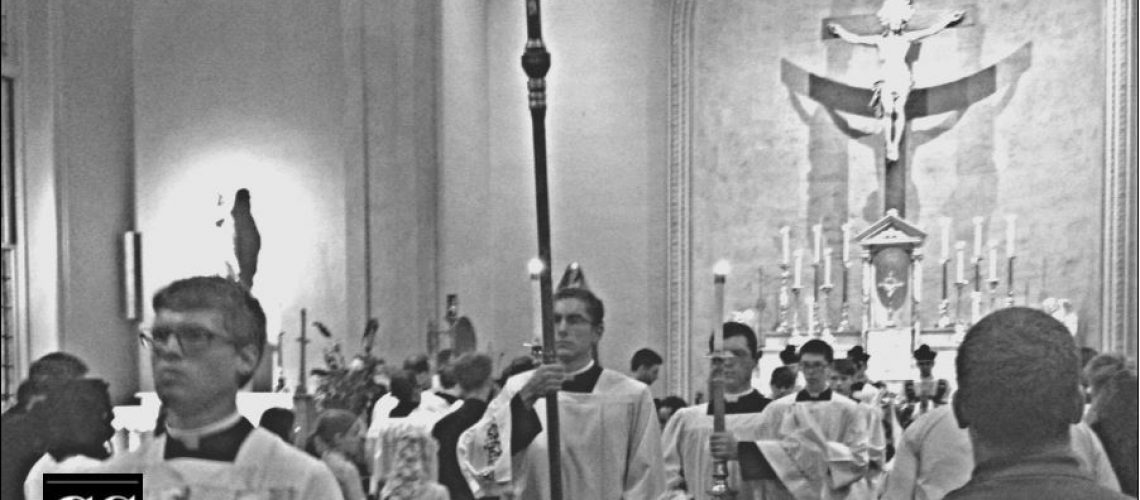
Consider, for instance, the Mass. There is an entrance procession, an offertory procession, and a recessional procession. The “General Instruction of the Roman Missal” is the book that guides the priest and deacon through the various prayers and movements) explains the offertory very briefly, but with great insight:
The offerings are then brought forward. It is a praiseworthy practice for the bread and wine to be presented by the faithful. They are then accepted at an appropriate place by the priest or the Deacon to be carried to the altar. Even though the faithful no longer bring from their own possessions the bread and wine intended for the liturgy as was once the case, nevertheless the rite of carrying up the offerings still keeps its spiritual efficacy and significance.[i]
In the early days of the Church, the faithful brought forth their own bread and wine to be offered in the Eucharistic sacrifice. This tradition calls to mind the many sacrifices that were brought in the Temple in Jerusalem to be offered in atonement or in thanksgiving.
Processions in the Trinity
In the same way, by bringing forth the bread and wine, the people offer to God the raw material for the sacrifice of the Mass. And in the same way, as the offertory comes forward, we offer ourselves along with the gifts. This is so that we might be transformed into the “one body and one spirit” of Christ.[ii]
There is yet another, much more mysterious and much more important procession. We recall it when we recite the Nicene Creed: “I believe in the Holy Spirit, the Lord, the giver of life, who proceeds from the Father and the Son, who with the Father and the Son is adored and glorified, who has spoken through the prophets.” As the Catechism reminds us, “The mystery of the Most Holy Trinity is the central mystery of the Christian faith and of Christian life.”
This procession of the Holy Spirit is a mystery, as is the generation of the Son from all eternity. In fact, theologians like Thomas Aquinas note that generation is the way we describe the procession of the Son from the Father.[iii] In the Trinity, then, we have two processions and Three Persons, but one God. That is quite a mystery!
Processing in Faith
Processions clearly hold a prominent place in our faith, but what does this mean for our daily lives with our families, at work, or in school?
Processions remind us principally of two things: first, processions start somewhere and end somewhere. They have a beginning, a middle, and an end. True, sometimes the start and the finish are at the same place, but the point isn’t that the location has or has not changed. Rather, those who are in the procession change.
People who take part in a procession are probably tired, a little smellier, and have even burnt some calories. But, more importantly, they have born witness to the fact that our lives on earth are also a procession. They are a procession that goes from here on earth to somewhere else: hopefully to heaven, and hopefully not to condemnation.
To be part of a procession means that you must move. There are only two options when it comes to processions: either to take part, or to sit back and watch, letting the procession pass by.
Our lives as Christian are made for joining in. Christianity has never been, and will never be, a sport for spectators. The spiritual life is one of constant movement. We advance in the ways of prayer, the practice of virtue, and our knowledge of and love for our faith. If we’re not moving forward, then we’re not a part of the procession.
In the Easter season, as we commemorate the Resurrection of Jesus and we wind down our celebration with the Ascension and Pentecost. With the Ascension, Jesus returns to the Father, from whence He came. With Pentecost, the Holy Spirit comes down so that we, too, might be sanctified and made holy to successfully undertake our own procession that ends in heaven.
End Notes:
[i] General Instruction of the Roman Missal, 73.
[ii] See Eucharistic Prayer III: “Look, we pray, upon the oblation of your Church and, recognizing the sacrificial Victim by whose death you willed to reconcile us to yourself, grant that we, who are nourished by the Body and Blood of your son and filled with his holy spirit, may become one body, one spirit in Christ.”
[iii] See ST I, q. 27, a. 1 and a. 2. For a historical analysis of the question, see the Pontifical Council for Promoting Christian Unity’s Greek and Latin Traditions Regarding the Procession of the Holy Spirit.


Hi Victor,
Thanks for the comment!
It’s true: I think processions are a wonderful part of our faith and can be a very effective tool for evangelization.
As for the Philippines, yes, they love their processions! As I recall, in some towns there are two separate processions for Good Friday: the men process following the Way of the Cross, and the women process following the path of Mary. When the stations overlap (e.g., Jesus meets His Mother), the two processions meet up and share a station, and, following the station, take off again in their respective directions. It’s a great visualization of what the Gospel tells us and what saints have recounted.
God bless!
Fr. Nate
Fr Nate
I didn’t see this locally, but I have another story: Yes, there was a place were Mary met Jesus on the way of the cross, however what happened next is this – The statue of Mary wiped the face of Jesus (yes, the statue had moving parts). Later, Mary reveals the cloth and shows (literally) the “3 faces of Christ”. I was a little shocked because this is certainly NOT biblical, but get this – the local Protestant Church had this tradition ALSO! After a little reflection, I guessed that this was symbolic that Mary understood that Jesus was the second person of the Trinity.
Anyway, I said I lost count, but yes there were 2+ hour processions for the stations of the cross around town AND there was another procession for the Feast of St Joseph on Mar 19th…so trust me, if you played trombone in the High School Band…well you get called for the rest of your life! No age limit there.
Victor
[…] Commentary: Processions & Processing – Fr. Nathaniel Dreyer at Catholic Stand Lashawan Qwadash: Crazy Belief of Black Hebrew […]
I mentioned previously that I had the pleasure to spend Holy Week in the Philippines. This is exactly what I enjoyed the most! There were so many processions that I lost count – I believe they started on Tuesday with a children’s procession. Perhaps 12 youngsters carried each float (~18 inch carvings of a saint…with lighting!!) with poles over their shoulders, and back-ups were always ready to jump in if they became sore or tired. This lasted ONLY 2 hours, and like you said, it backed-up traffic because there are only 2 main roads around town. There were marching bands and plenty of altar boys in procession – carrying high the processional cross or candles.
I thought to myself, “why do we not do this more in the US?!” I do believe it could really be popular. I know some may be thinking at this point that our separated brethren would be snickering, “look at those crazy Catholics WORSHIPING their statues!”
But this is where they will have a change of heart – because the procession as a whole tells a story! For example one carving, that caught my eye as better than most, was of Caiaphas tearing his garment. I can hear those Protestants mumbling, “Leviticus 10:6, Moses said to Aaron and his sons Eleazar and Ithamar, “Do not dishevel your hair or tear your garments…” Soon enough, they will be enthralled – I know this because the local Protestant church did in fact have their own similar procession!
Obviously most cold weather cities would best wait until summer, but I think each Diocese should alternate a procession between 2 parishes each year. This was the highlight of my trip.