
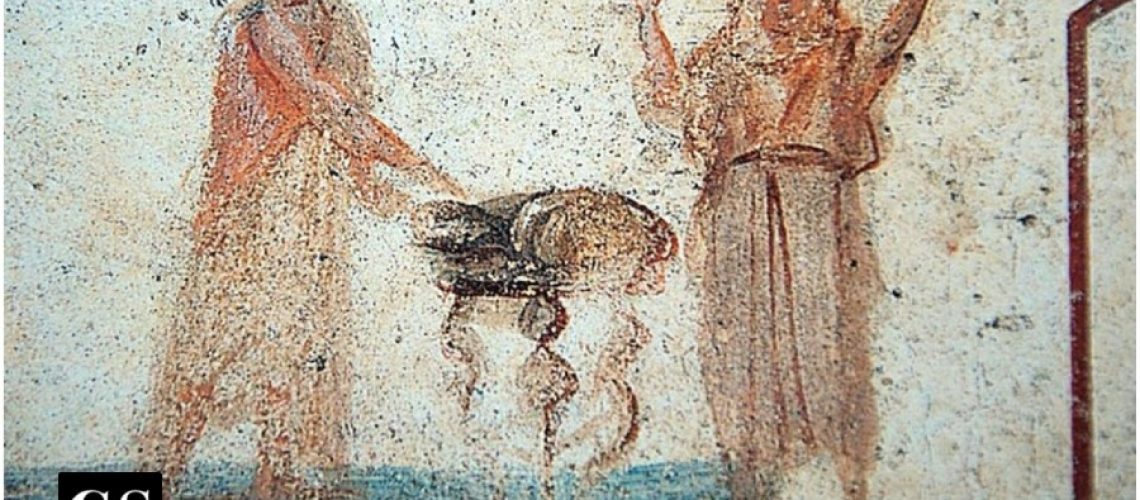
During one of my lectures, I was busily boring the class to death with stories of the Desert Fathers when one teenage girl started chanting, “What about the Desert Mothers!” I pretended not to hear her because I did not know what to say. Of course I knew that many women had felt called to the desert, but I didn’t know much about them and, truth to tell, I could not name one of them.
I spent that evening in the library and could not believe my luck when I discovered that one of the most important of the Desert Mothers was called Melanie, a name she shared with the girl who was taunting me that very morning. Melanie was a wealthy heiress married to Valerius Maximus, prefect of Rome. When her husband died she gave away all her money and went to Jerusalem where she founded a monastery. In 382 a distinguished visitor stayed at that monastery and came under her influence. His name was Evagrius.
He was both a friend and a pupil of St Basil, St Gregory of Nyssa, and St Gregory Nazianzus, and was the greatest mystical theologian of his day. After months of indecision it was Melanie who finally persuaded him to embrace the monastic life in the Egyptian desert. At first he learned all he could about the spiritual life from two great masters, Macarius the Great and Abbot Ammonius. Then he himself began to have an enormous influence on his fellow monks through his writings and his profound mystical theology.
The first monks were for the most part simple unlettered men. The great St Antony was a peasant farmer, Pachomius an ordinary soldier and Macarius a camel driver. They did not see themselves as monks as we understand them today, but as laymen who simply wanted to live a more radical Christian life ‘far from the madding crowd’. Their spiritual wisdom was handed on by word of mouth and only written down much later. Evagrius did not so much record their wisdom as assimilate it into his own spiritual life, and thence into his masterly, mystical synthesis.
He was the first to apply the Greek words ‘acedia’ and ‘apatheia’ to the spiritual life of the early monks. ‘Acedia’ was used to describe the spiritual weariness and fatigue that could lead the monks into the direst desolation that bordered on despair. The word ‘apatheia’ describes the inner calm and peace when the passions are pacified, at least for a time, before the final victory over the ‘demons’. Then a permanent peace that surpasses all understanding would raise the victor to paroxysms of joy that could only be contained in ecstasy. The combination of his great learning and the wisdom he gained in the desert, en-abled Evagrius to produce the first great spiritual synthesis that has had an enormous effect on Christian spirituality ever since.
It was developed and deepened in subsequent centuries by other spiritual writers, finally finding its fullest expression in the writings of the great Carmelite mystics. If St John of the Cross explored more fully than ever before the nature and meaning of ‘acedia’ in his Dark Night of the Soul, then St Teresa of Avila did likewise for ‘apatheia’ in her masterwork, Interior Castle. Though they used different words and symbols to express their profound teaching, it is essentially the same as that of Evagrius.
Prolonged periods of absence experienced in ‘acedia’ and brief moments of presence experienced through ‘apatheia’ always characterize a person’s relationship with God in the journey through their spiritual desert or ‘dark night of the soul’. When the desert seems totally desolate they turn to The Prayer of the Heart that begs for help, for perseverance and for patience to journey on, despite the ‘acedia’ that threatens to lead them to despair.
Any form of prayer will inevitably degenerate into meaningless babble if it becomes anything other than a means by which the human heart is raised to remain open to the divine. There is no perfect form of personal prayer in itself, but only different forms of prayer that are perfect for as long as they help a person to remain open to God. Words are only means. You should feel free to pick and choose at all times and use whatever helps you to do ‘the one thing necessary’. In Dom John Chapman’s spiritual letters he never tired of saying, “Pray as you can, not as you can’t.” And if you find a spiritual director who insists that you should pray as you can’t, look for another who helps you to pray as you can, not as he can.
When unexpected oases give temporary refreshment, then prayer bursts out into thanksgiving, praise and glory to the One who has led them there. No matter how self-centred we are when we are led into the desert, the One who led us there will eventually make us selfless through his mysterious game of hide-and-seek. Only then will the peace that surpasses the understanding surpass all we have ever hoped for and do so permanently.
Macarius was a contemporary of St Antony who founded the first monastic community in the remote and inhospitable desert of Scetis. He used to say, “There is no need to lose yourself in speaking, it is enough to say, ‘Lord, as you will’. If the combat presses hard say, ‘Lord to the rescue’. God knows what is needful to you and will have pity on you.” These short prayers echoed the prayer of Jesus himself in Gethsemane when he surrendered himself again and again to the Father’s will, though he was savaged by terrible temptations from which he asked for deliverance.
God can act perfectly only in those who perfectly give themselves over to him. When the heart’s desire genuinely begins to pray in harmony.with this prayer then it is the greatest prayer that anyone can ever make, and it will herald the greatest work that God can ever perform, in those who perfectly surrender themselves to him.
But the ultimate prayer, that gradually takes root in the heart after years of travelling in the spiritual wilderness is the final prayer that Jesus made on the cross. “Father, into your hands I commend my spirit.” This prayer gradually supersedes all others, not only in times of temptation, but at all times. It is the ultimate act of faith and trust because it involves the most perfect and unconditional offering of one’s whole being to God.
When I told my taunter the story of her illustrious namesake she was not at all impressed. “If I was a wealthy heiress,” she said, “I’d never give up everything just to live in a desert searching for some sort of peace that I can’t even understand when I find it.”
There have been times when the words of that girl who taunted me in the past have taunted me again, as I struggled for meaning in my own spiritual desert knowing that spiritual oases have an uncanny knack of drying up just when you think you can rely on them.


[…] Pray As You Can, Not As You Can’t – David Torkington at Catholic Stand […]
[…] Pray As You Can, Not As You Can’t – David Torkington at Catholic Stand […]
[…] Pray As You Can, Not As You Can’t – David Torkington at Catholic Stand […]
[…] World’s Most Secular Nation Wants to Adapt Muslim Blasphemy Laws – Religion Unplugged Pray As You Can, Not As You Can’t – David Torkington at Catholic Stand A Modern History of Gothic Vestments, 1838-1957 – […]
Wow ! Such a great roundabout of spiritual war and peace. That student confounds me.
“Spiritual oases have an uncanny knack of drying up just when you think you can rely on them.”
Yes, sometimes, just when you need it most, it disappears.
Thank you, Mr. Torkington. This was a most enjoyable and informative article. I’m off to read more about Melanie.