

On election night, a dear friend hosted a party. It wasn’t a watch party, in fact, guests were forbidden from mentioning the current election at all. Instead, she set up a bonfire, games, and a book swap – all themed around the Apocalypse. She knew people were stressed and that many people worried about the end of democracy. But, she also knew that not everyone was stressed in the same way or for the same reasons. At her party, my friend was able to welcome people from across the political spectrum. She gave us a place to be friendly together apart from the drama of the election.
At the end of the night, we all drove home happy, and went to sleep without worrying about the results. The next day, I had the opportunity to talk to family members who were thrilled with the results, and others who were brokenhearted. These are all good people, who tried to form their consciences well and vote according to those consciences. Some of them made better choices than others, of course, and before the election, I might even have argued with them about it. But afterwards, it’s sad to see both sides feeling a little tender.
Prior to the election, Paul Escott shared a thoughtful, gently worded article here on Catholic Stand. He encouraged voters to be “Guided by Compassion.” He argued that there could be a faithful, Catholic case for each candidate, and while I couldn’t agree with some of his conclusions, I appreciated his approach and his encouragement. Escott writes that
In weighing complex issues, imperfect candidates and partial solutions to pressing problems, the bishops fully acknowledge that faithful Catholics may come to different conclusions and support different platforms.
That can feel like a hard statement to hear in the heat of the election aftermath. Whether friends are yelling at you because you voted for Harris or family members are cancelling Thanksgiving plans because you voted for Trump, too many of us are left feeling a little bit battered about by the changing political tides.
It’s been a rough year for many people. During election years, it’s always a good idea to spend a little bit of time reaching out to the people you love and offering a reminder of the good things you share.
Intentional Compassion
I’ve been talking through this a lot recently with a few close friends – women I’ve argued with and angered. Women I’ve cried with. Women who disagree with me on so many of my deeply held beliefs, but who connect with my soul in a way that continually teaches me humility, trust, and loyalty. We all voted differently, and to a varying extent, we all disapprove of each other’s chosen political path. But, when the results came in – some of us cried and some of us reached out with love and understanding, despite being happy with the outcome of the election. It is, of course, easier in these relationships of trust. It’s easier too because we know that none of us voted out of malice.
But, that is the first step of showing compassion to our neighbors – assuming the best of their motives. Sometimes that takes a lot of work – and not just in political situations. I remember once, driving down Main Street, I ended up behind a car that stayed parked through two green lights. I was frustrated, honked my horn, and then noticed that the car wasn’t even on. It had stalled at the light. I remembered when my own car had stalled out and struggled to get going again. Instead of honking again, I tried to be patient. After a while, the driver got his car going and they limped off down the road, but he is still in my heart. I pray for him whenever I have car troubles of my own.
How the Other Half Lives
The trouble with voting is that we rarely get insight into the deeper thoughts in the hearts and minds of “the other side.” We rarely see the “why” behind their choices. Instead, we get sound bites and talking points. The truth is, in their hearts, “the other side” is a lot like us: they want to be loved, they want to feel secure in some way, they want to do the right thing and treat their neighbors well.
But this is a secular and poor-formed age. Many of us don’t even know how manipulated we are by the media that surrounds us all the time. We live in specially crafted isolating little bubbles in which most of our friends, colleagues, and information is curated for us – meaning we have no real idea why our neighbors would ever think differently.
It’s easy to look at Catholics voting for pro-abortion candidates like Trump and Harris and assume that they’re voting in violation of their consciences. It’s even easier to absorb media from one side or the other and convince ourselves that one side will do good, while the other will do only evil. But the truth, as Aleksandr Solzhenitsyn famously said, is that “the line separating good and evil passes not … between political parties … but right through every human heart.” Even through the hearts of our elected officials.
If we can try to see some of the good that “the other side” sees in their candidate, we can come a long way towards understanding why they rejoice or grieve at the results of the election. Understanding will give us an opportunity to heal a little of the divisiveness that springs up, stronger than ever, each election season.
Who Is My Neighbor?
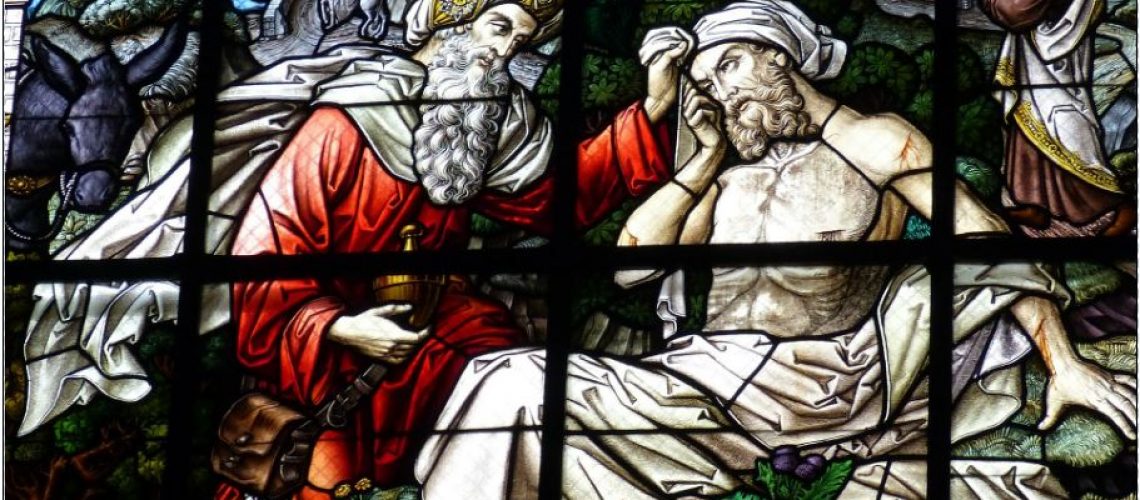
In his article, Mr. Escott continually draws upon the Gospel story of the Good Samaritan. It is a perfect example for us in this season, in large part because, unfortunately, we have grown so comfortable with hating the other that we often don’t even realize we’re doing it anymore. Mr. Escott writes that
The story of [the Good] Samaritan expands the definition of one’s neighbor to even hated enemies and shows that compassion … is the mark of a follower of Jesus. It is also a call to bind wounds and to actively heal the broken, which seems to be the state of so much of the nation at this difficult time.
In the post-election time, many Harris supporters state they will be avoiding “family and friends who voted for and support [Trump].” Some are taking to social media to vent bitterness and rage into the ether. Trump supporters are laughing at these outbursts, mocking and demeaning the people who share them.
Both of these responses are childish and unkind. Both of these responses can show us just how broken our nation is right now. Most of all these responses – outbursts and mockery – show us just how isolated we’ve become from the people who live alongside us.
In my day-to-day life, I’ve talked to people who are overjoyed at Trump’s win. I’ve talked to people who are heartbroken. But they’re all people who have close, physical communities. They can talk, cry, hug, and fight with people they see and interact with on a daily basis, and they are able to still see their Harris supporting coworker as a whole person, not just a joke on the Internet. I worry that, without a tangible community, many people are left to reach out for understanding on social media, where humanity is buried under algorithms and marketing schemes. Trapped in this isolating little world, it can become more and more difficult to see through the labels we put on ourselves. Like the Israelites of Christ’s time, who struggled to think of a Samaritan as Good, let alone as a neighbor deserving of love; we have to relearn to see in our community neighbors who voted for one or another of the flawed candidates on the ballot as good people, made in the image of God, deserving of our love.




6 thoughts on “Politics, Community, and Christ”
Pingback: VVEDNESDAY MID-DAY EDITION | BIG PULPIT
I appreciate your sincere attempt to equate racist misogynist hatred with someone who advocates for the bodily autonomy of citizens.
Pingback: FRIDAY MORNING EDITION | BIG PULPIT
These are admirable sentiments, but one cannot be even-handed about this.
It will be hard for Harris supporters to extend love to their friends and neighbors who believe that they are “vermin” who are “poisoning the blood of this country”, especially when Trump’s Gestapo (or whatever he will call it) breaks into the basemen of their house and drags away the desperate family of migrants escaping conditions in their “s***hole countries”. The Trump voters will be the ones who “inform” on them — though they’ll be surprised that their pets remain uneaten.
Totally unhinged, hysterical, blinkered comment by someone who is so invested in his ideology that he can’t assess reality to save his life. The author asks you to be charitable, and all you can do is spew venom. Get a grip.
I am quoting Trump. It is Trump who “spewed venom”.
Repeat: These are Trump’s words. Are they not venomous? If not, please explain why not.