

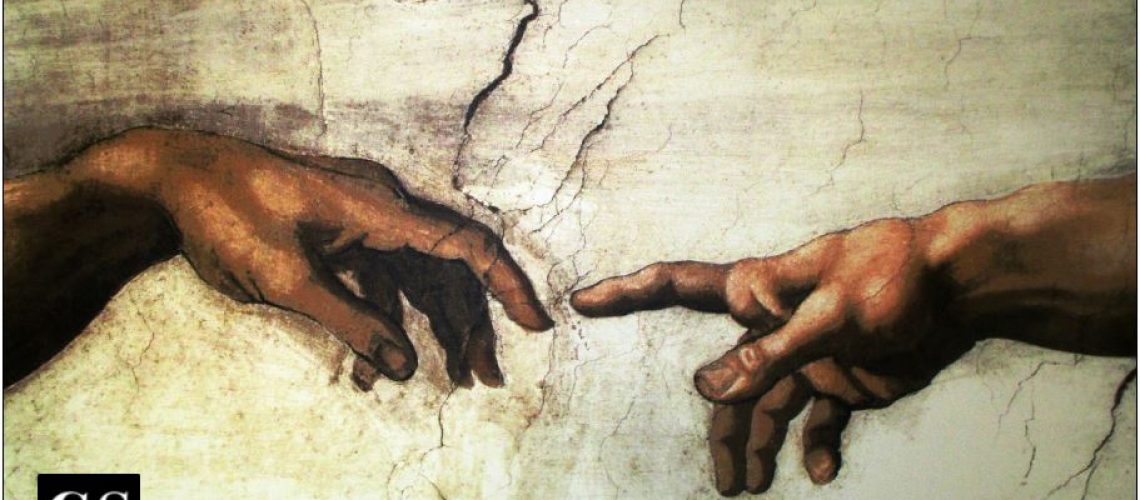
Original Sin is a complex doctrine which has variously been misunderstood as claiming that “babies are evil” or “women wrecked the world.” Creationists and Evolutionists have even fought about whether it requires a historical Adam and Eve.
To understand what the doctrine involves, it can be broken down into a series of claims:
- God created a first person (“Adam”)
- Adam sinfully rejected God
- Adam suffered personal consequences
- Adam’s sin damaged the world
- Adam’s sin damaged every other person
- Each person inherits Adam’s sin
- Adam’s sin is “propagated,” not imitated.
1. God Created a First Person (“Adam”)
The idea of Original Sin presupposes what the Catechism of the Catholic Church calls a “primeval event” (CCC 390). It is a historical moment when a first person sinned. As such, it implies that there must have been a first person.
Creationists read Genesis literally and envisage that Adam was directly created by God. To illustrate that he was never born, he is sometimes depicted artistically without a belly button.
But there is an alternative, evolutional model of creation. This proposes that animals were created to evolve and develop over time. At a point when a primate developed to a particular level of sophistication, God intervened to create a soul for that first primate (ensoulment). That first “human,” or first “person,” was Adam.
2. Adam Sinfully Rejected God
The doctrine of Original Sin assumes that Adam had a revelatory experience in which God offered a choice of eternal friendship (CCC 396).
Adam rejected the offer and he did so sinfully, with a disobedient “lack of trust” (CCC 397). His sin was “a fall” because humanity fell away from what it could have been.
Creationist and evolutional accounts argue about whether there was a literal fruit tree and a shifty snake (Genesis 3). The doctrinal point is simply that Adam rejected God’s gift and he did so in a sinful way. That meant that there were consequences.
3. Adam Suffered Personal Consequences
The consequences of Adam’s sin involved punishment for the sin and the loss of the benefits which would have accrued to a divine eternal friendship. These consequences are “subjective” (this section) and objective (next section).
Adam suffered a loss of internal mental harmony which caused him ignorance and the sufferings of frustration (CCC 418). Disorder between, and within, Adam’s thoughts and emotions also damaged his ability to form healthy relationships (CCC 400). This is apparent in the Genesis story as Adam tries to immediately blame Eve for his own sinful choice.
St. Thomas Aquinas (1225–74) explained the nature of Adam’s subjective disharmony as a turmoil of inner “concupiscent” desires (Summa Theologiae 1-2, Q.82, a.3). St. Paul illustrated what it meant with his anguished admission of how hard it is to resist temptation and live up to good intentions (Romans 7:15).
The scale of Adam’s damage is one of the historical points of disagreement between Christians. Some have argued for a heavy fall (total depravity) which destroys Adam’s will and reasoning. Others argued for a “softer fall” which leaves humans with the ability to use free will and reason theologically (e.g., Natural Theology).
Whether Adam lost the actual possession of inner subjective harmony (Creationism) or merely the opportunity for it (evolutional accounts) is another point of disagreement. However, either interpretation can be compatible with the core ideas of Original Sin.
4. Adam’s Sin Damaged the World
The doctrine of Original Sin claims that Adam’s sin had objective consequences, which introduced death into the world (CCC 400).
On the surface this seems to require a creationist reading of the Bible, otherwise there would be millennia of death in the world before Adam existed. However, there is an evolutional model which claims Adam’s choice caused death.
It suggests that when God offered an eternal friendship, it included the idea of miraculously perfecting the world into a deathless place (as an “eternal” friendship requires “immortality”). When Adam rejected the offer, he rejected the concomitant transformation of the world. If this were so, then it would mean that Adam’s actions are the cause of why everyone else experiences a world of death and decay.
Could the physical world have really been transformed (miraculously) into a deathless place? This idea is close to the Christian view of a heaven of resurrected (deathless) bodies. It means that heaven can be thought of as the deferred paradise which Adam rejected, and which is re-offered and accepted through Jesus’ salvific intervention.
5. Adam’s Sin Damaged Every Other Person
The doctrine of Original Sin states that every human shares the subjective and objective damage caused by Adam (CCC 416). This is because his actions created the contextual environment which everyone else is born into.
This is analogous to a head of state declaring a war. That declaration immediately affects every other citizen. If the war drags on, then it would affect future generations who would be born into that context.
One of the questions this raises is fairness. Would God act unfairly in allowing a single individual to make such a momentous decision, especially as it impacts so severely upon countless billions of others?
Traditionally, theologians have insisted that God acts fairly. This is because humans have no “right” to a divine friendship, or the subjective and objective benefits associated with it. If there are no rights and if everyone is treated equally (negatively), then there cannot be an issue of unfairness.
A slightly more nuanced approach considers Adam’s choice as analogous to the difficult decision which billionaire parents make over inheritance. Should they leave enormous wealth to children? Or would doing so undermine their heirs’ development of character through struggling? There is no single right answer to this question, and so billionaires typically take different approaches.
Perhaps God’s offer of eternal friendship and generous gifts raises similar questions. Yes, immediate immortality offers enormous benefits, but so too might deferring it until people have had a period of character building. If this is so, then it means that there might be no single “right” answer to whether God should have begun an immediate eternal friendship with Adam. If that were so, then picking a representative of humanity to make the decision would be a perfectly reasonable and fair way of proceeding.
Whether these types of responses are “right” answers to the problem of fairness is a further question. However, the fact that there are potential responses is important. It shows that the issue of fairness does not (necessarily) lead to a version of Original Sin which raises moral questions about God’s actions.
6. Each Person Inherits Adam’s Sin
The doctrine of Original Sin claims that Adam’s actions were sinful, and that people inherit the sin. This is why babies are explicitly baptized “for the remission of sins” (CCC 403).
The idea of inheriting sin is problematic. People can only be morally responsible for what they could have done differently. People cannot change events before they were born, so they cannot inherit sins associated with those events. This is why the Second Vatican Council (1965) declared that modern Jews cannot be blamed for the sin of murdering Jesus (see Nostra Aetate).
So, how can people inherit Original Sin?
The answer is that Original Sin is not really a sin in the normal sense of the word. It is a “sin” in an “analogical sense” (CCC 404). This is because “Original Sin” refers to a special type of human damage which can only (normally) be caused by sin.
When people sin, it destroys a relationship with God. This is because it destroys grace in the soul. People with Original Sin are born with a similar lack of grace. The lack is not because of an “actual” sin that they have committed. But, as it is like the lack which would be caused by sin, it is called “sin” in an analogous sense.
This means that it is a misunderstanding of Original Sin to describe babies (and the non-baptized) as “evil.” Babies have literally done nothing wrong. The doctrine of Original Sin merely means that they are born with a grace-sized hole in their soul.
One of the puzzling aspects of Original Sin is why this would be the case. Adam’s actions can explain the contextual damage of subjective and objective consequences. But why would it also cause God to create each soul and infuse it at the point of conception (Soul Creationism) with something missing?
Theologians have pondered the issues. It has been suggested that perhaps the human soul is analogous to a kitten born with its eyes closed. Humans are thus intentionally born spiritually “needy,” so that they cannot make Adam’s mistake of pridefully treating religion as a “do-it-yourself” affair.
On this way of looking at it, the lack of grace is important because it necessitates baptism, which must be administered by someone else. It thus makes the point that humans need each other, even when it comes to enabling something as deeply personal as a spiritual relationship with God.
7. Adam’s Sin Is “Propagated,” Not Imitated
The last core element of the doctrine of Original Sin is the idea that it is “propagated,” not imitated (CCC 404).
This is a technical formula to avoid the (Pelagian) misconception that people only have Original Sin because they imitate Adam’s bad example. If that were so, then new born babies would not have Original Sin because they are too young to imitate anyone else. Saying that Original Sin is propagated insists that it involves “real” damage, which is inside each human from conception.
However, the idea of “propagation” has also led to confusions, especially mistakenly associating Original Sin with sexual reproduction. This has even led to claims that the Virgin Birth was necessary for Jesus to be born sinless. The doctrine of the Immaculate Conception makes it clear that a human person (Mary) could be born without Original Sin, even if she is conceived in the normal way. So any linking of Original Sin to sex is a misunderstanding of the doctrine.
In 1950 Pope Pius XII argued that the idea of “propagation” means that the doctrine of Original Sin requires the scientific model of Monogenism. This is because he thought that humans must all be biologically “propagated” in a single genetic line (see Humani Generis, paragraph 37).
However, this biological model may need further nuance. For example, imagine that it is possible one day for people to “build” sperms and eggs in a laboratory and then gestate a resulting fetus without any link to, or “propagation” from, any other specific human.
Even if it is unethical to do this, would a resulting “propagation-less” baby be said to have no Original Sin? Or would the idea of “propagating” have to be extended to include any forms of human agency which produced a human baby?
Consider an even more extreme scenario. Suppose a robot one day has such advanced artificial intelligence (AI) that it achieved “personhood,” and then promptly asked to be baptized. Do only humans have Original Sin because Adam was a human? Or could Original Sin apply to non-human persons, because Adam was a person?
Issues about non-humans also raise questions about ensoulment. If God intervened in history to “create” a first ensouled human, could God intervene to ensoul a suitably sophisticated robot, thus leading to a genuine question about whether such a soul would have the Original Sin of lacking grace?
Hopefully, practical policies will never be needed to deal with abstract questions like these. However, thinking about them can help people to sharpen concepts and clarify the implications of ideas underpinning the doctrine of Original Sin.
Conclusion
The doctrine of Original Sin is complex and has been variously misunderstood in history. Understanding the doctrine is important for Christians because it has practical implications for baptism, as well as logical implications which impact upon other doctrines and theological opinions.




12 thoughts on “Original Sin: Clarifying Ideas and Avoiding Misconceptions”
Pingback: Is Marriage No Longer a "Remedy for Concupiscence"? - Catholic Stand
Thank you for putting this out there. I agree with your opinion and I hope more people would come to agree with this as well.
Pingback: The Three Nativities we Celebrate And Why + Genuflect
Pingback: Does the Common Good Require Integralism? - Rory Fox
Pingback: Original Sin: Clarifying Ideas and Avoiding Misconceptions - Rory Fox
Original sin is a loss; Adam could not pass on what he no longer possessed. The lack of original holiness and justice leaves us without the capacity to know God; thus, we are born dead and therefore need a savior.
Evolution is entirely compatible with this. The death described in genesis is not the cessation of material breathing, animal and plant death doesn’t subvert the path God used to bring us into being
Pingback: FRIDAY EDITION – Big Pulpit
I think you are interpreting “natural propagation” in Humani Generis 37, too narrowly.
Did you ever notice that humans cannot affect the material world by thought alone? The only way we can affect material things intentionally is by moving them around with our bodies, with or without tools. Ants and animals, act at this same material level as we. By pushing or pulling things, we juxtaposition material things to take advantage of their inherent natural capacities. This is true of building sand castles, growing corn, building electronic supercomputers, and engineering biology. Humans lack the power of intention to bring a new entity into material existence. By our power of intention, we can only move things around. The way to have avoided the demise of the Titanic was by rearranging things, the propulsion controls, not the deck chairs.
Sperm cells and egg cells, as all the cells of the mammalian body result from a process of biological differentiation of a one celled zygote, a grand example of the importance of relative location.
The engineering (juxtaposing) of human biological material may lead to a sperm and/or an egg, not attributable to one individual. Nevertheless, the result of fertilization using such manipulated human material would be a descendant of Adam. The essence of sexual propagation is fertilization (the combination of haploid germ cells), not copulation by two individuals. (Plants, e.g. do not copulate, but sexually reproduce.) Assuming such biological engineering resulting in germ cells is possible, it requires human biological material as the initial material to be moved around by human manipulation. The juxtaposition of the biological material may be due to human engineering. Nevertheless, the germ cells depend fundamentally upon the inherent nature of the biological material from which they form. Whether the relative juxtaposition of that material during the course of formation was or was not affected by human manipulation is superficial.
I think that Paul’s description of the law of sin in Romans 7:14 thru 8:2 is the best practical description of the effects of original sin in the lives of all human beings. He describes it as our human weakness in doing the things that we don’t want to do, and not doing the things that we should. I don’t know of anyone who is exempt from this. We even know that a baby is predisposed to this weakness, and will eventually become fully aware of it.
A fine job of threading this multi-eyed needle. Of course, it’s untoward to work a system with two diametrically opposite poles: evolution and creationism. The former is a sand castle and fragile by nature, though never-the-less a physical reality; the latter is a sand castle in-the-sky, an allegory of the highest order though never-the-less, not even quite on par with theoretical. Adam either was in real time or he wasn’t. Science wins hands down and I remember distinctly when the nuns told us that it was ok to believe. On point 3, when you say Adam suffered loss of mental harmony it was a textbook reference to the Hypothalamus and Amygdala which controls all our emotions whether we want them turned on or not. Point 4 is a anomaly since God offered Adam something he had no knowledge or experience with. Since you can’t prove a negative, Adam was at a great disadvantage. Point 5 is more nuanced – we don’t have rights but certainly expectations: you buy a puppy it expects food, shelter, ect. You make a friend you expect emotional reciprocity. Point 6 is more about Ghandi’s “grace size hole” which God filled than Christian baptism which is a means to instill. In either case something holy, metaphysical better fill that hole if the person is to find a higher power. Point 7 makes the case for changing Sin to Original Mortality since everyone born dies.
Original Sin is like:
https://en.wikipedia.org/wiki/Elastic_collision#/media/File:Translational_motion.gif
Rats. Link to .gif:
https://en.wikipedia.org/wiki/Elastic_collision