
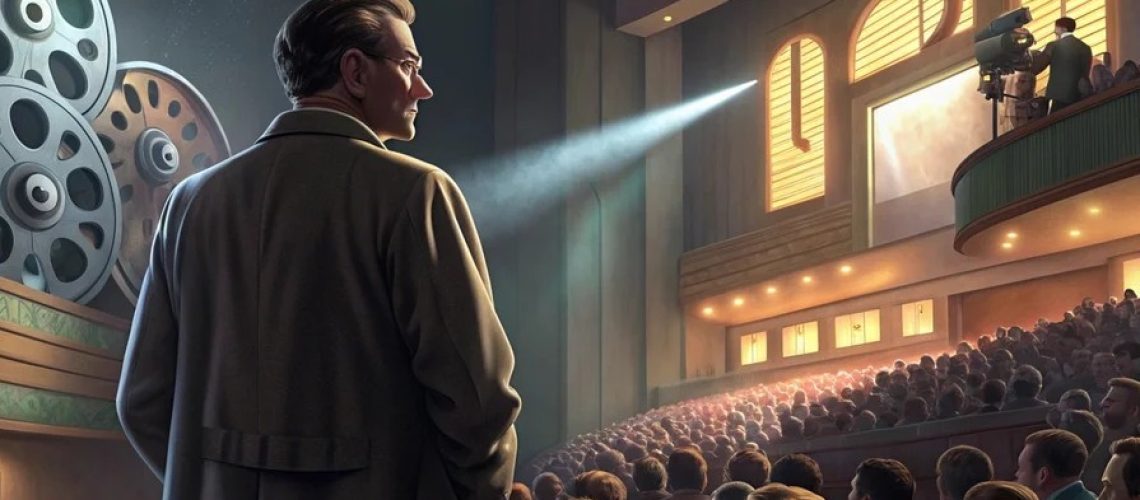
Here we go again. Another film was recently released,”One Battle After Another (2025)”, which implicitly mocks Catholic traditions.
Rather than being another complaint in the choir (Christians are, after all, supposed to turn the other cheek and transcend any affectual provocations), we could benefit from instead asking questions like “How can an atheist be just that, an atheist, without any concept of God?” Or: “Why does one need to insult or belittle Christian stories, in all negate them, in order to create?” Christ is the door, after all, not just to salvation and the fullness of live but to true creativity.
If one’s creative and artistic endeavor does not come from God, incentivized by elements such as love or artistic naïveté, then where does it come from? And what does it mean that a creative motivation and an artistic incentive draw its energy from the negation of God? And why? What is the need to actively going against God if there is no God, as per the now performative self-contradiction of the creative agent, the artist? Because ironically, it nonetheless seems to point towards God.
Alas, we are getting into theological territories, and this was an article meant to be about movies. But to really understand what is going on in Anderson’s One Battle After Another, we must ask, ” What kind of narrative structure does it have and what references does it make?” However, first we need to first revisit an old heretic story. Namely the one about Mary, Jesus and a Roman officer or soldier.
In short, in several Jewish exegetic works appears a counter tradition to the Catholic one, for instance in the Tosetfa, the Quhelet Rabbah and the Talmud, that claims that Jesus was not the son of a virgin Mary but instead of an adulterous one: that she cheated on Joseph with a roman officer or soldier, and that Christ was begotten though this adultery. That Mary was either seduced or raped and that the child, subsequently Jesus, went to Egypt, taught himself black magic and came back to Galilee as a false proclamation of the Son of God.
The main source of this claim, that of another father of Christ, is said to be that of Origen’s Contra Celsum, a refutation to a Celsum and his lost work Alēthēs logos. But the heretic story itself, that of Christ not being divinely conceived, was mainly perpetuated by the Jews, as Tertullian famously testified to around 200 AD. But what does this have to do with the aforementioned movie? Let’s get to the point.
To once again orient the reader: One Battle After Another is a film that came out earlier this year, made by the prolific director Paul Thomas Anderson. It tells the story of a far-left revolutionary group called “The French 75”, that perform subversive and terroristic acts against the government. The story itself is centered around three characters: Perfidia Beverly Hills played by Teyana Taylor (who also plays Mary Magdalene in the blasphemous The Book of Clarence, stoned for sleeping with a Roman soldier), Pat Calhoun played by Leonardo DiCaprio, and their daughter Charlene or “Willa” played by Chase Infiniti. The problem with the latter, as we come to find out as the movie progresses, is the fact that she’s not really the daughter of Pat, but instead the result of an affair between Perfidia and Steven J. Lockjaw, a soldier and officer in the US military, played by Sean Penn. The plot then encircles this intrigue, weaving it together with their antagonistic roles as outlaws and agents in a militaristic hegemony, not unlike the Jews and Romans of Jesus’ days. Which is not the only thing that bears a striking resemblance.
Let’s take a look at Perfidia. The picture that is painted is not particularly flattering: a thrill-seeking criminal, obtuse and unsophisticated, observed through an oversexualized and fetishizing gaze, and a mother that abandons her child before selling out her former friends to become an informer. What binds her congeniality to Mary, the virgin mother, is not only in the exact inversion of Mary’s righteous character but also in Perfidia’s identity and subject: she is a revolutionary, just as Mary is the ultimate embodiment of a revolutionary act, giving birth to Christ outside the usual order of things.
Perfidia, on the other hand, does not conceive through Annunciation, but through the adulterous encounter with the soldier, Lockjaw. Whether or not it is consensual or rape is unclear, but the result is the messianic figure and successor “Willa”, Charlene. So, here’s the irony, because even though the story follows the same structure as the heresy of Mary’s alleged adultery, it also inverts the image of the child: it is not Jesus that comes fourth, no, it is a baby girl. Almost as if the entire story has been inverted, following parallel to the historicity of Christ. The movie then goes on with the girl and her father, the heretic Joseph-variation, trying to escape authorities in the foreground of the unrevealed fatherhood of the girl, depicting the adoptive father as someone weak and broken, lost and unrighteous. Unlike the true Joseph, who instead was strong and steadfast, reliable and righteous.
The movie was well received. Not surprisingly, mainstream mockery seems to strike a subconscious tone with the audience these days. Last year, for instance, we saw how a half-naked blue and obese man, appearing in a context that can only be likened to the scene of the last supper, became the main symbol of the French Olympics.
A reference to Isaiah 53:5, how Christ was wounded for our sins and has “stripes” or chavar in Hebrew, also meaning blueness. Or why not the musical Jesus Christ Superstar, in which the Messiah is played by a woman, the same woman starring painted green in Wicked, were the green is symbolic of oxidizing copper or petrification, both pointing to Jesus, the copper serpent of Moses that died and rose from the dead.
In the prophetic conceptualization of Jesus’ resurrection by the ancient Egyptians, as seen in the famous depiction referred to as “The weighing of the heart”, he is seen sitting between Mary and Mary Magdalene, then as Osiris, green of color. Or why not the mainstream musician Lil Nas X, who in his music videos is seen dancing with the devil and being crucified with a crown of thorns. Or why not the latest rendition of the Mad Max-movies, Furiosa, where Jesus is presented as Dementus, a perverted and psychopathic outlaw. We could go on and on. Hardly anything original or new, neither the mockery nor general praise of its artistic pretense, and it seems like the movie One Battle After Another confesses to that same tradition.
Rest assured, this petītiō principiī or informal fallacy is as blatant as the identifying proposition of atheism: why would God or Jesus constitute one’s artistic content if the premise of one’s creative endeavor is His non-existence? Seems rather unnecessary, don’t you think, to blaspheme or synthesize one’s polemic identity against something that supposedly doesn’t exist?
Furthermore, Jesus was pretty clear: insults made against him aren’t really a problem, don’t worry, since their contents negatively affirms his presence anyway. It is instead insults against the Holy Spirit that aren’t forgiven. The Holy Spirit as the way in which Christ is begotten, as described in Luke 1:34, uttered by Mary herself: “How shall this be, seeing I have not known a man?”, prior to her creating in a divine manner. All of these mockery pieces – like the ones portraying a heretic alternative to the Incarnation – are made after “knowing a man”, Jesus. Ironically, why they are forgiven even if they are in fact blasphemous, due to the fact that He is always begotten in the ethos of the Holy Spirit, even though some movies imply otherwise. But to insult Mary and the birth of Christ might be something different altogether. If anything, it might lead to bad art.


“You mean the nuns that aren’t really nuns but criminals masquerading as nuns? ”
Growing weed is not a crime in most states now, so what are you on about?
And yes, the opening of your essay argued the movie “implicitly mocks Catholic traditions.” which you failed to show, and you have still failed to show. If anything, the movie celebrates Catholics, especially socially-justice minded ones (Sensei and the people he is protecting).
Your use of the word criminals, and I don’t know your politics, but by the look of it, is not good… implies that helping the oppressed is considered criminal work, and somehow mocking Catholic social teaching. If so, this would certainly exclude Harriet Tubman, and all the Christians who aided Jews in Hitler’s Germany.
But yes, TWBB is one of my favourite movies, so please link me to your article and I’ll check it out.
And finding beauty in all things is not “disturbed thinking,” it is literally how God works in the world and how for example, the ugliness of the Cross can be beautiful (for a better explanation of this, see Brian Zahnd’s eloquent “The Wood Between the Worlds.”
God bless
Well these aren’t just weed-growing people masquerading as nuns… they are a communist subversive terror organization… so, please.
Yes, it mocks Catholic tradition because it is a riff on an old Jewish story on herecy and adultery, that claims that Mary had an affair with a Roman officer.
And you are way too quick to reference Hitler and Tubman, come on… And I am not some pacifist; on the contrary, and that is why I point out and defend the story of Christ and Mary.
There Will Be Blood is basically about the dichotomy between people who believe we need to work hard, practically, to transcend and produce a sort of detached and transcendent place (Plainview) and on the other side the religious practitioner (Eli) that believs it is enough with faith, theatre and performance (which can be mimicked and imitated).
It ends with Plainview killing Eli with a bowling pin, symbolic of the crown of Osiris (which is the Egyptian way of telling the story of Christ, as he descends into hell and rises as king). Because the roots of Catholicism might be Hellenic, but the deep roots are Egyptian.
Anyway, relax dude. And the essay I wrote about it is in Swedish so I doubt it will help you very much.
This is probably the worst review over ever read in the history of reading film reviews, and failed to show how, in even the slightest of ways, One Battle After Another was “anti-Christian.” You literally didn’t show anything about the movie that was a negative depiction of Christianity. In fact, the only explicit Christians depicted in the movie, the nuns, are portrayed positively as aiding the man character. Get over your persecution complex and see beauty in all things.
Signed, a Christian and avid PTA fan
You mean the nuns that aren’t really nuns but criminals masquerading as nuns? I’m actually quite baffled by the ignorance in that comment…
I think your fandom makes you blind, a blind follower perhaps, but it wasn’t an anti-Christian message that was the point; it was the fact that it follows the same structure as an old Jewish heretic storyline. I am a big admirer of Anderson as well, and I’ve written essays on the concept of performative self-contradiction and the correlation to the baptism of the unholy well, alongside Mary and the boy symbolic of Jesus (H.W. or Hâwwe), in There Will Be Blood, and the fact that the main character (Plainview) is a completely inverted Messianic figure. Which binds together with the fact that he is from du Lac and the Lac bloodline are related to Mary Magdalene, via France.
But to be frank, I think the article you commented on is just way too far above your head and when you judge me as having a persecution complex, you are actually persecuting me. And if you see beauty in all things, then you are either disturbed or have a very plain and narrow view of things.
Signed, not a fan of you
The answer to your question “Why does one need to insult or belittle Christian stories, in all negate them, in order to create?” is simple; one does not. Viewing everything through a Christologic lens is natural for a Christian but also leads to confusion when viewing the actions of non-Christians. The art of atheists is properly understood only by viewing it from an atheistic perspective. Outrage that this movie somehow is intended to insult the Virgin Birth is a level of self-reference that only leads to pointless offense. You might be too young to remember when an artist intentionally used Christian iconography to insult Christians, but google Andres Serrano. In general, a fat blue man at the Olympics is just that and nothing more.
“Viewing everything through a Christologic lens is natural for a Christian but also leads to confusion when viewing the actions of non-Christians.”, you say and nonetheless refer to them as “non-christian.” Quite a contradiction on your part, or “lense”, wouldn’t you say?
And you are also talking about a fat blue man, half naked, that appears in the most viewed ceremony in the world in the context of the last supper… and yet you make it seem far fetched.
There are many artists that explicitly insult Christ, yes, but 1. What’s the point of pointing that out? It is alreqdy there. And 2. All such insults and blasphemous acts are forgiven, according to the Bible, unlike the ones directed towards the Holy Spirit. The latter which we find explained in the birth of Christ. Hence why the article points it out.
I agree that we shouldn’t paint the devil where he isn’t, but if you refuse to see these things, it’s better for you to take a seat and quiet yourself.
[…] Fire For Getting Way Too Political – Anthony Stine, Ph.D.Among The Cajun Magyars – Rod DreherOne Insult After Another: The Heresy in “One Battle After Another” – Catholic Stand MagazineLeo Continues To Correct The Wrongful Manipulations Of Francis – Fr. […]
[…] Ph.D.Leo Continues To Correct The Wrongful Manipulations Of Francis – Fr. Allan J. McDonaldOne Insult After Another: The Heresy in “One Battle After Another” – Catholic Stand MagazineWhy I Always Have & Always Will Call Myself “Catholic” […]
Gee, the answer to your spurious questions is simple. They are all jealous of something we
have – and they do not. Atheism is the sincerest form of Pride.