
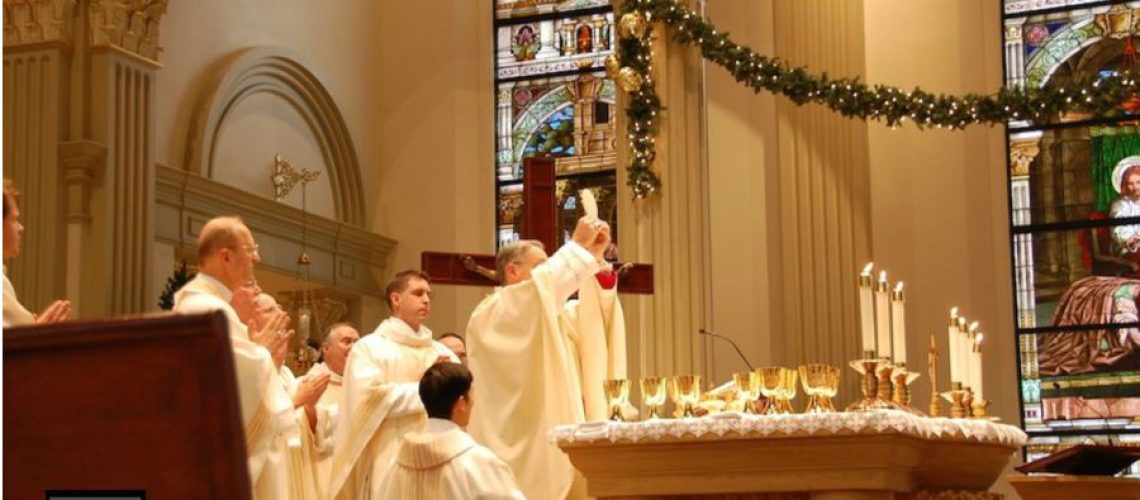
How should we view Mass suspensions in light of the moral order and obedience? The virtue of obedience seems especially relevant now as we finish the Triduum without Mass and head into another week of quarantine. Thinking that the prohibition is irrational and that it is based on exaggerated fears tempted me more than ever as I watched the online version of the Tridium take place in empty Churches.
Padre Pio
A friend recently brought up Padre Pio as someone we might consider during this time of strict social distancing orders that sometimes seem overboard. Padre Pio followed the orders of his superiors even when they appeared foolish and ill-intentioned. To Padre Pio following these orders meant doing God’s will because as he expressed it, “The will of the authorities is the will of God.” Of course, Padre Pio said this with full knowledge that he was in the right and very likely aware that his detractors had turned the pope against him. However, rather than defend himself, his attitude towards his superiors showed his meekness. According to Renzo Allgri’s biography Man of Hope, Padre Pio told an acquaintance “If my superiors ordered me to jump out of the window, I wouldn’t argue. I would jump” (102). Padre Pio’s obedience seems overboard until compared to Christ’s death on a cross. Saint Paul says in Philippians that “[Christ] humbled Himself and became obedient unto death—even the death of the cross” (Philippians 2:8). Padre Pio, like Christ, saw obedience as the road to glory.
Padre Pio’s example of obedience can seem almost dangerous. After being forbidden to have a public ministry and being told that he could only offer a private Mass, Padre Pio remained uncomplaining, suffering not only the skepticism and doubt of the Church but also the real pain of his stigmata. His obedience brought him to the point of copying a statement saying that reports that he was “being constrained or persecuted by Church authorities” were false (Allegri, 233) when they clearly were demonstrably true. Yet his trust in God was childlike. In the end, the pope realized his mistake and was deeply sorry. All things worked out for the saint. His obedience won him glory.
Of course, we have not made vows of obedience. Nonetheless, we find ourselves in a situation where obedience to Church and state is required. It is a time that may raise questions about our duty as Catholic citizens.
Obedience to the Church Always Comes First
In answering the question of obedience, the Catechism turns to the Fourth Commandment which deals with obedience to parents. The state represents a family on a grander scale, and, as far as this analogy holds, the Catechism recommends obedience to the state. However, when the state breaks with the teachings of the Church, “Citizens are obliged in conscience not to follow the directives of civil authorities when they are contrary to the demands of the moral order. ‘We must obey God rather than men’(Acts 5:29)” (CCC 2256). These words recall Christ’s injunction to “Render therefore unto Caesar the things which are Caesar’s, and unto God, the things that are God’s” (Matthew 22:21). Christ also sees a clear distinction between Church and State and recommends living in both these worlds at once. There can and should be a union between the moral order and the order of the state, but, in our fallen world, this may prove less than perfect. Christ’s statement raises an important point; a Christian may act morally even when paying taxes to a corrupt and brutal state. These questions demand more expertise than I have.
According to Catholicculture.org, the moral order itself means two things to the state and the church. To the Catholic Church it means “The proper direction of human actions to a person’s ultimate end, namely the eternal destiny. On a universal scale, the relationship of all human actions, under divine Providence, toward the final purpose that God has for the human race.” Whereas to state and even Church law it means “the legally established body of rights and duties among human beings either in general or in a given society.” These two concepts of the moral order, the legal and the supernatural, can work together harmoniously, and the legal should even take its directives from the supernatural end of humans.
Our Present Situation
Arguably, the Church views the present crisis in terms of these two concepts, the moral order of the state and of the Church, coming together. However, the authorities like those of Christ’s day do and say things that show ignorance and imperfection. Mayor Bill DeBlasio overstepping his authority and expressing hostility to the church, threatened to “take additional action up to the point of fines and potentially closing the building permanently” in reference places of worship not in compliance with the quarantine. DeBlasio, a democrat, might enjoy permenantly closing a dissenting Church for other reasons such as abortion. While these secular leaders often show disregard for human life and hostility to the Church, the Bishops believe obeying the quarantine protects and saves lives even when it precludes other moral goods such as Mass.
Mirroring this opinion, my local bishop explained the suspension of Mass as necessary for the protection of the vulnerable.
The Mass is our central act of worship, the source and summit of our Catholic faith, and it goes without saying that this difficult decision was not made lightly. It was done after prayerful consideration of the critical health threat that now confronts us. The gravity of it demands that we take whatever action is needed, despite the hardship, to protect the good of all, especially those who are most vulnerable at this time.
The response of this bishop aligns completely with the statements of governors, mayors, and, doubtless, bishops across the country who argue that closing down the country is the moral choice. This point of view may hold water, but, as the quarantine goes on and we face the prospect of an expansion, I think we need to ask tough questions as we interpret the Catechism’s injunction to follow the moral order. The “prayerful consideration” mentioned in the statement should lead us to consider placing every possibility on the table.
Saints Who Went Without the Eucharist
We should never forget that receiving the Sacraments is a privilege of which many saints and sinners couldn’t always depend. As we head into the end of Tridium banned from Mass, I’m reminded of the saints who went days, months, or even years without receiving the eucharist. Out of the many examples, Saint Issac Jogues may be better known. After having his hands deformed by a tribe of hostile, North American Mohawks, Saint Issac Jogues was barred from celebrating Mass because of a rule in the Church at the time. Eventually, he received a dispensation and, heroically, asked permission to return to America. He’s a great model for us now of the courage we should have when faced with apparent setbacks to our faith and our mission. We might also look for inspiration to Bl. Victoire Rasoamanarivo of Madagascar who went three years without Mass after Catholic priests were expelled from her country. During these years, she gathered believers together for communal prayer every Sunday, writing, beautifully, “I place before my mind the missionaries saying the Mass, and mentally attend all the Masses being said throughout the world.” Her devotion to the Mass can inspire us to renew our own devotion as, perhaps, we make a spiritual act of communion. There are many other examples of such saints in the Aleteia article “Saints Who Have Had to Live Without the Eucharist.” Whatever happens, Catholics can take these examples to heart and know that obedience will bring us glory.


[…] His championing of progressive causes including the rights of refugees, tolerance toward LGBTQ+ communities, increased roles for women, compassion toward the marginalized, and the need for better stewardship of the environment has earned praise from supporters but the deep ire of critics with a belief in a strict moral order and obedience to tradition. […]
[…] His championing of progressive causes including the rights of refugees, tolerance toward LGBTQ+ communities, increased roles for women, compassion toward the marginalized, and the need for better stewardship of the environment has earned praise from supporters but the deep ire of critics with a belief in a strict moral order and obedience to tradition. […]
Now that we know the pandemic is a hoax. We now need to atone for the sin of missing public Masses, giving our pinch of incense to Ceaser by complying with the Demonic restrictions such as wearing the filthy masks, and helping the Democrats steal the election. We all need to atone for these sins. We need to do this before we can receive Our Lord in the Blessed sacrament.
I respect your right to your opinion .
But, well, it’s baloney.
Padre Pio lived in a different time, in a different institutional iteration of the Church and had a particular mindset. What would he have done with a bishop who knowingly covered up sexual abuse and the Saint was brought into investigate or a Superior who gave an immoral command? Would he have just gone along with the cover up? Would he have obeyed and immoral command out of blind obedience? I hope not. No one is bound morally to hide the crimes of others or obey an immoral order; this is the faith of the Church.
The faithful have the “right” yes, the right (Canon 213) to worthily received the Sacraments. The Church teaches this and says that if someone approaches a priest for the Holy Eucharist he is to give them the Sacrament.
A good number of bishops found ways to allow their priests to give Holy Communion to the faithful.
Finally, yes, Saints and many “regular” people did without the Holy Eucharist; in times of persecution
or when no priests were available or a place was under interdict. We are not without priests, we are not suffering overt persecution, we are not under interdict. Most priests are ready and able to feed their flocks with the food of the Holy Eucharist.
Some call what has happened a “Eucharistic Fast.” No. Fast are not imposed; the Roman Church does not even “impose” under pain of sin fasting on the two days (a joke) required in Lent. Fasting is chosen not imposed, it is done out of faith and love for God. It is something that is done to be filled with God even as we fast from earthly food, not heavenly food which fills us with the life of God.The
Suspending public Masses is one thing, denying Holy Communion (with precautions) is a totally different thing.
Hi Father Khouri,
Thanks for reading the piece and for your helpful comments.
I almost feel like you think I’ve made a point that I haven’t. I suppose I was trying to look at the present situation from a variety of perspectives without really having a thesis. That may strike some as non-committal or frustrating.
I agree with you about our right to the sacraments and the importance of following our conscience. If it sounded like I was suggesting that Padre Pio was going against his conscience, that wasn’t my intention. I do think there’s a difference between matters that go against the teaching of the Church and more gray areas.
It sounds like you are passionate about bringing the sacraments to your parishioners and I think that’s great. Of course, asking a priest for the Eucharist is always there for those who can do that.
Thank you,
Paul
There seems to be too many opinions “out there” complaining about the suspension of the Mass in many dioceses. Thank goodness so many people want to receive the sacraments, but I sometimes wonder if their desire can be a form of vanity (“what about me?!”).
We are all aware of the shortage of priests in the USA and in European countries. By demanding Mass, I feel it’s not just us who may be placed in danger, but also our priests. Many of our limited number of priests are older; must we sacrifice them when there are graces that can be obtained without the sacraments (not the same graces, but how do we know the impact of any grace we receive)?
Fr Dwight Longenecker had a good piece that explained that while he may be capable of offering the sacraments outdoors at his parish, another older priest in the same diocese may not be able to function to that capacity. He said the bishops want there to be equality for all individuals of their diocese; basically, if one parish has outdoor sacraments, then all parishes must do it, or none at all. If my priest can do it, then so must the older priest who has a hard time walking. How difficult will it be for that older priest to approach every vehicle in which parishioners await the Eucharist? At my parish, every vehicle could drive up to our pastor and depart back to its parking space easily, but not all parishes have such efficient parking lots. https://dwightlongenecker.com/one-priest-speaks-from-the-heart-just-stay-home/
Hi Sarah,
Thanks for your comments. I think we both agree that this is a very difficult situation. Thank you very much for sharing Fr. Dwight Longenecker’s piece with me. I think he makes a lot of good points about solidarity with other parishes and the risk that elderly priests have. I also agree that many priests have done an amazing job of “re-imagining” their ministries through technology.
However, I wouldn’t use the word “clandestine” to describe unpublicized, private Masses. I don’t think the priests that I know who do this view their actions as covert. One priest even told the chief of police about his private Masses.
While I agree about the importance of solidarity, I would like to ask you what you think about personal choice in this matter. Do you think that solidarity means that we all regardless of legitimate differences in our situations need to make the same decisions?
I also fear a world in which a secular culture deems that Mass is non-essential. After all, the First Amendment guarantees freedom of religion and prohibits the government from meddling.
Finally, I fear a world that values the Eucharist even less than it does now. Fr. Longenecker says “Yes, it is at Mass that he is most especially with us, but he is not absent when we cannot receive the Eucharist. He is still with us. ” I agree. However, couldn’t this point of view if taken too far diminish the importance we attach to the reception of Communion in the Mass?
I don’t recommend one particular course of action right now. I wasn’t aware of the proposal to have outdoor Masses and I’m not sure it would work. I think the situation is genuinely difficult for all the reasons you and Fr. Longenecker stated. To me, life is always a matter of risk management, and I think in this crisis some people have forgotten this.
Thanks again,
Paul