
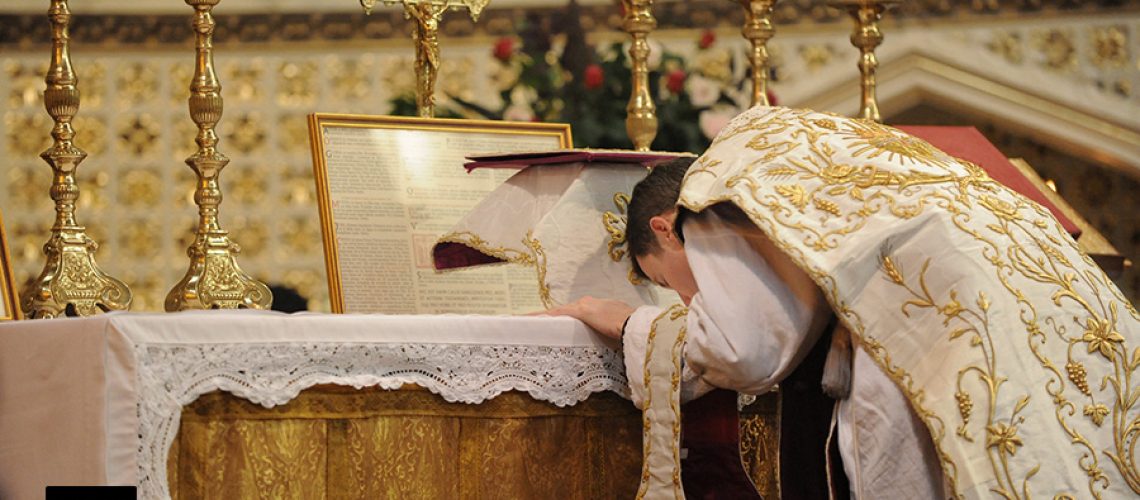
Looking at the priest has no importance. What matters is looking together at the Lord. It is not now a question of dialogue, but of common worship, of setting off towards the One who is to come. What corresponds with the reality of what is happening is not the closed circle, but the common movement forward expressed in a common direction for prayer. (Joseph Cardinal Ratzinger [Pope Benedict XVI], The Spirit of the Liturgy, 81)
During Mass, we very rarely see our priest’s face. Of course, we see his back, but that is how it should be when you are being led. The only time we see his face are those times when he turns back to beckon us to join him in prayer.
V: Dominus vobiscum.
R: Et cum spiritu tuo.
V: Oremus.
Let us pray! Come on! During those brief face-to-face encounters, he encourages us to go farther, climb higher, and dig deeper to give more of ourselves in this holy sacrifice. And we, accordingly, have his back, following, supporting, and bolstering him as he leads us to Christ. We pray together toward the Tabernacle, Christ’s home on the altar, facing east in our journey toward Jerusalem, our spiritual home on earth.
People face East
The writings of the earliest Church Fathers overwhelmingly indicate that Mass was celebrated by all facing east toward Jerusalem.
From the earliest days of Church, Christians faced east when at prayer. In fact, Tertullian (160-220 AD) actually had to defend Christians against the pagans who accused them of facing east to worship the sun. Many Church Fathers, such as St. Clement of Alexandria, St. Basil and St. Augustine, also speak of the practice of facing east. (ibid.)
Even before the earliest Christians were able to build churches, they celebrated Mass by all facing east together.
Before Christianity was legal in the Roman Empire, Christians worshipped in their homes. One of the oldest known house churches has been discovered on the far eastern edge of the Roman Empire, in present day Syria, at Dura-Europos. This house church dates from 233 A.D. Archaeologists have uncovered an assembly room in the house where as many as 60 people would gather for prayer. The room was designed with an altar against the east wall. In this way, the priest and all the faithful would together be facing east when celebrating the Eucharist. (ibid.)
Saints throughout the centuries wrote of the importance of facing east during Mass.
Writing in the 7th century, St. John of Damascus gives three explanations for the eastward stance of Christians at prayer. First, Christ is “the Sun of Righteousness” (Malachi 4:2) and “the Dayspring from on high” (Luke 1:78). Facing the light dawning from the east, Christians affirm their faith in Christ as the Light of the world. Second, God planted the Garden of Eden in the east (cf. Genesis 2:8). But, when our first parents sinned, they were exiled from the garden and moved westward. Facing east, therefore, reminds Christians of their need to long for and strive for the paradise that God intended for them. And, third, when speaking of his Second Coming at the end of history, Jesus said, “For just as lightning comes from the east and is seen as far as the west, so will the coming of the Son of Man be” (Matthew 24:27). Thus, facing the east at prayer visibly expresses the hope for the coming of Jesus. (ibid.)
The Mass is not intended merely to entertain or be a meal
Some have claimed that having the priest face the people better represents the communal meal shared by the apostles at the Last Supper. Others have stated that the priest can communicate better when facing the congregation. Yet this is not the underlying purpose of the Mass.
The congregation at Mass is not an audience that needs to be won over or entertained by an interesting performance by the priest celebrant, who has to keep himself front and center and not let parishioners out of his sight. No, the nature of divine worship demands that we not let anything interfere with the union between God and his people. In turning towards the Lord with the congregation, the priest celebrant embodies the role of a guide on the pilgrim journey towards the Lord, towards Heaven. He ceases to be tempted to act as the center of a performance for a captive audience. (ibid.)
As Cardinal Sarah so eloquently explained:
To convert is to turn towards God. I am profoundly convinced that our bodies must participate in this conversion. The best way is certainly to celebrate – priest and faithful – turned together in the same direction: toward the Lord who comes. It isn’t, as one hears sometimes, to celebrate with the back turned toward the faithful or facing them. That isn’t the problem. It’s to turn together toward the apse, which symbolizes the East, where the cross of the risen Lord is enthroned.
Finally, this posture through the Mass clearly delineates when the priest is acting in persona Christi and providing his interpretations of the Scriptures during the Liturgy of the Word. It is highly symbolic that he removes his maniple—a mini-stole, as it were, worn over his left arm—before stepping away from the altar to the side where he will offer his homily. He is, in essence, pausing his duties as the person of Christ to share his inspired thoughts with us.
By facing east together, as pilgrims seeking the purifying body and blood of the Lamb, we better embody the historical and theological purpose of the Mass. We also take the focus off of the priest as some ringleader or maître d’.
After all, the Mass is not about him. It is about Him.


[…] Strange Things Church People Say – Msgr. Charles Pope/Community in Mission Love Letters to the Latin Mass: The Priest Leads Us to Him – Cynthia Millen at Catholic Stand Exorcist Diary: Angelic Powers in an Exorcism – […]
Dear Cynthia ,
It was fascinating to learn about the direction of prayer during Mass.
As the first Christians were Jewish It was only natural that they were influenced by Jewish customs .
The Holy Ark , containing the scrolls of the Torah ,in every synagogue is located so that when one faces it ,one is facing in the direction of the Land of Israel. In Israel worshipers face towards Jerusalem and in Jerusalem they face towards the Temple Mount. If one does not know in which direction to face ,then , says the Talmud : ‘” let
him direct his heart to his Father in heaven “
Genesis 3:23-24
The Lord God therefore banished him from the garden of Eden, to till the ground from which he had been taken. He expelled the man, stationing the cherubim and the fiery revolving sword east of the garden of Eden, to guard the way to the tree of life.
The Temple of Jerusalem (along with the Archbasilica St. Peter’s and the Mother Church of the Catholic Faith: The Archbasilica of Saint John Lateran) all FACE East to symbolize our journey toward the tree of life. In other words, we enter each from the East – journeying in a Westward direction. During Mass we would obviously face West to “symbolize” (as Cardinal Sarah mentioned) this best.
Furthermore Ezekiel (8:16) mentions, “There at the door of the Lord’s temple, between the porch and the altar, were about twenty-five men with their backs to the Lord’s temple and their faces toward the east; they were bowing eastward to the sun.” Yeah, that was not a good thing.
Ezekiel goes on to describe the New Israel and the New Temple in Chapter 40, and guess what? Yeah, it faces East.
Ezekiel 47
“I saw water flowing out from under the threshold of the temple toward the east, for the front of the temple faced east. The water flowed out toward the right side of the temple to the south of the altar.”
John 19:33-34
But when they came to Jesus and saw that he was already dead, they did not break his legs, but one soldier thrust his lance into his side, and immediately blood and water flowed out.
Fact: Jesus’ lance wound is to his right side rib (see Shroud of Turin).
Perhaps your TLM has a crucifix with the wound on the left side?
Perhaps the pilgrim church on earth should journey toward the tree of life, not away?
Or perhaps we can all agree on this:
Ezekiel 46:9 (my translation)
When the people of the land come before the Lord to bow down on the festivals, if they enter by the north gate they shall leave by the south gate, and if they enter by the south gate they shall leave by the north gate. They shall never go back from whence they came.
Do you mean face east, as in “east”, or do you mean face east, as in facing Jerusalem? If the latter, your point is meaningful only for those in the West. It does not seem to dawn on you that there are Catholics in Asia, where they would be facing west, or Africa, where they would be facing north.
At any rate, most churches are not built so that people face east, or face toward Jerusalem. In my home church, built in 1922, the people faced north. At St. Peter’s, the people face west.
Jesus faced the apostles and spoke to them in their native language. In your view, the priest obviously does not take the place of Jesus. He faces away from them, and speaks in Latin. But the whole rationale for a male priesthood, set forth in Inter Insigniores, is that the priest takes the place of Jesus. If that is not the case . . .
“Facing east” means the direction of the rising sun, as that is the direction from which Christ will return. For churches that cannot have the altar facing east, we have what is known as “liturgical east” to symbolize this orientation.
As an aside, in the TLM you also have “liturgical north”, which is the direction the priest/deacon faces when chanting the Gospel. This is most notably seen during a Solemn High Mass, but is also seen when the priest moves to the left side of the altar during a Low Mass. North represents the darkness of man, and the Gospel is read facing this direction to symbolize bringing the light of the Gospel to those who are not yet evangelized.