
I was sitting alone on a darkened theatrical stage. On the other side of the curtain, an audience was gathering for the final performance of a play I had written called Beyond Mercy. Behind me stood the central image of the play: a door, illuminated from behind, its light spilling quietly into the darkness. I had been sitting there for a while. I was exhausted.
Not nervous, exactly. I had already performed the role twice, and both performances had taken more out of me than I expected. There were moments in the final act when I wasn’t entirely sure where the character ended and I began. Each night I had somehow found my way into the grief the scene demanded but this was the last night. And I didn’t know if I had another one in me. So, I sat there in the darkness, looking at the light coming through that door. And somewhere in that silence, I had the unmistakable sense of God saying:
One more time. This time, leave it here. Leave your grief here. Leave it on this stage. Let it live here now. And walk away ready for the second half of your life.
I don’t often claim that God “told me” something. I have lived long enough with my own psychology to know how easily we can baptize our thoughts and call them divine revelation. But every once in a while there comes an interior word that seems to arrive from somewhere deeper than our own mental noise.
This was one of those moments and sitting there, I began to understand that perhaps this play had been doing something to me that I had not intended when I wrote it. I thought I had written a play about mercy. Perhaps God had been using it to teach me how to receive it.
The Things We Carry
Beyond Mercy began as a story about four men trapped in a mysterious room. There is a door. They know, somehow, that they are supposed to go through it. But none of them can. Each carries something that prevents him from approaching it: shame, anger, fear, regret, grief. They argue. They hide. They tell stories. They hurt each other. Gradually, it becomes clear that the door isn’t locked. They are.
One of those men is called the Weary One. I wrote the role for someone else. Then, less than three weeks before production week, the actor playing him stepped away from the production. Suddenly I was going to have to play him myself. There is something almost comical about that now.
I had written a character whose entire struggle was that he could no longer carry what life had asked him to carry. Then I found myself playing him during one of the most exhausting periods of my own life. The weeks leading up to the performances were extraordinarily difficult. I was directing, producing, acting, memorizing, solving technical problems and trying to hold together a production that sometimes seemed determined to come apart.
Things broke. Plans failed. People disappointed me. I disappointed myself. I lost sleep. I became angry. I became impatient. There were days when I wondered why I had ever attempted the thing in the first place. And God did not make any of that disappear. That matters because Christians can sometimes speak about God’s presence as though His presence should make suffering less chaotic. We say, “God was with me,” and then tell the story of how everything miraculously worked out. Sometimes it does.
Sometimes God is with us and the equipment still breaks. God is with us and people still disappoint us. God is with us and we are still exhausted. God is with us and we still have to walk onto the stage. The miracle is not always that God removes the burden. Sometimes the miracle is that when we are certain there is nothing left to give, somehow there is still enough for the next act.
When Grief Becomes an Identity
There was another reason playing the Weary One became unexpectedly personal. He is a man who has experienced profound loss. His great temptation is not merely sadness. His temptation is to believe that surrendering his grief would somehow betray what he has lost. I think many of us do this. There are wounds we carry for so long that eventually we stop knowing who we would be without them. Sometimes suffering even becomes intertwined with love.
If I stop grieving, did it really matter? If I forgive, am I saying what happened was acceptable? If I become happy again, am I betraying the person I lost? If this wound finally heals, what happens to the person I was when I received it? So, we keep bleeding. Not always consciously. Sometimes we simply grow accustomed to the wound.
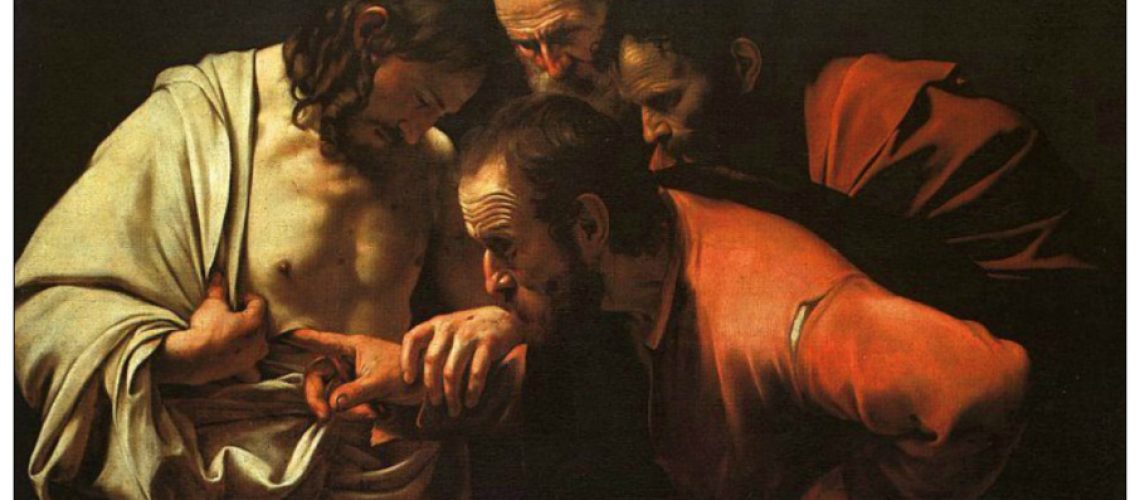
Christianity offers a strange answer to this problem because at the center of our faith stands a resurrected man who still bears His wounds. After the Resurrection, Christ’s wounds are not erased. Thomas can touch them. They remain part of Him but they are different now. They are no longer killing Him. Perhaps that distinction matters more than we realize.
Healing does not require forgetting. Forgiveness does not mean pretending something didn’t happen. Moving forward does not require declaring the past unimportant. The resurrected Christ remembers Calvary. He simply does not remain crucified. And perhaps some of us need permission to do the same. We are allowed to come down from our crosses.
One More Time
By the final performance, I was empty. That isn’t entirely metaphorical. The role required me to enter places emotionally that I normally keep safely contained. Night after night, I had to approach grief and anger and helplessness and speak words that felt less like lines I had written and more like the questions I had spent much of my life asking. By Saturday night, I wasn’t sure I could manufacture that emotion again. Which, I think now, was precisely the point because I had been trying to manufacture a great deal. A production. A performance. A vision. An experience for the audience.
I wanted the play to matter, to be beautiful. I wanted everyone involved to give everything they had. And beneath all of that was perhaps the quiet arrogance common to people who care deeply about their work: I thought I had to make it happen. Then I reached the end of myself and God was still there.
That night, sitting before the glowing door, I understood something about the strange Christian logic of self-emptying. St. Paul tells us that Christ “emptied himself, taking the form of a servant.” The Greek word is kenosis. Christian self-emptying is not self-destruction. God does not delight in burnout, and exhaustion should never become a measure of holiness but there are moments when we reach the limits of what we can accomplish by force of will. The illusion of self-sufficiency breaks. Our hands finally open because we no longer have the strength to keep them clenched. And sometimes we discover that emptiness is not the same thing as abandonment.
Sometimes emptiness creates room. I had emptied myself into this play. And there, in the darkness, I discovered that God had not emptied me. He had filled the space. There was enough.
One more time.
Leaving It There
The curtain eventually opened. I performed the role one last time. When the final act came, I tried not to perform my grief. I simply gave it away. Some of it belonged to the character. Some belonged to me. Some probably belonged to people I have loved and lost, to things I wish had happened differently, to failures I still carry, to prayers that seemed unanswered, and to versions of myself I have spent years trying either to understand or escape. I don’t know that grief ever disappears completely. I’m not sure it should.
Perhaps grief can change. Perhaps it can stop being something we carry and become somewhere we have been. There is a difference. One determines the weight of every step we take. The other becomes part of the landscape behind us.
We can look back, remember. We can even return occasionally but we don’t have to live there anymore.
After the final performance, people applauded. We took photographs. We hugged. Eventually the audience left. And then, as happens with every theatrical production, the world we had created began disappearing. Props were packed. Costumes came off. Lights went dark.
The stage that had seemed like an entire universe became a stage again. There is something almost liturgical about theater in that way. We build something temporary. We enter it together. Something happens there. Then it ends. The sacred space is dismantled and we return to ordinary life, hopefully changed by what occurred within it.
A day eventually comes when the set is gone. The door is gone. The room exists only in photographs and memory but I think something of me remains there too. And strangely, I am grateful for that. Because perhaps there are things we are not meant to carry forever. Perhaps honoring our suffering does not mean preserving it indefinitely.
Perhaps resurrection means allowing God to take even the worst things that have happened to us and transform them from open wounds into scars, still part of us, still visible, but no longer bleeding. I don’t know exactly what the second half of my life will contain. I suspect there will be other griefs. Other disappointments. Other rooms in which I discover doors I am afraid to open but I also know something now that I did not know when I began this production.
God was there when things went beautifully. He was there when everything seemed to be falling apart, in the applause, in my frustration. He was there when I was strong. And He was still there when I had absolutely nothing left. I thought I had built a stage on which to tell a story about mercy. I didn’t realize until the curtain closed that God had built one for me.
Perhaps that is what mercy sometimes looks like. Not forgetting. Not erasing. Not pretending the wound never happened. Just the quiet voice of God, somewhere in the darkness, finally saying: “You don’t have to carry this anymore. Leave it here.”
And walk through the door.


We are healed of a suffering only
by experiencing it to the full.
Marcel Proust