

St. Thomas Aquinas (1225 Anno Domini to 1274 Anno Domini) wrote a poetic prayer in Latin which has come to be known by its first words, Adoro Te Devote. His prayer has been set to music and is often used as a hymn at the Holy Sacrifice of the Mass, particularly after Holy Communion.
The Latin words “Pie pellicane” used by St. Thomas in the prayer are a reference to the traditional symbol of the pelican representing selfless love. In one story, with its beak, the pelican pierces its breast to feed its young with its own blood.
Here is the part of the prayer that refers to the “pie pellicane” and a translation into English:
Pie pellicane, Jesu Domine, me immundum munda tuo sanguine; cuius una stilla salvum facere totum mundum quit ab omni scelere.
Pious pelican, Lord Jesus, wash me, unclean, with your blood, one drop of which produces salvation for the entire world releasing it from all sin.
Many theologians and scholars have agreed with St. Thomas that all Jesus needed to do to save all of us from all our sins – the trillions of sins of all the billions of human beings in all of human history from the creation of Adam and Eve to the end of the world – was to shed only one drop of His blood. Because Jesus was the ManGod, the GodMan, any sacrifice, any tiny amount of sacrificial blood of His would have been sufficient to save us all.
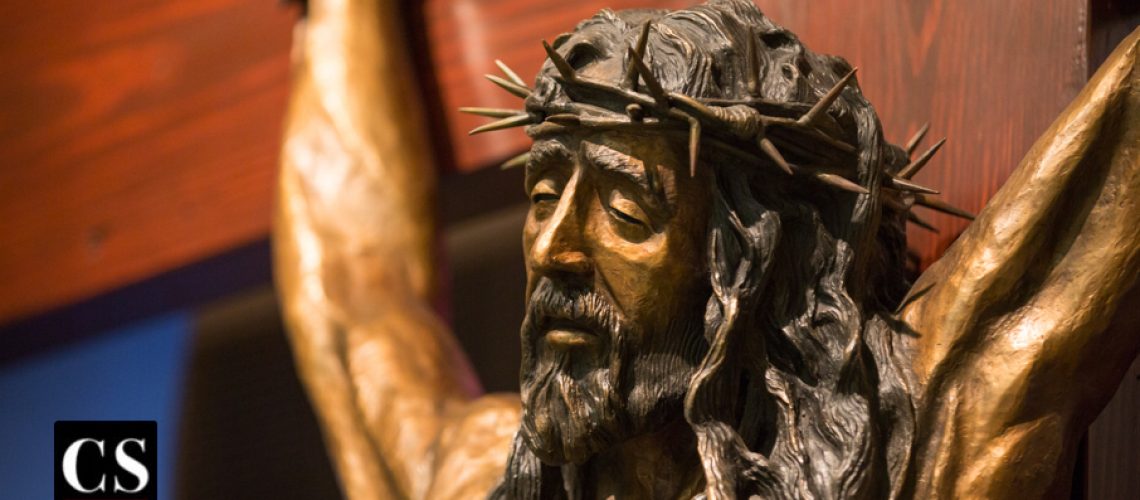
Jesus did not, however, offer a minimal sacrifice to His Father for us. While hanging on the cross, Jesus breathed many hundreds of breaths each hour, having to push up on the nail through His feet each time He wanted to breathe. Estimates vary about how long He hung alive on the cross (from 3 to 6 hours), but no matter how long it was, He breathed several thousand painful breaths before He died. According to one mystic, during His passion He bled 28,430 drops of blood. His body was torn, mangled, beaten, bloody, and bruised from the scourging, the beatings, the carrying of the cross, and being nailed to it with nails that had to be large enough that they could support His entire weight and his flesh would not tear free. His skull was penetrated by the thorns of the crown at his coronation by the Roman soldiers. The skin hanging from His back due to the scourging exposed His raw flesh to the wood of the cross and each time He rose up to breathe he raked that raw flesh in agony along the wood, going up and down.
This physical pain and suffering was only a part of what Jesus endured. His emotional, mental and spiritual pain are beyond our comprehension. Persons He had created, with free will to choose to love Him screamed to Pontius Pilate, “Crucify Him, crucify Him!” Men He created condemned Him to death; tortured Him; and mocked Him as He hung in agony of the cross. Eleven of His chosen men, His apostles, either betrayed Him or denied Him and fled. The one who betrayed Him did it for money and turned Him over to his bitter enemies, the Jewish High Priest and the other priests.
No apostle stood between Him and the soldier who was scourging Him. No apostle took away the hammer from the man nailing Jesus to the cross. No apostle said “No, take me, and set Jesus free.” No apostle eased His pain as He suffered for each one of them. As He suffered on the cross and looked down, He saw none of them, except one, the teenager John, and He knew the others were hiding for fear of their own personal safety.
What good could possibly come from all this unnecessary suffering when one minimal act of sacrifice would have accomplished our salvation? Why not simply shed that una stilla, that one drop St. Thomas mentions in his prayer? And why did it have to be so public instead of Him suffering in isolation? Later, had the one-drop scenario occurred, Our Lady could have told one of the gospel writers about Him bleeding from a minor wound as a young man, e.g. cutting Himself while working with Joseph, some blood flowing to the ground, and Him offering this up for all our sins.
Why? Why not something quick like hanging or beheading, and so much less painful than crucifixion?
God’s thoughts are not our thoughts and His ways are not our ways, but some things are clear even if Jesus’s agonizing suffering and pain do not make sense to us or we simply don’t want to confront the enormity of the evil of our own sins. One result of what He did is that we get a glimpse of the divine love and care for us when we are confronted with the extent of Jesus’s suffering for us.
St. Thomas considered the broad extent of all of Jesus’s suffering:
Speaking generically, He did endure every human suffering. This admits of a threefold [application]. First of all, on the part of men: for He endured something from Gentiles and from Jews; from men and from women, as is clear from the women servants who accused Peter. He suffered from the rulers, from their servants and from the mob, according to Psalm 2:1-2: ‘Why have the Gentiles raged, and the people devised vain things? The kings of the earth stood up, and the princes met together, against the Lord and against His Christ.’ He suffered from friends and acquaintances, as is manifest from Judas betraying and Peter denying Him. (Summa Theologiae, Third Part, Question 46).
If He had shed that single drop of blood, with no other pain or suffering, we might be inclined to say, “All my sins? Really no big deal. All it took was some minimal hurt or aggravation of Jesus to pay for all of them.” Had He shed that single drop we might not come to the realization of the true impact or effect of our sins, the possibility of spending all eternity without Him and in hell. The entirety of Jesus’s suffering, passion and death make clear for us the cost of our own redemption and the redemption of all human beings.
But Why So Public?
Jesus could have suffered and died in secret, in isolation. But many, many people witnessed it personally. The leaders of the Jews erroneously thought that by having Jesus tortured and crucified for all to see would stifle His new “Way” and that would be the end of His challenge to their power.
Most probably three of the gospel writers, Matthew, Mark, and Luke, were not present for the crucifixion of Jesus. However, since it was public, there were many eyewitnesses, both Jewish and Roman, from whom they could learn what happened. And of course, the Blessed Virgin Mary saw it all and she is believed to be one source for much of what is in the gospel of Luke.
Had this been done in secret, and assuming the Holy Spirit would not reveal the details to the evangelists, we would not know what happened. Also, the publicity added the pain of humiliation to what Jesus did for us. Naked, imprisoned on the cross, with no worldly possessions, suffering a death sentence reserved for criminals, hoisted up between two murderers, and crying out in pain as people mocked Him and cursed Him – a more humiliating death is unimaginable.
Conclusion
It is so easy and convenient to engage in a false theology of Jesus’s passion and death like this:
OK, trillions and trillions of sins, for which He was whipped thirty nine times with the Roman flagellum exposing His flesh and bones, some twenty thousand drops of blood, so for my sins that comes out to less than an infinitesimal tiny nano nano micro gram of blood and an calculably small part of one whipping stroke. I alone didn’t cause Him that much suffering.
Such rationalizations are a sinner’s attempt to render one’s sins so insignificant that they are hardly sins; they ignore the “eternity” and “infinity” facts; and they are an implicit insult to Our Lord and Savior for what He did for each of us. The “E& I” facts include:
One single mortal sin, for which there is no repentance and absolution, is all that it takes for one to be condemned, by one’s own action, to a hell that is eternal.
Because of what Jesus freely chose to do for each of us – and for everyone alive and everyone who ever lived, and everyone who ever will live – is to make available for us eternal happiness and joy with Him in heaven forever.
What Jesus did for us was a human/divine act of infinite love, and no greater love than this is possible-He literally laid down His life for our spiritual lives.
St. Paul provides an explanation of why Jesus did this for each of us:
Looking on Jesus, the author and finisher of faith, who having joy set before him, endured the cross, despising the shame, and now sitteth on the right hand of the throne of God. (Hebrews 12:2; emphasis added).
The whole time Jesus was suffering and in pain, He was aware of this “joy.” It was a double joy. First, He was dong the will of God the Father. His prayer – “My Father, if it be possible, let this cup pass from me; nevertheless, not as I will, but as you will. . . . Again, for the second time, he went away and prayed, My Father, if this cannot pass unless I drink it, your will be done.” (Matthew 26:39, 42) – was being answered with each drop of His blood.
The other source of Jesus’s joy was that he knew with each breath, as each drop of blood flowed, with each searing pain in His hands and feet, He was saving each of us and all of us. He was making it possible for each of us to regain the glory for which we had been created. He was overjoyed that again we could be home with Him.
Once we come to know what Jesus did for us and the details of all of the pain and suffering, if we then ask Him why He did this for you and for me, His clear response is:
You are of infinite value, beyond price, your are mine, and you are worth it all. Even if you were the only sinner, I would have done all of this for you.




3 thoughts on “Just One Drop of Jesus’s Blood”
Thank you and God bless you!
Nancy T-“Thank you” and “God Bless: right back atcha. Guy
Now if you could compose something so beautiful and poignantly perfect for Christmas, Guy, then Easter will take care of itself.