

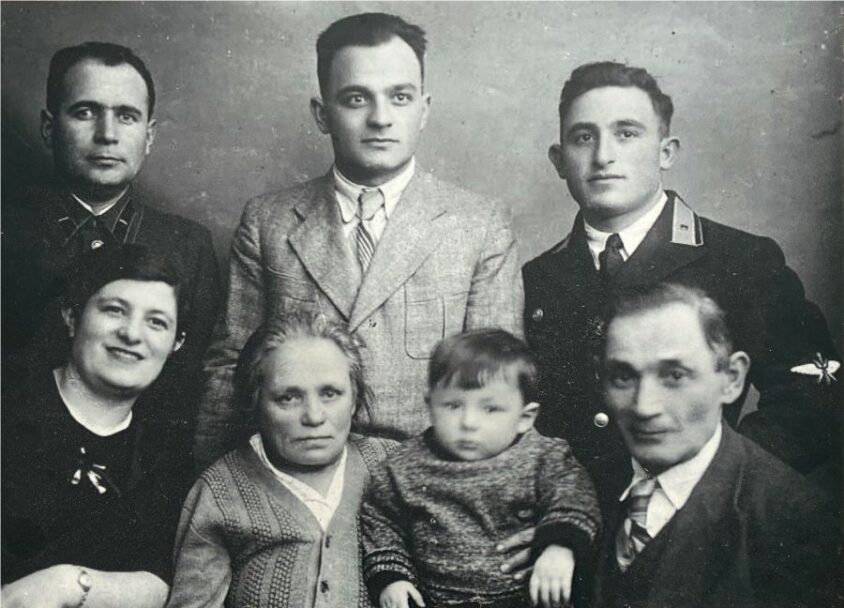
I was born in Soviet Russia one and a half years before Hitler’s attack on the Soviet Union. Soon thereafter, a major modern war began and continued with extreme intensity for five full years (June 1941 – May 1945). My father, an officer in the Soviet Army, and my mother’s younger brothers—one of whom was a civil mobilization worker and another a military pilot—died during the war. My maternal grandfather died of tuberculosis during the same period. Only three of us survived: my mother, her mother (my grandmother), and myself.
We were Jewish, but our family came from an extremely poor background. Ten years earlier, in the Ukrainian countryside, we had endured extreme suffering during a period without stable government—conditions disturbingly reminiscent of what is occurring in Ukraine today. Nationalist bands were active, and anti-Jewish pogroms were frequent. My grandmother’s parents were killed in one such pogrom; they were burned alive with their neighbors inside a synagogue. Approximately ten years later, Soviet power arrived. Despite its cruelty toward perceived enemies, the new regime provided education, employment, and pilot training to four young members of our family, and my father was incorporated into the army.
After the war, we moved to Moscow. There, my Jewish origin was effectively reduced to insignificancein daily life. Being Jewish implied social isolation and a degree of unofficial but systematic discrimination—nothing overtly violent, but persistently present. This situation continued until my university years, when I encountered individuals who had recently been released from prison. Under Joseph Stalin—who died around that time—the number of such former prisoners was immense. Many of them were more intelligent than I, and some were Christians. Through them, I encountered books previously unknown to me, circulated through samizdat. Among these texts was an account of the Bolsheviks’ destruction of Russian Orthodox spirituality and the Church. I was deeply moved by this revelation and entered the Russian Orthodox Church, receiving baptism while still a student. I was not denounced, and I never believed I had acted wrongly, since I had never previously “received the faith of my parents.”
Approximately twenty years later, the Soviet secret services identified me as a “dissident,” and my position in an important academic institution was terminated. Living within the Russian Orthodox Church while facing expulsion from both employment and, ultimately, from Russia itself was extremely difficult. The Church itself remained imprisoned within the Soviet mentality. Stripped of my modest property and expelled from Russia to Israel—precisely because the authorities knew I was Jewish—I arrived without any real understanding of what awaited me. My only reference point was the Six-Day War.
The discovery of real life in Israel was stunning. I remain forever proud of Israel and of what that brief war accomplished for the nation.
This period coincided with the peace agreement with Egypt (1978), one year after my expulsion to Israel. This peace, deliberately promoted by U.S. President Jimmy Carter—whom I consider to have been hostile toward Jews—was, in my view, naïvely embraced by Menachem Begin, who dreamed of “eternal peace with all Arabs.” (See my articles in Catholic Stand, October 25, 2023, and January 31, 2024.) Five years later, these developments ultimately led me from Israel to France, where I found a research position in Strasbourg and lived as an Orthodox Jew.
In Israel, I lost all interest in Russian Orthodoxy, yet certain memories of my Christian life remained. While in Moscow, I had read a samizdat book describing the apparitions of Our Lady of Fatima. For a Russian Christian, this work was a stunning revelation of an entirely new Christian vision and understanding. After two years working in Strasbourg—initially without knowing a word of French—I chose to attend a scientific conference in Portugal, near Fatima, and traveled there.
From that point onward, my life followed two parallel paths. In my free time outside of work, I studied Jewish texts in the traditional ḥavruta format, while at home I increasingly read Catholic works, beginning with Fatima. This dual pursuit continued during my sabbatical year in Montréal, where I met Catholic friends of exceptional warmth and openness. This was thirty years ago.
Summary of Spiritual Crises
In summary, my life has passed through three profound spiritual crises.
At approximately twenty years of age, I was Jewish yet entirely ignorant of God. The “accidental” discovery of Bolshevik historical crimes awakened me from my atheistic Russian worldview and led me to enter a religious life through Russian Orthodoxy—a faith in which I remained for many years.
At around forty years of age, I was expelled from Russia and sent to Israel without any prior knowledge of that land. There, I acquired my Jewish identity in its full sense, together with Jewish faith.
In parallel, while living in France, I continued to explore Catholic spiritual phenomena that I had first encountered in Russia through samizdat. Thirty years later, in Canada, I accepted the Catholic faith fully and without hesitation.
Present Crisis and Question
Despite this, I remained Jewish and sincerely hoped that Israel would one day recognize the importance of the Catholic Church. Today, however, my vision of Israel’s future has been deeply shaken by the catastrophe in Gaza (see my article in Catholic Stand, June 4, 2024). Israel has once again surrendered its eternal destiny to the authority of a President of the United States—different, of course, from the one who engineered peace with Egypt—and the outcome of this surrender remains uncertain.
Paradoxically, my conviction has only strengthened that Israel’s eternal vocation ultimately belongs to the one faith that is true forever—the Catholic faith. This realization leaves me unable to remain silent. I now find myself in a fourth spiritual crisis, unfolding amid troubling yet deeply compelling circumstances.
The central question that now occupies my mind is this: How is the Catholic faith, which I fully embrace, related to the Jewish people?
William Durand and the Liturgical Answer
I leave the interested reader to seek answers in the history of the Church and in her writings. For myself, I found a compelling response in a book written more than seven hundred years ago by the French bishop William Durand. His beautifully written Latin treatise, Rationale divinorum officiorum (available in a complete English translation from 2013, Rationale of the Divine Offices, and in a full French translation from 1854), provided a profound and convincing answer to my question—one that I recognized only recently, though it had long been before me.
It must be acknowledged, however, that this perspective was not universally adopted. Church history shows many periods in which the Church was guided differently and was often openly hostile toward Jews.
William Durand was born around 1230 in Puimisson, in the Narbonnaise region near Béziers, into the lesser nobility of Languedoc. He died in Rome on November 1, 1296, and was buried in the Dominican church of Santa Maria sopra Minerva. As a close collaborator of the popes during the final third of the thirteenth century, he held numerous judicial, administrative, and diplomatic positions throughout the Papal States.
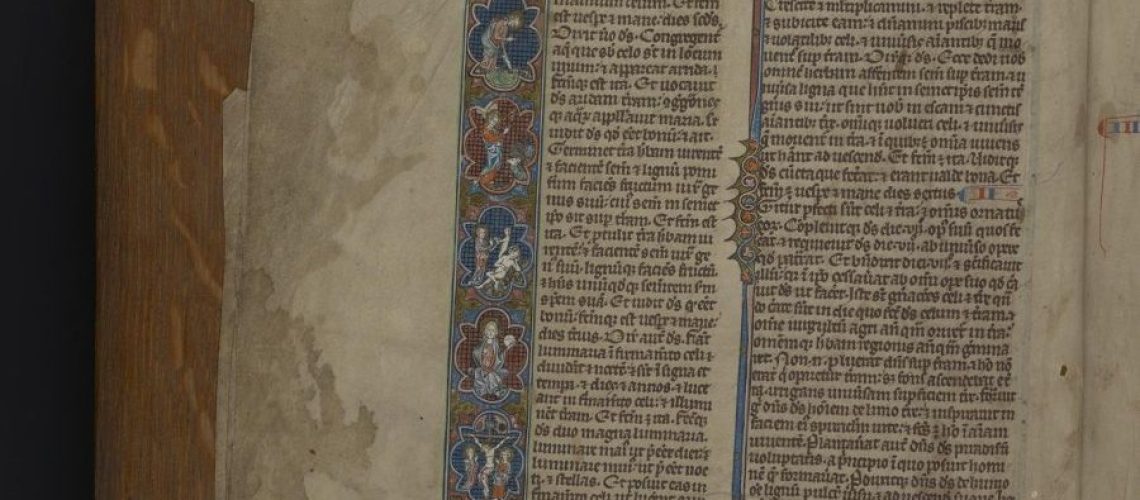
His monumental Rationale of the Divine Offices—a liturgical commentary rather than a liturgical book—was written during his episcopate in Mende. Divided into eight books, it sought to reveal the “hidden and beautiful mysteries of the divine offices.” Its influence was immense: more than two hundred manuscripts survive, followed by over one hundred printed editions. For more than three centuries, it was among the most frequently consulted works in ecclesiastical libraries.
The answer to my question lies in Book IV, On the Mass and Each Action Pertaining to It. Durand privileges what he calls the “mystical meaning” over the purely literal or historical sense. Symbolic geography plays a central role, particularly in the priest’s movements at the altar, which represent the relationship between Jews and Gentiles within salvation history.
Durand teaches that the Gospel first came to the Jewish people, then to the Gentiles, and that it will ultimately return to the Jews. This symbolism is enacted in the liturgy itself, culminating in the post-Communion prayer recited at the right side of the altar—representing Israel’s final reconciliation.
The tone of this vast work—over five hundred pages—is remarkably serene and hopeful. Jews are not portrayed as excluded, but as awaiting convergence, which Durand assures will come after the defeat of the Antichrist.
This vision presents a profoundly positive understanding of the place of the Jewish people within the Catholic mystery of salvation.
Glory be to God the Father, the Son, and the Holy Spirit.
It was a beautiful and fruitful time for of the Church, with the Rationale becoming for studies of the medieval liturgy the same what were for theology Sentences of Pierre Lombard. It continued for about four centuries, but it finished with the rigorous and down-to-earth German criticism of the Mass becoming prevalent.




7 thoughts on “Jewish Catholic”
+
pax
This article is a reduction of most complete article printed on my site of Research Game :
https://www.researchgate.net/publication/399917597_Jewish_Catholic
Pingback: TVESDAY LATE-AFTERNOON EDITION - BIG PVLPIT
Dear Dr EB, Bear with me, making a good point one of my daughters, J, did research in the jungles if Ivory Coast on primate communication. Once she was home, Texas, for a break and we were in a porch if a ranch house if one of her cousins and a bunch of manly man Texans including me were talking about the rigors of hunting deer and wild hogs and how the hogs can be huge and dangerous when you’re out there with a high powered rifle and a pistol. And one brave soul recounted how he had to kill one charging at close range blah blah blah. Someone turned to my daughter J and asked her about the jungle. She told them about one night alone in base camp when she was stalked by a leopard and started running. Leopard got real close and she dove thru a window of the kitchen hut and grabbed two butcher knives, turned to face the leopard, realized she was an idiot, jumped out an opposite window as the leopard jumped in the hut. She ran toward a jeep and got in, stated it, a drive away before the leopard got to her
All the men were silent.
One of them said”and we think we’re tough guys killing pigs with high powered rifles”
Dr EB , it’s the same for me thinking I’ve been through things in my life, defending the faith in arguments with pagans, proud of myself when I walk out of the confessional with less than a rosary penance AND THEN I read about you life. And I thought I was a tough Guy.
Once I exit purgatory I would be honored to shake your hand in heaven.
Guy, Texas
+
pax
Dear Guy,
thank you for you message and appreciation.
But you put me in a difficulty with your prediction to come to me from purgatory: I do not know honestly where I will be after the death, and I wish you to desire to be straight in heaven.
Edouard
+
pax
Dear Guy,
Your message was very happy and proud of your family. I felicitate you with the remarkable qualities of one of your daughters. You have raised her to be honest and very strong.
Edouard
`G-d bless you – four spiritual crisis’, I can’t imagine.
+
pax
Thank you. I can not expect for a better,most cordial reaction. Got bless you, dear Papist !