

To read Part I
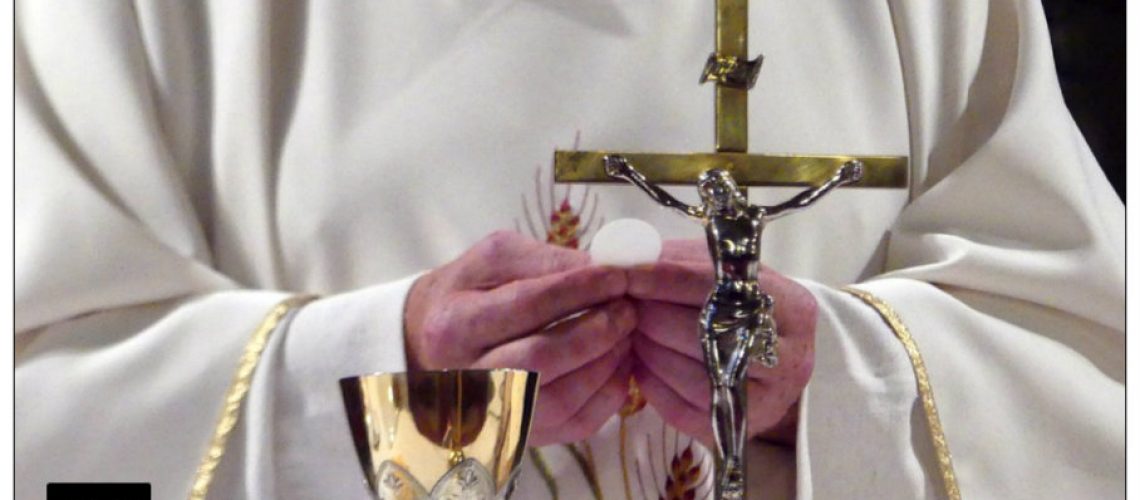
In this Catechism’s section on the Eucharist, Part Two, Section Two, Chapter One, Article 3, the Catechism never refers to the Eucharist or to the Mass as a simple “meal,” not even as a “holy meal.” (Paragraphs 1322-1322).
Church Fathers, Council of Trent, & Recent Popes
In the fourth century St Ambrose (340-397 A.D.) stated that the priest must “offer sacrifice for the people” (Catechetical Letters, 23). St John Chrysostom (died 407 A.D.) asserted that the Mass and what Jesus did in His passion and death are one single sacrifice:
. . . For Christ is everywhere one complete Body. Just as He is one Body and not many bodies, even though He is offered in many places, so there is but one sacrifice. It is our High Priest who offered the sacrifice which cleanses us. So we offer now that which was then offered, and which cannot be exhausted. (Homily 17 on Hebrews 3; emphasis added).
As the Council of Trent explained: “In this divine sacrifice which is celebrated in the Mass, the same Christ Who offered Himself once in a bloody manner on the altar of the Cross is contained and offered in an unbloody manner.”
St. John Paul II wrote that: “The Eucharist is above all a Sacrifice.” (Dominicae Coenae).
Pope Benedict the XVI did not mince words when he spoke about the Eucharistic sacrifice:
The Eucharist is not a meal among friends. It is a mystery of covenant. “The prayers and the rites of the Eucharistic sacrifice make the whole history of salvation revive ceaselessly before the eyes of our soul, in the course of the liturgical cycle, and make us penetrate ever more its significance” [Saint Teresa Benedicta of the Cross, [Edith Stein], Wege zur inneren Stille Aschaffenburg, 1987, p. 67]. (Pope Benedict XVI Homily at 49th Eucharistic Congress; emphasis added).
If the Mass is Just a Memorial Meal . . .
For some Protestants, and, sadly, for more and more catholics, the mass is nothing more than a memorial of Christ’s passion and death. These people are called “memorialists” and they ignore Christ’s words spoken on Holy Thursday to the apostles, “This is My body . . this is My blood,” and the context in which Jesus spoke these words. They focus instead on His words that follow, “Do this in remembrance of me.” (Luke 22:19). For many these words are the basis for the denial that the mass is a sacrifice.
The English word “do” is a translation of the Greek word ποιεῖτε which is the word in the New Testament descriptions of the Last Supper. This word was used by Jesus to say much more than eat a meal with one’s friends. As Jesus used this word it had the sense of “do this sacrifice,” or “offer this sacrifice.” Also, the Greek word ἀνάμνησιν is much more than a reference to a simple commemoration with no hint of sacrifice. This word too is associated with sacrifice and refers directly to a sacrifice that is a sacrifice offered to God.
“Do this in remembrance of Me,” in its full sense, in the sense that Jesus used these words, means “Make this sacrifice of Me to God, remembering me.”
Another misinterpretation of the words of Jesus on Holy Thursday is Luke 22:15 translated as “And he said to them: With desire I have desired to eat this meal with you, before I suffer.” Jesus used the word “pascha” which is not a reference to a meal. The “pascha” is the lamb of the Passover sacrifice.
Before the Last Supper, Jesus had sent Peter and John ahead to prepare for Him and the apostles (only) to do the Passover ritual together. One of the most important things they had to do in this preparation was get a lamb – and this had to be a lamb that had been sacrificed in the Temple that was then to be eaten by those present. This lamb was the “pascha.”
Typically, according to the historian Josephus, 250,000 lambs were sacrificed in the Temple for the Passover for the inhabitants of Jerusalem and 2.5 million pilgrims present. After a sacrificial lamb’s throat was slit, it was placed on two crossed wooden staves to be cleaned, gutted, and skinned. The lamb was crucified. This is the true context of the Last Supper: “And the day of the unleavened bread came, on which it was necessary that the pasch should be killed. (Luke 22:7).
After the lamb was sacrificed, priests poured its blood on the altar in the Temple. There was no meal in the Temple. Then a family took a lamb home – because it had to be eaten as part of the Paschal sacrifice. In instituting the Holy Sacrifice of the Mass at the Last Supper, Jesus is, in effect, telling His apostles, “I am the new victim, the new lamb. I am the new sacrifice. I am giving you the new covenant in My blood, the new testament. Now, eat my body and drink my blood.”
And taking bread, he gave thanks, and brake; and gave to them, saying: This is my body, which is given for you. Do this sacrifice remembering me. In like manner the chalice also, after he had supped, saying: This is the chalice, the new testament in my blood, which shall be shed for you. (Luke 22:19-21).
On behalf of the people, sacrifices were offered in the Temple by priests to God. At the Last Supper Jesus ordained the first priests, the twelve apostles (and no one else) to the sacrament of the ministerial priesthood, the sacrament of Holy Orders. Today at the Holy Sacrifice of the Mass Jesus again offers His sacrifice for us to the Father, through His priest, a priest who alone is present in the person of Christ, in persona Christ.
Sacrifice
The word “sacrifice” literally means to make sacred, to make holy, to set apart. This is not a word of equality, diversity, fellowship, equity, or inclusivity.
The Hebrew Word for Holiness, “qodesh” which means “apartness,” or “sacredness,” is used over 400 times in the Old Testament. The Greek Word for Holiness, hagios, also means “set apart.” This word and the word for holiness are used almost 200 times in the New Testament. God is holy, God alone. He is “set apart” from His creation and, before Mary said, “Yes,” and Jesus was incarnated within her as one of us, a human being, God was totally set apart from us.
Although only God is holy, all of us are commanded to be try to be holy:
But according to him that hath called you, who is holy, be you also in all manner of behavior holy: Because it is written: You shall be holy, for I am holy [Lev 19:2]. (1 Peter 1:15-16).
What we do here is strive to be holy by setting ourselves apart from the world:
Do not love the world or the things in the world. If anyone loves the world, the love of the Father is not in him. For all that is in the world—the desires of the flesh and the desires of the eyes and pride of life—is not from the Father but is from the world. And the world is passing away along with its desires, but whoever does the will of God abides forever. (1 John 2:15-17)).
And be not conformed to this world; but be reformed in the newness of your mind, that you may prove what is the good, and the acceptable, and the perfect will of God. (Romans 12:2).
If the Mass is a meal, nothing more, no thing and no one is made holy. The meal is simply and only there to feed us and, perhaps, to be with others who are also seeking physical nourishment and fellowship here and now. Nothing is set apart to assist us in thinking past this life. Nothing is set apart to make us consider and adore a holy God, to make us want to also be holy, and to enliven us to seek His eternal holiness in heaven. At such a meal, no human being who is the God-man is sacrificed to make this all possible for each of us.
At a mass meal, all you need is a table, no priest, male or female; just an M.C., master of celebration, facing the people and occasionally providing stage directions; no sacrifice, no Jesus really present, no sacrificial victim.
So What? No Harm, No Foul
Such a meal, presented as an ineffective substitute for the Holy Sacrifice of the Mass can do worse than be a happyclappy, glad-handing, fun fest. Denigrating and totally ignoring that the Mass is the Holy Sacrifice and relegating it to the status of a parish fish fry in the community center can not only result in a blasphemous party before God, much like the worship of the golden calf in the wilderness. The mass-as-meal can devolve into a Novus Disordo, an occasion of sin. If the faithful regard “the meal” as an event for recognizing each other, applauding the choir, and celebrating birthdays and anniversaries of those present, these others become the “idols” who are the focus of the meal. The mass as mere meal flaunts the First Commandment.
Well Did Pope Benedict XVI Say
Before he became Pope Benedict XVI, Cardinal Joseph Ratzinger wrote this in the 2000 publication of “The Spirit of the Liturgy”:
Wherever applause breaks out in the liturgy because of some human achievement, it is a sure sign that the essence of liturgy has totally disappeared and been replaced by a kind of religious entertainment. Such attraction fades quickly – it cannot compete in the market of leisure pursuits, incorporating as it increasingly does various forms of religious titillation.
Other popes have also added their input on the subject, including Pope Saint John XXIII and Pope Saint Pius X.
Pope Saint John XXIII’s said to those gathered at a church,
I am very glad to have come here. But if I must express a wish, it is that in church you not shout out, that you not clap your hands, and that you not greet even the Pope, because ‘templum Dei, templum Dei.’ [‘The temple of God is the temple of God.’].
Pope Saint Pius X said, “It is not fitting that the servant should be applauded in his Master’s house.”
St. John Marie Vianney
St. John Marie Vianney knew that God’s goal for each person was to end up set apart, to end up holy, to end up in heaven:
A Christian who is led by the Holy Spirit has no difficulty in leaving the goods of this world, to run after those of Heaven; he knows the difference between them. The eyes of the world see no further than this life, as mine see no further than this wall when the church door is shut. The eyes of the Christian see deep into eternity. (On The Holy Spirit).
There is no better way to end this [somewhat long] discussion of the Holy Sacrifice of the Mass than with some of St. John Marie Vianney’s wisdom:
If we really understood the Mass, we would die of joy.
There is nothing so great as the Eucharist. If God had something more precious, He would have given it to us.


1 thought on “If The Mass Is Just A Meal, To Hell With It: Part II”
Pingback: If The Mass Is Just A Meal, To Hell With It: Part II MEK Enterprises Blog - Breaking News, SEO, Information, and Making Money Online!The Number 1 Online Blog Worldwide!