

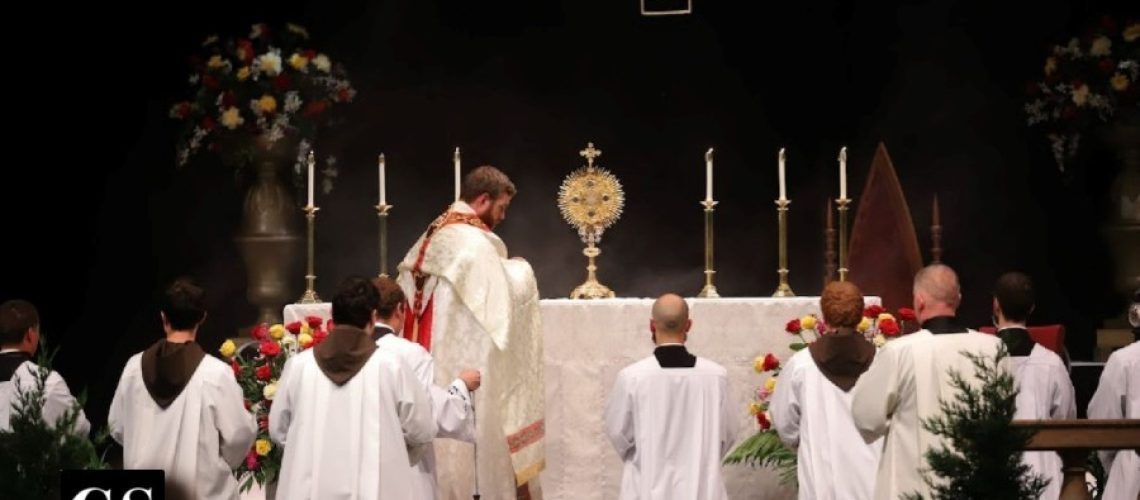
At a dinner party in 1950, Mary Flannery O’Connor [“Flannery” to her friends and now to countless appreciative readers], heard then-famous author [never heard of her before, fame is so fleeting] Mary McCarthy say the Holy Eucharist is a symbol. In her typical forthright honesty, Flannery said, for everyone to here, “Well, if it’s a symbol, to hell with it.”
Flannery was no neophyte in theology and no slouch at symbolism. She knew exactly what was implied in saying the Eucharist is a symbol and she knew in detail the Church’s true teaching on the Eucharist. She knew and believed that the Eucharist is so much more than a mere symbol.
For many reasons, the same can be said about the statement that “The Mass is a meal,” if by this is meant it is only a meal, or merely a meal, or primarily a meal and nothing more.
After the Second Vatican Council, the Holy Sacrifice of the Mass was called and referred to by some as a meal. Often the word used was simply the word “meal” alone, not “sacred meal,” not “heavenly meal,” not “holy meal,” and not “sacrificial meal” (although such descriptive adjectives were sometimes used). Since the end of V II there has been a dramatic decline in the numbers of the faithful who believe, and for that matter are even aware of, church teachings about and related to the Holy Sacrifice of the Mass and the recognition that it truly is a here-and-now in-the-present sacrifice. These include a stunning failure to believe in: the Real Presence as truly and actually being Jesus Christ’s physical body and blood, soul and divinity; the Mass as sacrifice; and the all (and only) male ministerial priesthood.
It is now beyond question that this decline is related to, and caused in part by, the widespread failure to teach the Mass as sacrifice. This decline is undeniable as is the connection between the denied beliefs and the failure to proclaim the sacrificial nature of the Mass.
Protestant Deformers
Many Protestant deformers rejected the theology of the Mass as sacrifice. Many of them, including Martin Luther, said, contrary to church doctrine and tradition, that the Mass was not of divine origin, but was merely the work of some men in power in the church, and it could have no effect on one’s salvation. For many Protestants today the Eucharist is a fellowship meal, nothing more. The Thirty-Nine Articles of the Church of England reject the Mass as a sacrifice: “Wherefore the sacrifice of Masses, in which it was commonly said, that the Priest did offer Christ for the [living] and the dead, were blasphemous fables, and dangerous deceits.” None of these protesters eat the flesh of the Son of Man or drink His blood at any of their meals.
One anecdote bespeaks the decline in catholic belief in the Mass as the Holy Sacrifice and in the Real Presence. About a year ago I attended the First Communion of a relative in a very large parish some distance from where I live. As is typical in some, if not many, parishes now, the atmosphere before Mass, and also during the whole thing, was one of fiesta in church, phone calls, picnic and socializing. For the talk – it never rose to the level even of homily, let alone sermon – the priest asked the children who were going to receive Holy Communion what did they usually do in the last days of November each year (it was then mid-December). The responses were all about Thanksgiving Day. The priest focused on the meal, and asked who was present, what they ate, (several children got to describe the meal in detail), and what they did in terms of giving thanks. The priest seized upon the idea that everyone was thankful. The object of the thanks was never mentioned. He proceeded to say that receiving Communion would in future be like having a family pizza party every week.
Pepperoni, anyone? Extra cheese? It is not necessary to list everything about the Holy Eucharist and the Holy Sacrifice of the Mass that was not said. As the night follows the day, in this case darkness following light, it is crystal why many such children will grow to reject the doctrine of the Real Presence and the church itself, and why their parents already do.
Catechisms
None of the various catechisms through history has ever stated that the Mass is a meal. The two most influential catechisms used over the years in America make it clear that the Mass is a sacrifice, not mere symbols, not a memorial dinner, not a mere meal.
Baltimore Catechism II (1941):
Lesson 34 On the Sacrifice of the Mass
- Q. What is the Mass?
- The Mass is the unbloody sacrifice of the body and blood of Christ.
- Q. What is a sacrifice?
- A sacrifice is the offering of an object by a priest to God alone, and the consuming of it to acknowledge that He is the Creator and Lord of all things.
- Q. Is the Mass the same sacrifice as that of the Cross?
- The Mass is the same sacrifice as that of the Cross.
- Q. How is the Mass the same sacrifice as that of the Cross?
- The Mass is the same sacrifice as that of the Cross because the offering and the priest are the same–Christ our Blessed Lord; and the ends for which the sacrifice of the Mass is offered are the same as those of the sacrifice of the Cross.
- Q. Is there any difference between the sacrifice of the Cross and the sacrifice of the Mass?
- Yes; the manner in which the sacrifice is offered is different. On the Cross Christ really shed His blood and was really slain; in the Mass there is no real shedding of blood nor real death, because Christ can die no more; but the sacrifice of the Mass, through the separate consecration of the bread and the wine, represents His death on the Cross.
The Catechism of the Catholic Church (1994):
At the Last Supper, on the night he was betrayed, our Savior instituted the Eucharistic sacrifice of his Body and Blood. This he did in order to perpetuate the sacrifice of the cross throughout the ages until he should come again, and so to entrust to his beloved Spouse, the Church, a memorial of his death and resurrection: a sacrament of love, a sign of unity, a bond of charity, a Paschal banquet ‘in which Christ is consumed, the mind is filled with grace, and a pledge of future glory is given to us.’ (Catechism 1323; emphasis added).
What is This Sacrament Called . . . The Holy Sacrifice, because it makes present the one sacrifice of Christ the Savior and includes the Church’s offering. The terms holy sacrifice of the Mass, “sacrifice of praise,” spiritual sacrifice, pure and holy sacrifice are also used, since it completes and surpasses all the sacrifices of the Old Covenant. (Catechism 1330; emphasis added).
Read Part II tomorrow


1 thought on “If The Mass Is Just A Meal, To Hell With It: Part I”
Pingback: Israel Votes To Re-invade and To Eliminate Gaza and The Palestinians As The Cardinals Debate A Second Francis vs. A Return To Catholicism Pope In The News Round Up | Traditional Catholics Emerge