

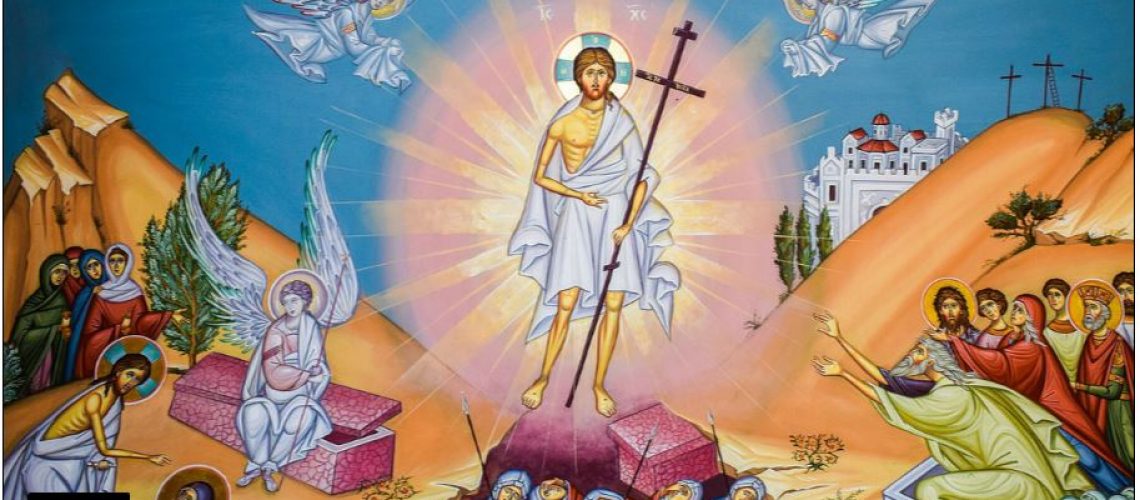
Is Jesus Christ more than a prophet, much more than a mere human being? And, if not – aren’t there weighty consequences in the balance for all of mankind? Is this not a pivotal question, one that every human being must ponder in the course of their lives?
If Jesus Christ is the Son of the Most High God, is He not unique in every way – like us – in that, He assumed a human nature, and yet – very unlike us – in that, within one hypostasis (person), He also possesses a Divine nature:
The Church thus confesses that Jesus is inseparably true God and true man. He is truly the Son of God who, without ceasing to be God and Lord, became a man and our brother:
What he was, he remained and what he was not, he assumed,” sings the Roman Liturgy (cf. LH, January 1, Antiphon for Morning Prayer; cf. St. Leo the Great, Sermo in nat. Dom. 1, 2; PL 54, 191-192). And the liturgy of St. John Chrysostom proclaims and sings: “O only-begotten Son and Word of God, immortal being, you who deigned for our salvation to become incarnate of the holy Mother of God and ever-virgin Mary, you who without change became man and were crucified, O Christ our God, you who by your death have crushed death, you who are one of the Holy Trinity, glorified with the Father and the Holy Spirit, save us” (cf. Liturgy of St. John Chrysostom, Troparion “O monogenes”)![1]
With this in mind, is it common in one’s experience of the world, to encounter an inanimate object or creature, that possesses more than one nature? Undoubtably, this is not the case:
We see everything around us as having a nature, but only one nature: the tree has the nature of a tree, the man has the nature of a human being, a rock has the nature of a rock. The nature of a thing indicates the kind of thing it is. Logically, every created thing has one nature, its own particular nature. No created thing has two natures or it would be two things at one time, which is impossible.[2]
If Christ is unique, in that He possesses both a human, and Divine nature in one hypostasis (person); can it not be said, that One Who possesses a Divine nature, is not only God, but is of one substance with the other two persons of the Holy Trinity – The Father and the Holy Spirit:
The Trinity is One. We do not confess three Gods, but one God in three persons, the “consubstantial Trinity” (cf. Council of Constantinople II (553): DS 421). The divine persons do not share the one divinity among themselves but each of them is God whole and entire: “The Father is that which the Son is, the Son that which the Father is, the Father and the Son that which the Holy Spirit is, i.e., by nature one God” (cf. Council of Toledo XI (675): DS 530:26). In the words of the Fourth Lateran Council (1215), “Each of the persons is that supreme reality, viz., the divine substance, essence or nature” (cf. Lateran Council IV (1215): DS 804).[3]
Thus, if Christ, the second person of the Holy Trinity, remains Divine as He assumes a human nature, does this not beg the question: Why does He Who is Divine, choose to take on flesh at all? The Catechism of the Catholic Church proposes a fourfold answer in paragraphs 457–460:
The Word became flesh for us in order to save us by reconciling us with God, who ‘loved us and sent his Son to be the expiation for our sins’: ‘the Father has sent his Son as the Savior of the world’, and ‘he was revealed to take away sins’ (cf. 1 Joh 4:10; 4:14; 3:5).[4] The Word became flesh so that thus we might know God’s love: ‘In this the love of God was made manifest among us, that God sent his only Son into the world, so that we might live through him’ (cf. 1 Joh 4:9). ‘For God so loved the world that he gave his only Son, that whoever believes in him should not perish but have eternal life’ (cf. Joh 3:16).[5]
The Word became flesh to be our model of holiness: “Take my yoke upon you, and learn from me.” “I am the way, and the truth, and the life; no one comes to the Father, but by me” (cf. Mat 11:29; Joh 14:6). On the mountain of the Transfiguration, the Father commands: “Listen to him” (cf. Mar 9:7; cf. Deu 6:4-5)! Jesus is the model for the Beatitudes and the norm of the new law: “Love one another as I have loved you” (cf. Joh 15:12). This love implies an effective offering of oneself, after his example (cf. Mar 8:34).[6]
The Word became flesh to make us “partakers of the divine nature” (cf. 2 Pet 1:4):
For this is why the Word became man, and the Son of God became the Son of man: so that man, by entering into communion with the Word and thus receiving divine sonship, might become a son of God” (cf. St. Irenaeus, Adv. haeres. 3, 19, 1: PG 7/1, 939). “For the Son of God became man so that we might become God” (cf. St. Athanasius, De inc., 54, 3: PG 25, 192B). “The only-begotten Son of God, wanting to make us sharers in his divinity, assumed our nature, so that he, made man, might make men gods (cf. St. Thomas Aquinas, Opusc. 57, 1–4).[7]
Out of love, Christ was sent by His Heavenly Father, not only to take on flesh, but also, that He redeem All of mankind. And, Christ walked among us, that He model for us the way in which one should live out one’s life according to God’s will, conforming His humanity, (human will) perfectly to that of the Divine will. Only God can make men partakers of the Divine nature, Men and women are quite unable to repair and abolish the original sin of Adam and Eve, nor can they reach Eternal life without Christ – the Way, the Truth and the Life. St. Anselm expresses this beautifully in his writing Cur Deus Homo:
[T]o sin is nothing else than not to render to God his due…. This is the debt which man and angel owe to God, and no one who pays this debt commits sin; but everyone who does not pay it sins. This is justice, or uprightness of will, which makes a being just or upright in heart, that is, in will; and this is the sole and complete debt of honor which we owe to God, and which God requires of us. For it is such a will only, when it can be exercised, that does works pleasing to God; and when this will cannot be exercised, it is pleasing of itself alone, since without it no work is acceptable. He who does not render this honor which is due to God, robs God of his own and dishonors him; and this is sin. Moreover, so long as he does not restore what he has taken away, he remains in fault; and it will not suffice merely to restore what has been taken away, but considering the contempt offered, he ought to restore more than he took away. For as one who imperils another’s safety does not enough by merely restoring his safety, without making some compensation for the anguish incurred; so he who violates another’s honor does not enough by merely rendering honor again, but must, according to the extent of the injury done, make restoration in some way satisfactory to the person whom he has dishonored. We must also observe that when anyone pays what he has unjustly taken away, he ought to give something which could not have been demanded of him, had he not stolen what belonged to another. So then, everyone who sins ought to pay back the honor of which he has robbed God; and this is the satisfaction which every sinner owes to God.[8]
Jesus Christ is perfectly sinless, He possesses a Divine nature, He is God, one in substance with His Heavenly Father and the Holy Spirit. And, He assumed a human nature – He is like us in all things, but sin. Thus, only He, is able to make reparation to His Heavenly Father for our offenses, only He, can take upon Himself the sins of all mankind, and then offer His Life as a ransom. His very life – that the faithful be granted Eternal life. He satisfied our debt, and restored the honor due to God as a matter of justice, the honor lost through – the sin and contempt mankind leveled, and continues to level, against Him. Through His Resurrection, we have been set free from a slavery to sin, and receive daily, the grace He merited for us.
Therefore, let us rejoice with St. John Chrysostom in the words of his paschal homily:
Let no one weep over his sins, for pardon has shone from the grave. Let no one fear death, for the death of our Savior has set us free. He has destroyed it by enduring it. He has despoiled Hades by going down into its kingdom. He has angered it by allowing it to taste of his flesh.
When Isaiah foresaw all this, he cried out:
O Hades, you have been angered by encountering Him in the nether world.” Hades is angered because it is frustrated, it is angered because it has been mocked, it is angered because it has been destroyed, it is angered because it has been reduced to naught, it is angered because it is now captive. It seized a body, and lo! it discovered God. It seized earth, and, behold! it encountered heaven. It seized the visible, and was overcome by the invisible.
O death, where is your sting? O Hades, where is your victory? Christ is risen and life is freed! Christ is risen and the tomb is emptied of the dead! For Christ, being risen from the dead, has become the Leader and Reviver of those who had fallen asleep.
To Him be glory and power for ever and ever. Amen.[9]
[1] Catholic Church. Catechism of the Catholic Church : Revised in Accordance with the Official Latin Text Promulgated by Pope John Paul II. 2nd ed. Vatican City
Washington, DC: Libreria Editrice Vaticana ;
United States Catholic Conference, 1997., 469., (Hereafter cited as CCC).
[2] EWTN, Gerard M. Gaskin, “Jesus Christ the Person,” accessed October 14, 2024, https://www.ewtn.com/catholicism/teachings/jesus-christ-the-person-125
[3] CCC, 253.
[4] Ibid., 457.
[5] Ibid., 458.
[6] Ibid., 459.
[7] Ibid., 460.
[8] Anselm, Sidney Norton Deane, Gaunilo, and Christian Classics Ethereal Library. 1903. Proslogium ; Monologium ; an Appendix in Behalf of the Fool, by Gaunilon ; and Cur Deus Homo. Reprint ed. Chicago: Open Court., pg. 201. http://www.ccel.org/ccel/anselm/basic_works.pdf
[9]Crossroads Initiative, “Easter Paschal Homily – John Chrysostom,” accessed October 14, 2024, https://www.crossroadsinitiative.com/media/articles/easter-paschal-homily-john-chrysostom/




5 thoughts on “If Christ Has Not Been Raised, Your Faith Is Futile!”
Pingback: Woe to Those Who Call Evil Good and Good Evil, Do These Three Things to Protect Yourself From Demonic Influence, and More Great Links!| National Catholic Register - Todd K Marsha
Pingback: SATVRDAY AFTERNOON EDITION | BIG PULPIT
No created thing has two natures or it would be two things at one time, which is impossible.[2]
A person with multiple personality disorder can have many natures as well as a person who
is possessed. And we all have a sinful nature hopefully balanced with a holy one.
We hear a lot here about His status. Not much about his teachings. Might makes Right?
I’m not sure why you would be complaining about that, CC, seeing as your pet theory is that no one knows what Christ actually taught because the Church suppressed it all right at the beginning.
Nevertheless, you do raise an important point in spite of yourself, one that gets downplayed quite a bit these days. In the Savior’s words: “Apart from Me, you can do nothing.” (Jn 15:5)
It is literally impossible to follow Christ’s teachings on our own. No one is strong enough. It’s a recurring theme in Paul’s letters: The law did not save anyone. All it did was ensure that those who broke it–which was everyone–had no excuse, and could not plead ignorance.
That is why His status matters a great deal. Because of who He is, we must seek Christ first. It is only in resting in Him, relying on Him, receiving the graces that He sends through the Sacraments, that we will be able to do as He commands, and to bear the fruit He both promises and demands of us.