

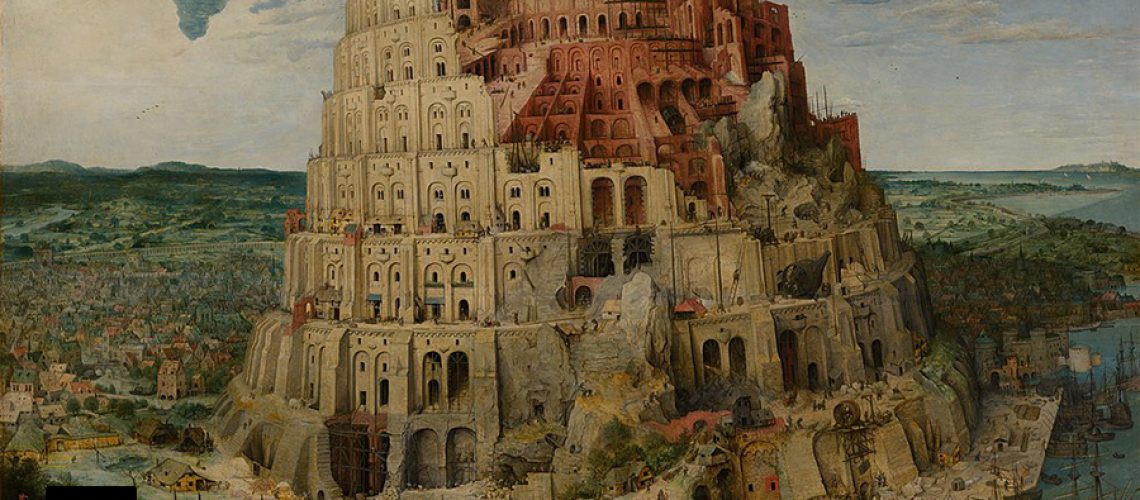
A well-known book among novelists is The Seven Basic Plots by Christopher Booker. Booker argues that virtually all stories ever told fall into just seven fundamental plot archetypes: Overcoming the Monster, Rags to Riches, The Quest, Voyage and Return, Comedy, Tragedy, and Rebirth. If one is a fiction reader, one need not think for long to fit most works into one of these categories.
Similarly, I think that the history of human failure can be summed up, not in seven plot types, but in a single plot type: Babel. From the tower itself, to Aaron bowing to the pressure of the masses to construct a golden calf—like all idolatry, a tangible sign of taking control of one’s own destiny while feigning adoration of a deity—to Gnosticism, to empire building, to the neo-Gnosticism of our times. Call it globalism—call it what you will—but it is the same plot with the same motives, the same lack of faith in the Creator, and the same pride goading us to believe that we can succeed without him.
And, as with the first Babel story, success is never clearly defined and is but a shiny cover for a dark cloud of short-term rewards. It is the abandonment of destiny and the adoption of fate. Fatalism is fatal. Unlike the Catholic global recognition of truth wherever it may abound—a faith that is, in its essentials, the same in every age and in every place, but in its décor, fabulously diverse—modern globalism is a fatalism, a do or die fatalism, with no goals beyond death: a carpe diem fatalism with a single hope: to extend its days.
And, you may ask, what does all of this have to do with Artificial Intelligence or AI? We’ll get there soon enough.
In the 1960s, numerous authors predicted the immanent failure of the food supply to keep up with the growth of the population, destined to result in massive starvation throughout the globe. And while there were certainly some starvation events, they were more distribution related than supply related, having more to do with war and international relations than with production.
Were these pundits wrong? Yes and no. Well-educated people, even thoroughly mis-educated people, rarely make serious math errors. I suspect that their math, like that of Thomas Malthus two centuries earlier, was close to being spot on. Errors are rarely about the math—there’s little room for argument in the realm of numbers—and nearly always about the assumptions on which the mathematics rest.
What neither Thomas Multhus nor the population alarmists of the twentieth century were able to include in their calculations was the unknown. There is no standard numerical constant, no common innovation multiplier to serve future predictions. All of these alarmists were correct in their mathematical predictions. However, their predictions did not include what has come to be known as “the green revolution”, that is, the changes in horticulture, farming methods, fertilizer, and hybridizing. They had no crystal ball. The timing of the innovations was serendipitous to be sure, certainly providential, and necessary.
If civilization is anything, it is fragile. Small cracks create great catastrophes. The green revolution was necessary and timely. I will not take up your time running back through history to point out a list of such turning points, moments where civilization teetered and then recovered balance through seemingly serendipitous innovation or discovery.
Call it innovation, call it discovery, call it what you will, but artificial intelligence is clearly providential. Civilization is, I believe, at a teetering point. Everywhere I look there is evidence of our inability to keep up with the times; that is to say, our inability to harness knowledge at the pace that it is acquired and put it to use serving a civilization that grows more interdependent, and therefore, more fragile daily. The failure, to see artificial intelligence as providential, will, by default, assign its power to evil use.
The only plot there is, when viewed from the highest vantage point—the Tower of Babel plot—will surely rule the day if we let it. The goal will be the same as always: global monopoly. Yes, being concerned about run-away AI taking the reins and doing as it pleases—rewriting its own programming if it is programmed to do so—is a real concern, but a worse concern is an evil monopoly controlling information. That won’t happen if we are vigilant, and killing or ignoring the golden goose will only keep our coffers empty.
What I am saying is very simple: AI is an extraordinary gift, and in any gift of this stature lie immense dangers: danger that it will be ignored; danger that it will be used for evil. The simple truth is that both will happen. Complacency will do its damage, as will alarmism. Greed will play its part. The ideologues and autocrats will embrace it to do their damage.
Could there be a shinier trinket for an ideologue? For an autocrat? I think not. Don’t let them have it. This immense gift belongs, like all things, to God. I, like many, have experienced the temptation to view AI as a prelude to apocalypse. Many believers have looked upon Christ’ words concerning “when the wood is dry” and fabricated from them a sort of Christian fatalism. Yup. AI will be our undoing. Uh huh. Scripture will be fulfilled. We’ve been so proud of our machines—the work of our hands—that we’re practically worshiping them. Yup. Just like Jesus predicted. As though we had some God-given duty to stand back and watch it all go down so that the prophecy might be fulfilled to our limited, impatiently proud understanding.
We embrace this fatalist drivel as though we’re yielding to God’s will. We need to look at the whole picture. In the parable of the unjust judge, Jesus asks, “Will not God then secure the rights of his chosen ones who call out to him day and night? Will he be slow to answer them? I tell you, he will see to it that justice is done for them speedily. But when the Son of Man comes, will he find faith on earth?”
His question is rhetorical. The answer is up to us.
And maybe that’s how it will play out. Perhaps artificial intelligence will be the antichrist’ usher. Or perhaps, via its power to make connections, it will be the servant of so great a reawakening that the world has never seen the like. Hell is infinite embarrassment. What a staggering embarrassment our use of AI for truth and goodness would be for the abyss.
It is not ours to decide that the end is in sight. Deciding so may make it so if we are ready to sheath or intellectual and spiritual swords. Prophets are great listeners, not great extrapolators.
I had just completed writing this article when I read Scott Ventureyra’s article titled “Harari’s Follies at Davos: Setting the Record Straight on AI and Humanity” which does an in depth job of showcasing the logical fallacies of those, like Harari, who would assign to AI attributes, like agency, which it is incapable of possessing. Only persons have agency, and AI will never have personhood. Unlike the Next Generation of Star Trek, in our next generation, the likes of Lt. Commander Data will not have an evil twin. Robots programmed to do evil will not be evil robots. Robots are tools. Tools aren’t evil. Evil requires agency. Evil programmers will be with us until the end of time.
I followed the link to Harari’s speech provided in Ventureyra’s article and quickly discovered, by reading the comments, that Harari had accomplished only what I expected: convincing common people that they should have nothing to do with AI Was that his intent? To scare the masses? In charity, I can only assume that he actually believes what he says, which is sad in itself.
Bishop Fulton J. Sheen of twentieth century television fame could have shaken his finger at television and seen it as the work of Satan and the beginning of the end. Satan has, after all, certainly had his way with many of the networks. However, Sheen, whose canonization appears to be back on track, saw TV for what it was: an immense, providential gift. Dear Servant of God, Bishop Fulton, please pray that we may embrace great gifts as responsibly as you did. May the Church continue to pray the prayer of the psalmist, “Prosper the work of our hands, oh Lord, prosper the work of our hands.”




1 thought on “AI and Babel: The Perpetual Plot”
Dear Mr. German,
Thanks for an interesting calming article, to encourage normal people of true Faith to not immediately despair of AI. However, I appeal to your ‘engineer super-power’, which is to be a problem-solver and offer insights on how to overcome practical human difficulties, to please write a follow-up article to offer us non-Techies some practical examples regarding how AI applications may well-serve also the goals and systems of the Kingdom of Heaven present on the Earth, in the Church. I confess to being already worried at the current dishonest mis-uses of this dramatic new technology, and that I tend to see it as a threat rather than as a gift. No joking here: please do offer us non-Tech types some hopes and possible Godly uses of this powerful new technology for the sake of the Lord’s Kingdom, by His People. Thank you!