
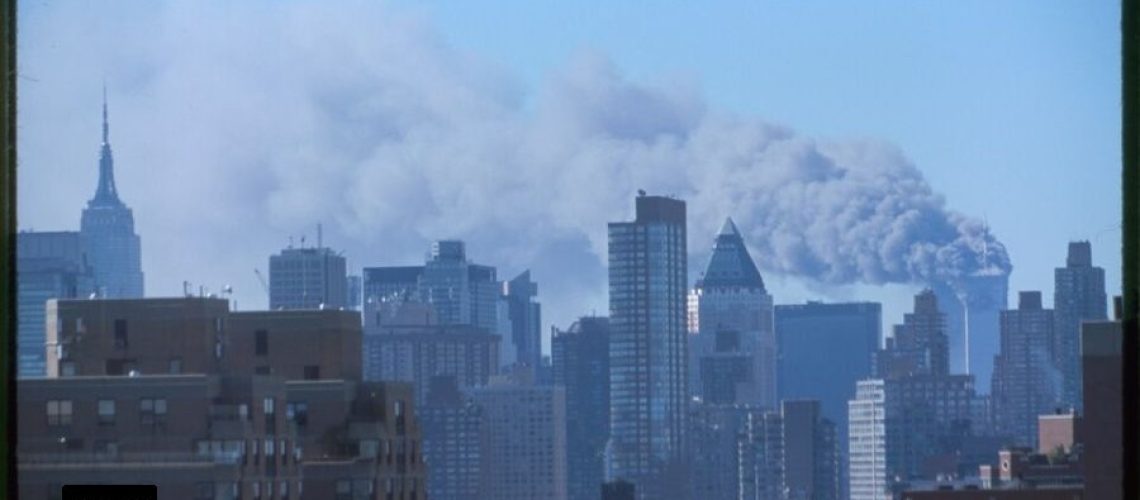
A little early for this sort of thing, but someone I know brought it up. And, so, I wrote down the basics of what I remember about the morning of September 11, 2001.
I was getting ready to leave for work that day and decided to make some breakfast to take with me. I turned on the TV to keep me company and saw one tower smoking. Commentary was confused. I remembered how a B-25 bomber hit the Empire State Building in 1945, and wondered how such a thing could happen again. Then the second plane hit the second tower. I blurted out “That was no accident!”
I had already started cooking some eggs so I finished up, put the food in the fridge and went to work. Soon after I got there someone got a TV set up on our floor, and the whole team (2 floors worth) gathered to watch. We saw the first tower go down, then the second.
Stunned I went back to my desk and started checking news feeds. Soon after that the CEO led us in “a moment of silence” over the PA system and then sent everyone home for the day.
The next day we just automatically began giving our military and military supplier customers an informal but real priority. This was never set as policy, it was just the way things worked out.
Moments That Stand Out
The only other moments I remember as clearly (other than both happy and sad personal moments) are when I heard that President Kennedy had been shot, and later learned he had died. Neil Armstrong’ stepping on the moon, Nixon’s resignation, the 1968 police riot in Chicago, and the evacuation of Saigon are other such moments.
It turns out I’ve seen – and remember – more history than I generally let myself think about.
Which brings me to the subject of the Scripture and the Gospels. Is there any event in history for Christians that surpasses the Resurrection?
Scripture And The Gospels
Is scripture – and especially the Gospels – a gift to us, or something we have created and own? This is a (nearly) polite way of wondering if Scripture is historical or fictional.
Even when I went through my late adolescent revolt against the Faith, I had no real objections to the historic Gospel accounts of Jesus’s life. I might have doubted as to what I believed, but I did not doubt the authenticity of the source material.
If that sounds confused and contradictory, well, it was the 60s. My particular weakness, back then, was that I wanted people to see me as sophisticated, hip, and unswayed by primitive notions and even more primitive emotions.
Beyond that, my family of origin was not merely broken, it was shattered… and more than a little pathological. I spent years of time and effort healing and getting past old wounds and antique trauma. There are some things I wrestle with even today.
So, as might have been predicted, my late adolescent and early adult (playing fast and loose with the term “adult”) rebellion against the ordinary was more about making myself feel “special” than anything else. (See this earlier column on distaste for the ordinary and the fear of “being normal”.)
I mention this to admit that I am painfully aware of how tempting it can be to rewrite one’s life history.
I have seen the temptation indulged to one extent or another in my own ‘nuclear family.’ I ended up living exclusively with one branch of my family after the age of 10. I separated from the other branch only to establish a distant, loose, and uncomfortable détente with it later in my 20s.
This also applied to my wife’s family – an international, multicultural assemblage of shifting rules and hidden motivations – sometimes hidden to the point of being both unknown and unknowable.
One might expect this to make me especially susceptible to various theories of Scriptural analysis of various human needs that come into play when discussing the validity and authority of Scripture. These analyses include the need for validation and for an intrinsic human authority to remake what is actually written into a person’s projection of “what is really meant.” They also include the rank reinterpretation of the substance depending more on what someone wants or needs Scripture to say than what it says.
Gifts That Are Given, Not Things We Have Made
As Catholics – as Christians – we hold that Holy Spirit helps the leaders of the Church teach the truths of Christianity. He guides us when we are willing to listen and patiently, indefatigably pulls us and pushes us back on track over time when we stray.
What we hold as a central fact is this: that the Church and the body of the Church’s teachings are not of human origin, but are gifts from God. They are entrusted to us for our use and nourishment, yes, but in the end they are not ours. God gave us these gifts and He and the Holy Spirit sustain, protect and preserve them. Their preservation is not due to own poor, sometimes misguided efforts.
I sit down to write one of these columns almost every month, usually at the same time each month. (Lately, however, some health issues have played a bit fast and loose with my scheduling.) I have heard three humorous variations of the writing process over the years:
(1) Writing is easy. You just open a vein and bleed.
(2) There’s nothing to writing. All you do is sit down at a typewriter and open a vein.
(3) Writing a column is easy. You just sit at your typewriter until little drops of blood appear on your forehead.
(The third one has always been my favorite. I first encountered it in a book by the humorist H. Allen Smith.)
Most writers will tell you that their work experience validates some variation of these sayings. There is little in life that is as wonderful as having written. But there is also little more terrifying and terrible than the process of accomplishing it.
That being so, one might think that that a writer would be eager to claim all possible credit for producing the words that flow out on the page or on the glowing screen that has replaced paper for so many of us.
Indeed, when you have struggled and fought and pushed yourself back to the keyboard multiple times to wrestle with a stubborn bit of prose that just does not want to seem to take proper shape and express what you imagine you want to say, there is a sometimes overwhelming desire to take credit for the final product.
It Doesn’t Come Out The Way You Might Have Imagined
In all honesty, I have yet to produce a single piece of writing that came out as I imagined it would when I first sat to put down the words. This is true of the first, painfully derivative short story I wrote in the 6th grade. It’s also true of the syllables you are reading now.
I may tell myself I am writing, and I may tell others “I spent last night working on my column” or “I got another chapter done in the volcano novel last week” – but no matter how often I got up and paced, or how wet my T-shirt got from effort, or how much I mumbled, backed up, cut and pasted, started over, and invented whole new vocabularies of imprecation to be applied to deadlines, the muses, and my poor, abused and long-suffering editor…at the end, when I read what I have written, I find something in it that I cannot completely account for. I remember writing it; I remember thinking something had to go here…but it was not in my mind when I started and I cannot account for its creation; it simply appeared someplace between the mind, the fingers, the keyboard and the display.
God created us in His own image. He expects that we will become creators ourselves – not ex nihilo, of course, but from out of the raw material of learned fact, observed events, discernment, education, and experience.
Essays Are Not Fiction
Most of my published work has been non-fiction (though some of the politicians I covered in my past as a newspaper reporter might wish to disagree).
Unlike straight reporting, essays are composed of some fact (one intends), some reportage of experience, some opinion, and even some thought – some of it possibly original. The exact mix is subject to the needs of the publication and the topic.
But even fiction is not completely fictional. To be successful, fiction has to be plausible. Even the most far-fetched science fiction or fantasy has to “ring true” for it to be readable; if it is not, readers would reject it, assuming any editor ever allowed it to pass their guarded gates.
In my early days in newspaper work, my primary manager complimented me on being prolific.
“Are you kidding?” I said. “Reporting is easy. All you have to do is write down what actually happened and then stop. Fiction has to make deep sense or it ends up unreadable.”
Essays are different. Essays have to make sense out of those things that – we think – actually happened. They have to stick to the factual as much as possible, with only an occasional analogy permitted. Potentially, the essay can offer the worst of both worlds for the writer.
Great Events Draw Us In
Among the great events of my lifetime are the Kennedy Assassination (and the dismal round of killings and assassinations that we all feared might become commonplace that followed), and the 9/11 attacks. There are others, but those are the two you can almost always count on someone being able to tell you where they were and what they were doing when they heard the news.
Great events draw us in. We cannot help but remember where we were and what we were doing when we heard.
I was not yet born in 1941, but every adult I ever met in my youth could tell me where they were and what they were doing when they heard the news about Pearl Harbor. This tells me that this singular capacity of the human being is crucial to understanding how we pass understanding along to our children and our children’s children. After the Kennedy Assassination and later, after 9/11, I saw how the mechanism works in us all.
This is true with the Bible as well. The accounts of the Resurrection do not actually feature the Resurrection. They recount the circumstances and reactions of the Apostles and the early community to hearing of the empty tomb.
- In Matthew, Jesus appears to Mary Magdalene and another woman before sending the disciples to Galilee.
- Mark describes the empty tomb and has an angel telling women including Mary Magdalene to notify the disciples and Peter.
- Luke reports two angels at the tomb, two disciples walking Emmaus and encountering Jesus, and Jesus appearing to the disciples in Jerusalem.
- John tells of Mary Magdalene going to the tomb and meeting with two angels, then of the risen Jesus outside the garden tomb, and of evening appearances to the apostles.
And here we have it. Where they were and what they were doing. No explanations or explications. No moral points. Just the strong, solid memories of where they were and what they were doing when they learned, when they encountered the Risen Lord.
This is much like my memory of fixing breakfast when I saw the plane fly into the tower on TV. It’s also like the indelible picture I have of the school lunch line when the school principal rushed in with his face white and his voice breathless, saying “They just shot the President!” Then he shook his head, and rushed off elsewhere to tell whoever.
Scholars may expostulate, theologians may opine and reflect, pastors may preach. But the simple words of the Gospels match my experience of news of great events that have happened in my memory.
Vivid. Unadorned. The impact is portrayed without the event being detailed.
This happened. The world rocked around those for whom it had meaning, taking a moment to resettle and move forward again, forever changed, the meaning of all things forever altered. This is what real memories of a suddenly experienced, unexpected event looks and feels like.
For me, at least, this is how I know it is real.

