
We are now firmly ensconced in “Ordinary Time.” But even ordinary time is not that ordinary.
Ordinary Time includes the days between the end of the Christmas season and the beginning of Lent. But it also includes the days between the end of the Easter season and the beginning of Advent. Christmas celebrates the birth of Jesus, and Easter the death and resurrection. In ordinary time, however, we focus on the life and ministry of Jesus.
The United States Conference of Catholic Bishops says
“Ordinary Time is a time for growth and maturation, a time in which the mystery of Christ is called to penetrate ever more deeply into history until all things are finally caught up in Christ. The goal, toward which all of history is directed, is represented by the final Sunday in Ordinary Time, the Solemnity of Our Lord Jesus Christ, King of the Universe.”
The word “ordinary” carries a lot of meanings in Catholicism:
- Those days in the church calendar not included in the major seasons, such as Christmas and Easter, as mentioned above.
- The parts of the liturgy of the Mass that do not change. (The parts that do change are the “propers,” including such things as the readings, the psalm, the Collect and other special prayers, and so on.)
- Ordinary jurisdiction is that which is part of a church office – a bishop, for example, who is known in this context as the ordinary.
- Levels of care, such as in medical situations. For example, a nasal cannula administering oxygen would be considered ordinary; attaching someone to an ECMO machine (which oxygenates blood outside the body) is not.
Our focus is on calendar days.
The Seasons Of The Church
Seasons are a natural way to organize the cycle of feast and fast days of the church, beginning with the primary seasons of Christmastide and Eastertide. The church seasons reflect stages of the life of Jesus, so Christmas and Easter are obvious choices, marking and beginning and the end of Jesus’ Earthly life.
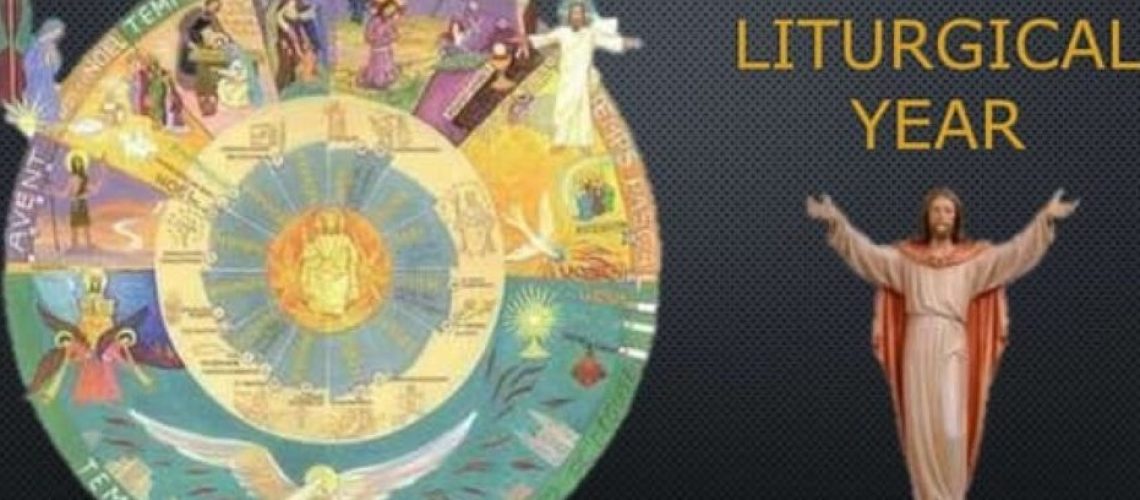
The Church year begins in Advent, and proceeds through various seasons into the second stretch of Ordinary Time. The yearly cycle then starts again. The various seasons are ordered as follows:
Advent
Christmas
Epiphany
Ordinary Time
Lent
Triduum
Easter
Pentecost
Ordinary Time
Advent and Lent are seasons closely enough related to Christmas and Easter that many people think of them – or feel about them – as prequel extensions to the major seasons.
Click this link to view a Wikipedia diagram of the liturgical year. Notice the colors associated with each season. These associated colors determine the color of vestments and various adornments of the altar, lectern, and pulpit throughout the year.
Ordinary Time
The Second Vatican Council formally established the term “Ordinary Time.” Prior to Vatican II the Church called these two periods of time “the Season after Epiphany” and “the Season after Pentecost.”
It is important to note that ordinary time gets its name because the Sundays are numbered rather than named. The term ‘ordinary’ thus refers to ‘ordinal’ as in numbered. Even so, we tend to think of “ordinary time” as ordinary in the sense of not being exceptional. This is because, as a season, ordinary time is not dedicated to a special period of time in the life of Jesus as are, say, Christmas and Easter.
Consider, also, that ordinary tasks, duties, and even entertainments occupy most of our lives. So too, the lack of a special theme or occasion (on the whole) for the Sundays in ordinary time makes it easy to think of them as “ordinary” in the sense of not being special. Yet many saint’s days and special feasts and fasts populate the calendar during these times.
We spend most of our lives doing ordinary things and in ordinary occupations. We simply cannot live most of our lives in a continuous peak, with each moment surpassing the previous one. Even so, what constitutes ordinary can vary wildly from one life to another.
The ordinary life of an accountant is much different than the ordinary life of a paramedic. Not that one is stressful and the other is not; both can have periods of great stress. But the stresses are generally of different kinds. The rapidity of transition from one moment to the next generally differs wildly between these two examples.
It is generally accepted that Jesus’ ministry lasted about three years, perhaps as many as three and a-half years. But the Gospels focus on highlights and moments of special teaching significance. Many of the Gospel stories also focus on wonders and signs.
We have no idea how much time Jesus spent walking from one place to another without surrounding crowds. We also have no way of knowing how many hours Jesus spent in ordinary teaching to small groups. Similarly we do not know how much time he spent at work as a carpenter to support His ministry.
Reading the Gospels we get a sense that He might well have set aside time to be with His closest disciples for special teaching, but we have no idea how much time, if any, He devoted to them.
Even so, most of the time of His ministry would be ordinary essentially by definition, even if the events themselves would seem extraordinary from our perspective.
Redeem The Time
One of my favorite hymns when I was young was “Come Labor On”, which contains the phrase “Redeem the time; its hours too swiftly fly.” This sentiment comes forward to me when I contemplate the numbered days of Ordinary Time.
The calendar provides us a specific focus for Christmas and Easter, and their preparatory seasons. For Ordinary Time we can find ourselves on our own. This is when our sensitivity to what God may be calling us to do in service becomes most important. If nothing else, we can spend some Ordinary Time in developing that sensitivity. Like the Sundays of Ordinary Time, our days are numbered, and we have a responsibility to use them well.
I close with two of the verses of that old hymn:
Come, labor on.
Cast off all gloomy doubt and faithless fear!
No arm so weak but may do service here.
Though feeble agents, may we all fulfill
God’s righteous will.
Come, labor on.
No time for rest, till glows the western sky,
till the long shadows o’er our pathway lie,
and a glad sound comes with the setting sun,
“Servant, well done!”



[…] Here We are in Ordinary Time – Mark Belanger at Catholic Stand […]
‘Ordinary’ can also mean an amalgam of theological possibilities and outcomes based on historical precedent.
Nicely put!
Thank you, since I later felt it should have been better elaborated.