

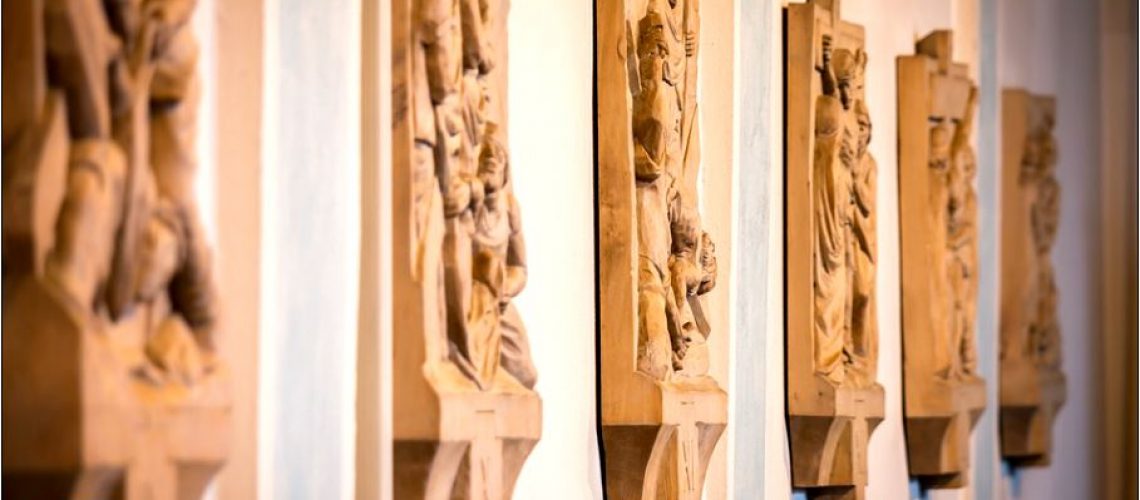
A friend of mine asked me three questions and I’d like to share those questions and answers with you, the reader. The first question: “Why am I meditating on the Stations of the Cross when it is not even Lent? I answered as follows; “Isn’t every day like a day of lent? As long as there is sin in the world, prayer and sacrifice will be necessary for salvation, and prayer plus sacrifice, in my opinion, is synonymous with lent.” “But why do you come to the Church to pray, meditate, and write? Can’t you do these things at home in the comfort of your office?” I answered again: “I could do those things at home, but I would not pray, meditate or write as well because there is a profound difference between being at home or being at the church.” My friend responded: “What difference is that, may I ask?” My final answer which ended the conversation: “There are angels here, quite a few; it is indeed a Holy place, and that helps, it helps a lot.”
So once again I find myself walking, praying, and meditating on the Stations of the Cross. Today my focus is on Stations 11 and 12: Christ nailed to the cross and the death of Christ on that cross.
Station 11: Jesus is Nailed to the Cross
As I look at this station and pray, my thoughts shift to the humanity of Christ, who is and was and always will be truly man and truly God. Totally human and totally divine—the essence of the Incarnation expressed so well in sacred scripture: “In the beginning was the Word, and the Word was with God, and the Word was God. All things came to be through him, and without him, nothing came to be…And the Word became flesh and made his dwelling among us, and we saw his glory, the glory as of the Father’s only Son, full of grace and truth.” (John 1: 1-3, 14, NAB). The incarnation, indeed, a miracle, a unique and awesome miracle.
As I continue to pray and gaze at this station it is as though I am there, standing on the side lines watching the agony and infliction of pain as spikes are driven into his hands and feet. I see no miracles here, only suffering, the physical suffering as cold, iron spikes rip through his body, the mental and emotional suffering as the guards and the executioner’s scorn who they believe is a criminal, deserving death. They do not know of his innocence as we do. For them, he is a criminal, a Jewish criminal like so many before him, deserving of death, a brutal death because Caesar has made it so, and for the Roman soldier or executioner the justice of Caesar is just, and this man, Jesus, deserved to have spikes driven through his hands and feet so that justice could be served. There is no guilt or delay as the executioners and soldiers prepare our Lord for death. This is what I see as I pray and look upon our Lord on the Cross.
With that much pain, torment, and hate directed toward him, I wonder how Jesus felt at that moment? I believe that he felt what I would have felt if I were there instead. The pain permeated the surface, finding its way into my soul. In his place, I would have been a tormented man, tormented beyond anything I could imagine. Would I lose hope? Would I lose faith? Would I still believe, trust and love God the father?
Christ could not despair because he is without sin and grace abounds in him, not only in his divine nature by necessity, but also, in his human nature by choice. Perhaps, a lesson to be learned from this station is that no matter how bleak and desperate the moment is, we should not, we cannot despair, but carry our cross as Jesus tells us:
Come to me, all you who labor and are burdened, and I will give you rest. Take my yoke upon you and learn from me, for I am meek and humble of heart; and you will find rest for yourselves. For my yoke is easy, and my burden light (Matthew 11:28-30).
Station 12: Jesus Dies on The Cross
As I look at this station I see life, healing, and love in abundance. And I see all of this in the death of our lord. Without his death, we have no life. I also see two people, only two, at the foot of the cross. The blessed mother of God and St. John, the Apostle. Only two to worship our Lord at the Altar of the cross where the greatest sacrifice in history took place. Only two witnesses were present for his healing, his love, and his sacrifice meant for the world.
In my thoughts, the healing from the cross transcends time; it is past, present, and future. During the Exodus this healing was found in the desert on a pole with an image of a bronze serpent when God through the priesthood of Moses (Psalms 99:6) healed the penitent Israelites: “So Moses prayed for the people, and the Lord said to Moses, ‘Make a seraph and mount it on a pole, and if anyone who has been bitten looks at it, he will recover” (Numbers 21: 7-9). We also know, through instruction, experience, or both, that this healing is found through the Holy Sacrifice of the Mass (CCC 1386). The healing is there; it is God’s way of being with us always until the end of time, through the Mass and the Holy Eucharist.
As we receive holy communion each of us is healed differently because each of us is unique. My pain is not the same as your pain, but if I give it to the Lord, I can share it with him, and he in turn will share his healing with me. Because my pain is different from yours, my healing is also different from yours, yet it is the same Spirit, the Spirit of Jesus, the Holy Spirit that heals you and me.
In many ways, the healing offered in the Sinai desert, on Calvary, and through every Mass is a Pentecost where there was such diversity. Each person heard the Apostles speaking of Jesus and the new covenant in his own language (Acts 2:3-4). Different gifts, different healings, but all the same Spirit.
I bring this meditation to a close with thanksgiving; thanks to God for his help and his healing which comes to us through the cross, the crucifixion, and the Holy Mass where my suffering can be merged with the sufferings of Christ. I thank God for the mystery of the Mass which I will never completely understand in this life. I can understand enough to know that it is the source of healing and that’s good enough for me, for now.





6 thoughts on “Healing and Holiness Through the Death of our Lord:”
Peter,
Thank you for your additional comment. I’m sure that the Eucharist proclaims the death and the resurrection of our Lord. However, it is so much more than that: “At the heart of the Eucharist celebration are the bread and wine that, by the words of Christ and the invocation of the Holy Spirit, become Christ’s Body and Blood.” (Catechism of the Catholic Church 133).
The cause is a miracle, at every Mass a miracle occurs. The proof is the tremendous healing and peace received through every Mass.
God Bless and thank you for reading my article
richard.
Peter,
Thank you for your comment. Yes, I agree, the Eucharist is our life; I pray for those who are unable or unwilling to receive Christ in Holy communion.
richard
The sacraments associated with receiving the Spirit of Christ are Baptism and Confirmation. The Spirit of Christ needs to be within us prior to participation in the Eucharist, otherwise we are not in the state of grace.
The Eucharist is for proclaiming the death of Christ until He returns.
We were healed, are being healed, and will be healed. We consume His Divine Flesh that we may be made one flesh with Him, that through our union with Him we may be, like Him, resurrected according to God’s Will.
SE,
I wholeheartedly agree with your comment.
Thank you for your response
richard
Jesus transfers His human rest from His meekness and humility towards the Father into us when His Spirit is within us and we yield to Him. Jesus’ death on the cross enabled us to receive the healing and life that come from His Spirit.