
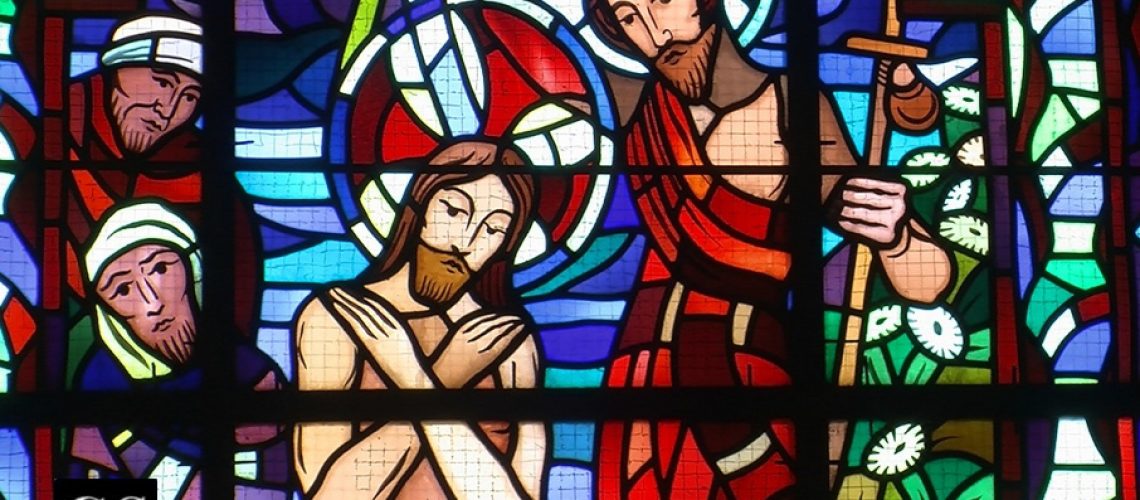
He Must Increase, I Must Decrease
The Isenheim Altar Piece is a famous series of paintings by Matthias Grünewald done in 1512-1516 A.D.
He painted it for a monastery that operated a hospital that specialized in caring for people with skin diseases and the plague. The central panel has an image of Jesus on the cross. John the Baptist is shown at the foot of the cross (although he had been murdered by order of the drunken King Herod before the crucifixion). The painting includes John’s words in Latin – “illum oportet crescere me autem minui.” These words are usually translated as “He must increase, but I must decrease.”
These words of the Baptist are from the apostle John’s gospel:
And John also was baptizing in Ennon near Salim; because there was much water there; and they came and were baptized. For John was not yet cast into prison. And there arose a question between some of John’s disciples and the Jews concerning purification: And they came to John, and said to him: Rabbi, he that was with thee beyond the Jordan, to whom thou gavest testimony, behold he baptizeth, and all men come to him. John answered, and said: A man cannot receive any thing, unless it be given him from heaven. You yourselves do bear me witness, that I said, I am not Christ, but that I am sent before him. He that hath the bride, is the bridegroom: but the friend of the bridegroom, who standeth and heareth him, rejoiceth with joy because of the bridegroom’s voice. This my joy therefore is fulfilled. He must increase, but I must decrease. He that cometh from above, is above all. He that is of the earth, of the earth he is, and of the earth he speaketh. He that cometh from heaven, is above all. (John 3:23-31).
The Latin word translated as “increase” means to grow, and conveys a sense of becoming great, increasing in fame or power. The original Greek word used by the apostle John literally means to be amplified and conveys a sense as used by John of becoming more important. The Latin word for “decrease” means to lessen or diminish. The original Greek word means to make less in rank or influence.
John the Baptist’s words have been translated in various ways:
He has to become greater while I become less.
His ministry must grow and I must become lesser in popularity.
He must be exalted, I must be diminished.
He must grow in the hearts and minds of the people and I must have less.
However his words are translated, the Baptist’s statement is about his realization that he must be humble, particularly as regards the earthly praise and notoriety he had achieved before Jesus began His public life. We do not know how many followers he had, but his words are spoken in reply to some of them who no doubt held John the Baptist in very high regard. They address him as “Rabbi,” but he reminds them, in all humility, that he has already told them that he is not the Messiah and that Jesus is “above all.”
Jesus’s words, deny yourself, are another way of saying what John said:
Then Jesus said to his disciples: If any man will come after me, let him deny himself, and take up his cross, and follow me. (Matthew 16:24)
While John the Baptist was still alive, Jesus praised him, not for what he may have appeared to achieve in terms of earthly fame and glory, not for the celebrity he had achieved as a teacher and holy man, not because he had many followers, but for what he had done to “decrease” so that Jesus could “increase.”
Jesus said this about His cousin, John:
As John’s disciples were leaving, Jesus began to speak to the crowd about John: “What did you go out into the wilderness to see? A reed swayed by the wind? 8 If not, what did you go out to see? A man dressed in fine clothes? No, those who wear fine clothes are in kings’ palaces. 9 Then what did you go out to see? A prophet? Yes, I tell you, and more than a prophet. 10 This is the one about whom it is written: ‘I will send my messenger ahead of you, who will prepare your way before you.’ Truly I tell you, among those born of women there has not risen anyone greater than John the Baptist; yet whoever is least in the kingdom of heaven is greater than he. From the days of John the Baptist until now, the kingdom of heaven has been subjected to violence, and violent people have been raiding it. For all the Prophets and the Law prophesied until John. And if you are willing to accept it, he is the Elijah who was to come. Whoever has ears, let them hear. (Matthew 11:7-14).
John the Baptist went on to “decrease” to the point of being imprisoned for telling the truth, in public, about King Herod Antipas’s adulterous affair with his sister-in-law, Herodias. Alone in a cell, with none of his followers present, he was beheaded. No crowd cheered on the executioner. The executioner alone, and perhaps some with him, heard any last prayer John may have said. Today no one knows for certain the location of John’s bodily remains. There is no earthly monument raised to honor him. This is the man Jesus described with the words “Those born of women there has not risen anyone greater than John the Baptist.”
St. Paul On How To Decrease While Publicly Evangelizing, Ministering & Teaching
In one of his epistles to the Corinthians, St. Paul speaks about how he serves the people. He presents a textbook summary of how one ordained can avoid the danger and temptations of “increasing” in response to the adulation and praise that can easily accompany public ministry.
And I, brethren, when I came to you, came not in loftiness of speech or of wisdom, declaring unto you the testimony of Christ. For I judged not myself to know anything among you, but Jesus Christ, and him crucified. And I was with you in weakness, and in fear, and in much trembling. And my speech and my preaching was not in the persuasive words of human wisdom, but in shewing of the Spirit and power; that your faith might not stand on the wisdom of men, but on the power of God. (1 Corinthians 2:1-5 )
Paul does not proclaim his God-granted status as an apostle to the Gentiles. He does not entertain. He does not focus on himself. He made it clear that he would not present himself as a skilled public speaker or an actor on a stage expert in dramatic presentations and histrionics. Any of these things which had the potential to “increase” Paul in public fame, popularity, and celebrity would detract from the message – Jesus Christ and Him crucified.
It is easy in our me-me-me now-now-now more-more-more world of constant entertainment and eye candy on screens that are everywhere to focus on ourselves, to “increase” in worldly terms, while either intentionally or without a thought “decreasing” Jesus. In this world where we are taught to grab for all the (earthly) gusto we can, we have a clear path to get us to our true home in heaven: humility. Decrease as did John the Baptist and deny ourselves as Jesus told us to do.


[…] He Must Increase, I Must Decrease – Guy McClung, Ph.D., J.D., at Catholic Stand […]
[…] On mora rasti, ja se moram smanjivati – Guy McClung, Ph.D., JD, na Catholic Stand […]
[…] and Analysis:He Must Increase, I Must Decrease – Guy McClung, Ph.D., J.D., at Catholic StandGet Behind Me, Satan! Reflection on These […]