
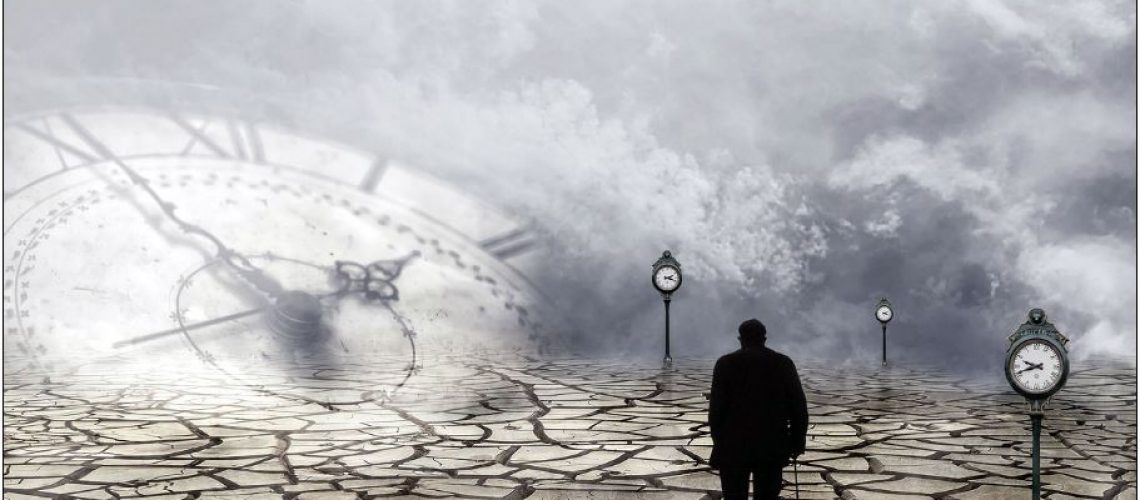
“Do not go gentle into that good night…Rage, rage against the dying of the light.” —Dylan Thomas
“If I had my life to live over again, I would form the habit of nightly composing myself to thoughts of death. … There is not another practice which so intensifies life.”— Muriel Spark, Memento Mori
Shall We Go Gently?
I’m now 96, living at a senior residence (euphemism for old folks’ home) where the conversation is either about the Philly teams, or aches and pains. Putting on my pants while standing up is an adventure, as is all activity for which I can’t use a walker or picker-upper. The aches and pains are immediate reminders that we do not usually go gently into that good night, though complaining is not the raging Thomas had in mind. Would being vocal about my hip arthritis be therapeutic, mentally if not physically? I think not.
Interior vs Exterior
Lewis Carroll’s white-haired Fr. William, sure that he has no brain left, is perfectly willing to stand on his head again and again. This is the big question: what should be done if my mind becomes as decrepit as my body? I have seen signs of what could happen at Masses I used to attend in the chapel of a local nursing home, managed by an order of Catholic nuns. The nursing home is also a rehab center for patients with Alzheimer’s and other senile mental disorders. Many of the elderly nuns were there for either physical rehab, nursing care, or Alzheimer’s.
During the Mass I would occasionally hear one of the patients (not one of the nuns) making a comment—”that’s beautiful”, “praise God”, “where’s my watch”, “thank you, Father”. As the priest made his rounds handing out Holy Communion to each of us, visitors and patients, I would look up and see one of the patients sleeping; the priest or the Extraordinary Minister of Holy Communion (a nun) would gently nudge the patient and slip a small portion of the Host into her mouth. I would see another nun, sleeping during the Mass; her hands folded in prayer, she would seem oblivious to all that goes on around her, even when asked to receive the Host. I recall that five or six years earlier–she was sharp, witty, alert, managing a large enterprise for the order. What are her interior thoughts now, I would wonder? Her hands folded in prayer–does that posture mirror an interior devotion?
Which direction will I take–will my exterior display of what I’m thinking disappear? Will there still be an interior self to contemplate and pray?
Memento Mori
As I think of growing old and last days, I recall the Ash Wednesday injunction: “Remember man, thou art dust and unto dust thou shall return.“ The Latin motto, “Memento Mori” (remember that you have to die) was important in Medieval times for those pursuing an ascetic discipline, to hone their thoughts to the hereafter.
And in our own time, we have Memento Mori, a wonderful novel by Muriel Spark about forethoughts of death and how they enhance life. In the novel, a group of elderly people—arty and social types—receive occasional phone calls (before the days of cell phones) “remember you must die.” Their lives go on, perturbed somewhat by the calls, but not exceedingly so. As some confront death, they compose themselves for an end to life, as the quote above suggests. At the end of the novel, it is not clear who has been sending the phone messages—perhaps God?
A Better Road
So, as we grow old how should we contemplate visiting that “undiscovered country”? Should we follow Dylan Thomas’s advice to his father, fight and rage? Or is there a better way? I’ve been fortunate to find a better road, my Catholic faith and the first three of the Twelve Steps.
Let me explain how the first three Steps work.
STEP 1: “We admitted we were powerless over (an addiction goes here), that our lives had become unmanageable.”
Outside of science fictional downloading of one’s mind or unlikely cryogenic techniques there is no way to avoid death—we are powerless over death. Being afraid of death is not an effective way of dealing with something that is inevitable.
STEP 2: “Came to believe that a Power greater than ourselves could restore us to sanity.”
For this situation, sanity—a right way of thinking—corresponds to fundamental Catholic doctrine. The soul is immortal and, moreover, body plus soul can be resurrected. The nun with hands folded for whom intellect was a gift almost forgotten still possessed a soul, a soul that could engage in devotion.
STEP 3: “Made a decision to turn our will and our lives over to the care of God as we understood God.”
Trust in God is the tool by which we engage Step 3. We live so as to be worthy of the Mercy of Jesus, as expressed in the Litany of Trust, confident that Jesus loves us and transforms us, despite our sins and failings.
So the short version of the steps — I can’t, God can, I’ll let God do it — is the ramp onto that thruway to the undiscovered country.


“From too much love of living, from hope and fear set free, we thank with
brief thanksgiving whatever gods may be, that no life lives forever, that
dead men rise up never, that even the weariest river, winds somewhere
safe to sea.
C. A. Swinburne