

“When he uttereth his voice, there is a multitude of waters in the heavens, and he causeth the vapours to ascend from the ends of the earth; he maketh lightnings with rain, and bringeth forth the wind out of his treasures.” Jeremiah 10:13 (KJV)
Introduction
Leftist politicians and MSM practitioners have made much noise about the danger of global warming caused by man-made CO2 (and to a lesser extent, the CH4 in cow farts), but have not supported their claims with facts or scientifically valid reasoning. My purpose in this article is not to rebut their claims, but rather to make the point that the changes in climate which have occurred in the past and can occur in the future are due to natural, non-anthropic causes. Which is to say that these changes occur no matter what humans do or don’t do.
The short term time scale climate changes called weather are certainly non-anthropic. And even if the butterfly in Australia beats its wings and causes a tornado in Kansas (as a chaos theory of weather would have it), most butterflies beating their wings have no effect on the weather. It takes generally much energy (in the physics sense of that word) to affect weather.
The Tonga Volcano Eruption
One event that had such energy was the recent underwater eruption of the volcano Tonga (full name: Hunga Tonga-Hunga Ha’apai). According to an article by Jeff Childer on Substack, the dire consequences of this eruption will meet the most pessimistic predictions of global warming advocates in the near future.
In this article I don’t intend to analyze Jeff Childer’s propositions in detail. Rather, I’ll try to draw a big picture of what might be going on, guided by historical events and plausible scientific inferences. I hope the reader will look at the references given below about the Tonga eruption and the more general ones about climate, what is and is not science, to get a complete story.
Let’s first briefly examine what occurred in the Tonga eruption
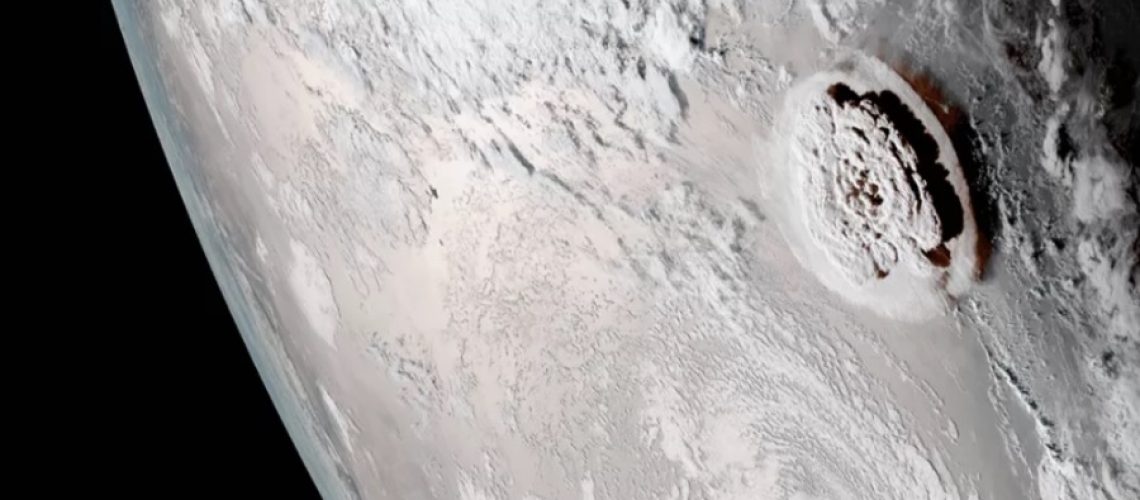
In the center of the featured image is a satellite image of the volcanic eruption that occurred in January 2022. You can get a qualitative idea of the scale from the curvature of the horizon. Below is a time lapse image showing the eruption as it first broke the ocean-air interface:
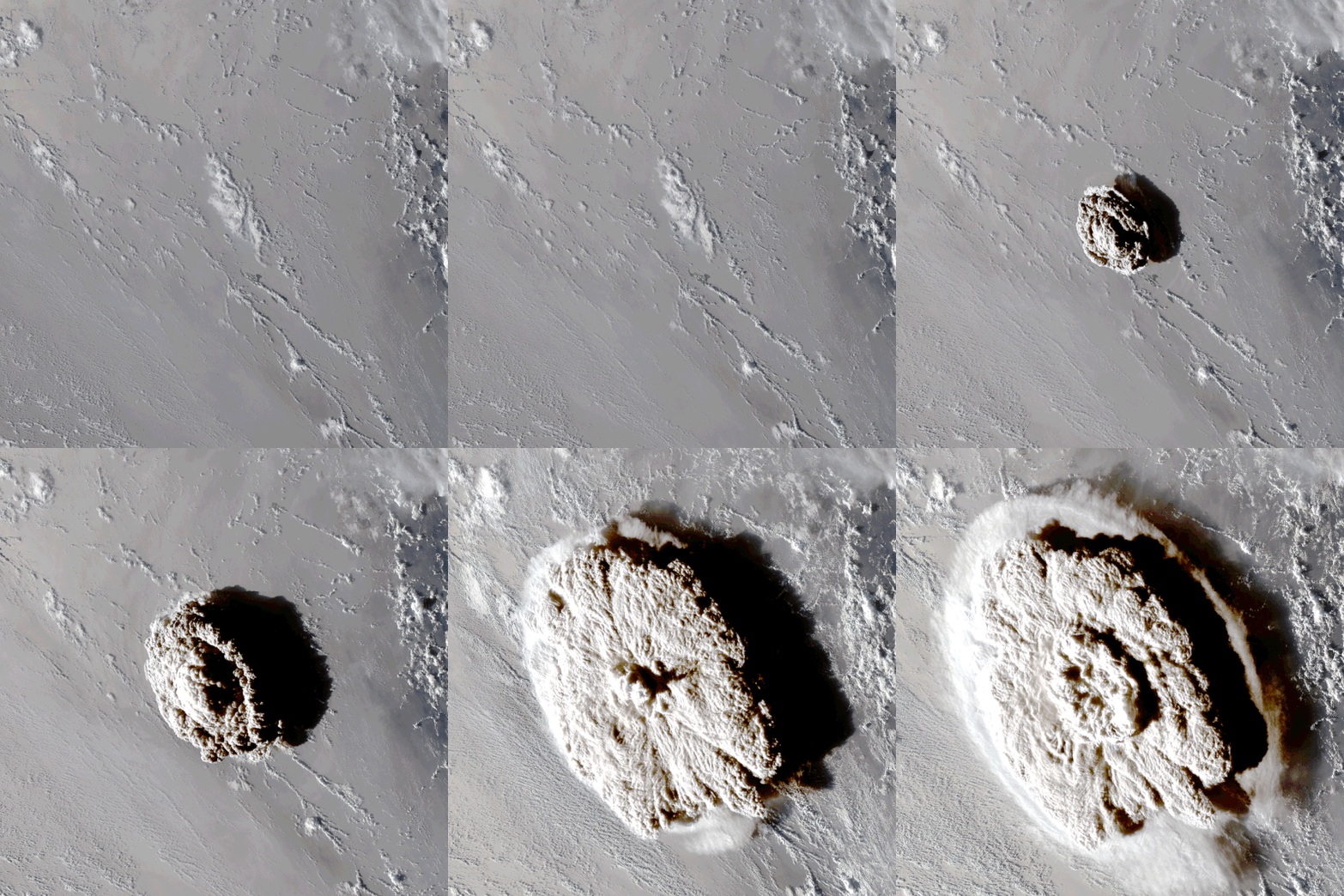 From NASA via Wikimedia Commons
Let’s continue with the pictorial representations of the Tonga eruption (as the Chinese saying goes, “one picture is worth…”):
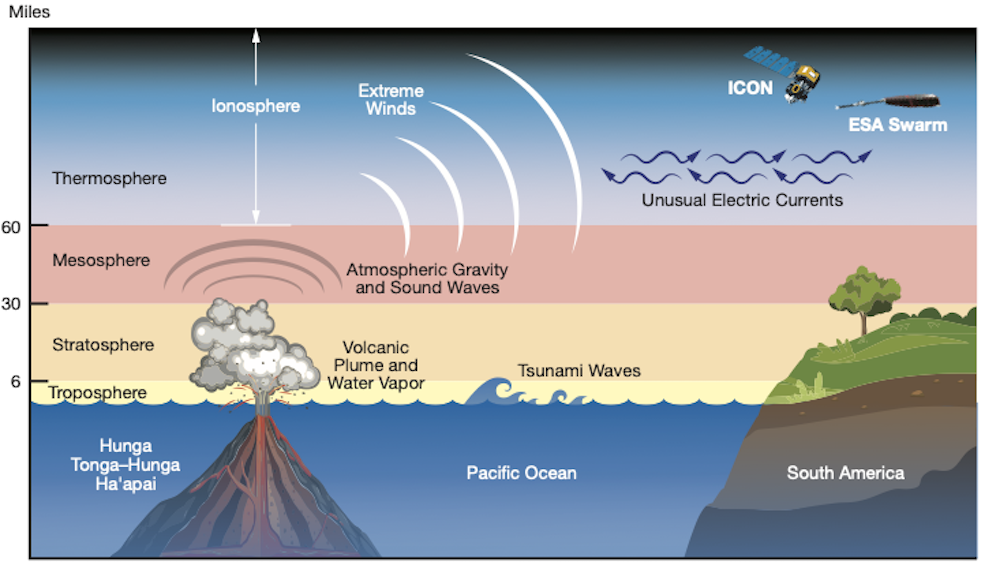 NASA’s Pictorial Representation of Tonga Volcano Eruption,
Credit: Goddard Space Flight Center/Mary Pat Hrybyk-Keith
Besides the effects shown in the picture above—tsunamis, plasma currents in the thermosphere, ejection of huge amounts of water into the atmosphere—the eruption caused sea water temperatures to increase and roiling of the sea bed. Melting of antarctic ice resulted from warmer sea water. Since H2O is a greenhouse gas (see below), one might expect a warming effect from the eruption, unlike that from other major volcanic eruptions. (See this article about the “Year without a Summer.“)
Let’s look at this natural catastrophe from a historical and scientific perspective.
Perspective: Long Term Climate and Solar Activity
In the past, before man-made CO2 could possibly contribute to global warming, there have been periods of warmth and cold. In recent history there was the Medieval Warm Period (MWP, roughly 950 to 1300) followed by the Little Ice Age (LIA, roughly 1400 to 1700). During the MWP Greenland was colonized by Vikings who had to leave when the cold came. During the Little Ice Age, the climate became much colder; for example, the river Thames froze almost every year in the winters between 1600 and 1800.¹ Soon and Baliunas have proposed that fluctuations in solar output, indicated by sunspot activity, correlate with such temperature variation and may be causal. (Of course this interpretation has been criticized by global warming advocates.)
Perspective: Greenhouse Gases
What is a greenhouse gas? The term comes from warmth in greenhouses due to emission of CO2 by plant respiration. How does this occur? Here’s a brief explanation. Polyatomic molecules (molecules with three or more atoms) can vibrate in a bending motion. The discrete frequencies of these vibrations lie in the Infrared (IR) region of the spectrum, the region corresponding to heat radiation. IR radiation at the vibrational frequency can be absorbed by a molecule, increasing its vibrational energy, and then re-emitted, the molecule reradiating the absorbed radiation and going back to lower vibrational energy. Now, not only CO2 but also H2O is a greenhouse gas. And there is much more H2O in the atmosphere than CO2. Indeed, the effect of H2O is clearly shown on cloudy nights—the night temperature on a cloudy night is much higher than when the night is clear, other factors being the same. Also note the direction in which radiation re-emits is essentially random since the molecules rotate. Thus one could expect half of the thermal radiation absorbed by a greenhouse gas to go back to earth and half out to space.
Perspective: Vulcanism
Catastrophes from erupting volcanos have been noted through history from Aetna to the most recent, Tonga. In almost all cases there is a large amount of particulate matter emitted into the atmosphere, ashes, cinders, aerosols, etc., that shield the earth from sunlight. This results in cooling, as occurred in 1816, “The Year without a Summer,” after the tremendous eruption by Mt. Tambora. There is usually a large amount of sulfur dioxide, SO2, emitted in volcanic eruptions. However, SO2 does not act as a greenhouse gas. Since after a cursory internet search, I have not found out why this is so, I’ll propose the following explanation: SO2 combines with with H2O to form sulfurous acid, acid rain which would not stay in the atmosphere. This reaction removes H2O from the atmosphere…and thereby is a cooling agent. Far-fetched? Maybe.
Final Thoughts
So, how do these perspectives guide us in predicting the effects of the Tonga eruption? As for me, I’m in a quandary. Where are the particulates that usually come from a volcanic eruption? Has this particulate matter spread through the ocean and not into the atmosphere? The south Pacific has warmed, and that will cause more H2O to come into the atmosphere, so that there will be more warming than just from the water in the eruption.
If I use local weather here in northeast Pennsylvania as a gauge (and I admit that’s not necessarily reliable), the summer has been unusually cool and wet. I have to conclude that I don’t know what the effects—short or long term—will be. However, I know that it is too complicated to make facile predictions. (But see note 2.) That’s the same conclusion to which I came 26 years ago, converted from being a warmist after reading Prof. Richard Lindzen’s masterful 70 page exposition on why anthropic global warming was silly. (Here is a Youtube address on this by Lindzen, who held an endowed chair of Meteorology at MIT.) I hope that in all the non-linear differential equations that govern the weather, with all their chaotic solutions and unknown boundary conditions, there is a feedback principle operating that mediates catastrophe. God, the designer of all things, would have it so.
Notes
¹An interesting note about search engine bias: if you search in Google or Bing for “images, medieval warm period” you’ll find many images with the Medieval Warm Period flattened out with a sharp temperature increase in present times (in some cases that I know of, by use of massaged computer data). However, if you search with Duck, Duck Go with the search term “IPCC image Medieval Warm Period” you’ll find a number based on the 1992 IPCC report. For example,
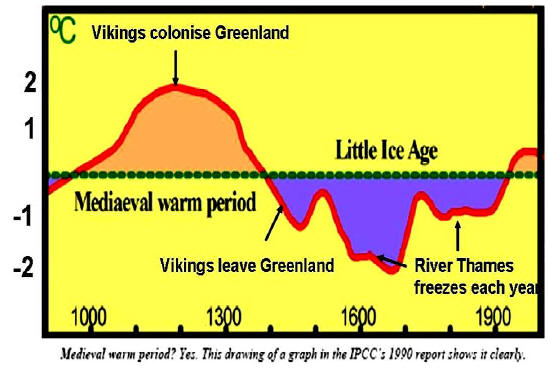 From Notrickszone.com
²After this article was written I ran across an image from NASA observation SAGE III (March 2022) that showed a ring of aerosols and particulate matter in the stratosphere (presumably the edge of a shell). This would indicate that there would be some cooling effect due to shielding of sunlight.

Credits: Image courtesy of the Earth Science and Remote Sensing Unit, NASA Johnson Space Center; Photo number: ISS066-E-161686; PI: Jean-Paul Vernier, National Institute of Aerospace/NASA Langley Research Center
https://eol.jsc.nasa.gov/
The dark brown ring just below the blue is the supposed ring of aerosols and particulate matter.
³This article was previously published, in a slightly different form, on The American Catholic.
References
The reader will find it difficult to find references on Global Warming skeptics using Google or Bing. I advise DuckduckGo as the least likely to misdirect. There are two authors whose work as skeptics I respect: Matt Briggs, see his blog, William Briggs, Statistician to the Stars, and search for “global warming;” Anthony Watts, see his blog, Watts up with that.”
I’ve written several posts about anthropic global warming. Here’s an example: “Lessons in Scientific Integrity: Climategate.”. Here’s another: “Hello, My Name is Bob and I’m a Climate Change Denier.”
And here is a web page of articles on the Tonga eruption:




23 thoughts on “God, Not Man, Makes Climate”
Pingback: A Pandemic of Violent Attacks on Priests in South Louisiana, This Third Party Could Be an Answer to Voters’ Increasing Dismay, and More Great Links!| National Catholic Register – Catholic Mass Online Search
Pingback: A Pandemic of Violent Attacks on Priests in South Louisiana, This Third Party Could Be an Answer to Voters’ Increasing Dismay, and More Great Links!| National Catholic Register - News Trends
Pingback: A Pandemic of Violent Attacks on Priests in South Louisiana, This Third Party Could Be an Answer to Voters’ Increasing Dismay, and More Great Links!| National Catholic Register - My Catholic Country
Pingback: A Pandemic of Violent Attacks on Priests in South Louisiana, This Third Party Could Be an Answer to Voters’ Increasing Dismay, and More Great Links! - JP2 Catholic Radio
Thank you for your fascinating article!
Pingback: God, not man, makes climate - Only Local Pennsylvania Vivrr
Bob Kurland just commented on God, Not Man, Makes Climate.
In response to captcrisis:
I suppose pollution is God made (not Man made) too.
CC, CO2 is not pollution as defined by the Cambridge Dictionary or Webster’s: damage caused to water, air, etc. by harmful substances or waste.” “something (such as man-made waste) that makes an environment unsuitable or unsafe for use.
The effects on climate change warming make our storms, heat waves, sea level rise more dangerous. People have already died from this.
https://skepticalscience.com/co2-pollutant-advanced.htm
Although it has some very important and beneficial effects, CO2 meets the legal and encyclopedic definitions of a “pollutant”, and human CO2 emissions pose a threat to public health and welfare.
The term “air pollutant” means any air pollution agent or combination of such agents, including any physical, chemical, biological, radioactive (including source material, special nuclear material, and byproduct material) substance or matter which is emitted into or otherwise enters the ambient air.
“greenhouse gases in the atmosphere may reasonably be anticipated both to endanger public health and to endanger public welfare….The major assessments by the U.S. Global Climate Research Program (USGCRP), the Intergovernmental Panel on Climate Change (IPCC), and the National Research Council (NRC) serve as the primary scientific basis supporting the Administrator’s endangerment finding.”
I’ve decided not to respond to any more comments by advocates of anthropic global warming. The evidence is against them, and if they would read some of the articles linked in the post, they could perhaps understand this. I was a global warming advocate in the 1990’s until I read Lindzen’s essay and other articles on why this didn’t make scientific sense. But I guess there is what is termed “invincible ignorance,” which can’t be convinced by rational arguments.
Lindzen’s essay
Lindzen’s writings were debunked by climate scientists. Our climate and the Iris analogy just don’t work.
“They that sow the wind shall reap the whirlwind.”
Our free will contributed. We humans are the cause. Interesting how ExxonMobil under wrote this non-scientific, foo-foo theology. Love the horrible use of ChatGPT in several of the paragraphs. In the future, please do not cut and paste. My plagiarism program is having a field day, especially the links to Exxon, BP, and Shell.
Mathius, you use invective, veiled in sarcasm, without rational arguments. You’ve accused me of plagiarism. You criticize my arguments as proceeding from oil companies. That’s a major error in logic. If the arguments are correct, what does it matter where they come? I’m tempted to delete your comment because of your accusation of plagiarism, but let’s let it stand as one more example of non-rational argumentation by advocates of anthropic global warming. By the way, before you posted your comment, I had ask chatGPT to write an essay on climate change and the eruption of the Tonga volcano. The result follows pretty much warmist party lines. I’ll be publishing the ChatGPT essay along with mine on Substack shortly, so one may compare whether I indeed have used it in this post.
Pingback: MONDAY MORNING EDITION – Big Pulpit
Reiligion trying to deny global warming by humans does not go well in the end. Its a huge mistake and never should be allowed in the name of Catholicism.
Global warming is physics. Want to bring God into this? God made the physics long before humans were around. God is not going to change the rules of physics just for us.
https://en.wikipedia.org/wiki/Greenhouse_gas
Greenhouse gases are those gases in the atmosphere that raise the surface temperature of planets such as the Earth. What distinguishes them from other gases is that they absorb the wavelengths of radiation that a planet emits, resulting in the greenhouse effect.[1] The Earth is warmed by sunlight, causing its surface to radiate heat, which is then mostly absorbed by water vapor (H2O), carbon dioxide (CO2), methane (CH4), nitrous oxide (N2O), and ozone (O3). Without greenhouse gases, the average temperature of Earth’s surface would be about −18 °C (0 °F),[2] rather than the present average of 15 °C (59 °F).[3][4][5]
Human activities since the beginning of the Industrial Revolution (around 1750) have increased atmospheric methane concentrations by over 150% and carbon dioxide by over 50%,[6][7] up to a level not seen in over 3 million years.[8] Carbon dioxide is the cause for about three quarters of global warming and can take thousands of years to be fully absorbed by the carbon cycle.[9][10] Methane causes most of the remaining warming and lasts in the atmosphere for an average of 12 years.[11]
The vast majority of carbon dioxide emissions by humans come from the combustion of fossil fuels, principally coal, petroleum (including oil) and natural gas. Additional contributions come from cement manufacturing, fertilizer production, and changes in land use like deforestation.[12][13][14] Methane emissions originate from agriculture, fossil fuel production, waste, and other sources.[15]
Average global surface temperature has risen by 1.2 °C (2.2 °F) as a result of greenhouse gas emissions. If current emission rates continue then temperatures will surpass 2.0 °C (3.6 °F) sometime between 2040 and 2070, which is the level the United Nations’ Intergovernmental Panel on Climate Change (IPCC) says is “dangerous”.[16]
Thank you, renewable guy, for presenting arguments and not invective in your comment. As a physicist, I agree that physics (and physical chemistry) govern climate. But as Lindzen showed in his masterful 70 page document, the math–non-linear partial differential equations, and difficult boundary conditions make a physics solution too difficult. The warmists are not using physics, they’re using computer programming.
I also don’t agree with the numbers you’ve cited for temperature changes and their source. With respect to predicted temperature changes, most of those changes that have been predicted in the past have failed to materialize. Not surprising since computer programs are based on non-physics models, and models have assumptions about what will happen. In the words of Matt Briggs, models do what they’re told to do, and are susceptible to manipulation (see my cited post about scientific integrity).
There are several issues you don’t address that are independent of scientific theorization:
1) Warmer periods have occurred in the past (MWP, ROMAN) without man-made production of CO2.
2) H2O is also a greenhouse gas and present in much greater abundance than CO2 or other greenhouse gases.
3) With respect to scientific backing for anthropic warming, there are many physicists more eminent than I who do NOT subscribe to warmist doctrine. But, as I’ve said elsewhere, authority is not the last word on scientific truth.
I suppose pollution is God made (not Man made) too.
whether pollution is made by man or God is essentially irrelevant to what are major factors affecting climate, but thanks CC for keeping up to your usual standards of commentary.
You don’t believe that pollution, in the form of carbon dioxide caused by burning fossil fuels, if continued over centuries, can influence climate? You believe it’s not even possible?
CC, CO2 is not pollution as defined by the Cambridge Dictionary or Webster’s: damage caused to water, air, etc. by harmful substances or waste.” “something (such as man-made waste) that makes an environment unsuitable or unsafe for use.” Your thesis that man-made CO2 (including that which humans exhale) contributes significantly to global warming is not proven. Moreover, one could regard CO2 as a necessary ingredient in the atmosphere, since it is required for plant growth. Your comments, like those of other warmist advocates, makes me believe that you don’t really understand how science or, indeed, rational argument proceeds.
https://climatereanalyzer.org/clim/t2_daily/
If you want scientific support look at Union of Concerned Scientists and not PragerU. You seem to have regurgitated Prager’s faslsehoods.
Gee, Tumbleweed, I don’t read Prager U. I did cite Lindzen, who held an endowed chair in meteorology at MIT. There are many other noted scientists who are skeptics,e.g. Frederick Seitz, former President of the National Academy of Science. In any case authority should not be a sole source of judging correct science. If it were, science would never have advanced.
By the way, the Union of Concerned Scientists has not, on other matters, struck me as an expert or unbiased source. Scientific organizations are not scientists, being staffed and directed by those who can’t do.
As a retired physicist (with a record of published papers and refereeing positions), I look at scientific arguments and not invective. Could you please supply scientific arguments and reasoning to support your position. Or do you, like other
anthropic global warming advocates suppose that invective is enough to overcome facts and reason?
Pingback: God, not man, makes climate
“If you walk in my precepts, and keep my command-ments, and do them, I will give you rain in due seasons.
“And the ground shall bring forth its increase, and the trees shall be filled with fruit.
“The threshing of your harvest shall reach unto the vintage, and the vintage shall reach unto the sowing time: and you shall eat your bread unto the full, and dwell in your land without fear.
Leviticus 26.3-5