

When Dostoyevsky wrote his famous line in The Idiot, amid the squalor and anxiety of an impending revolution, he could barely imagine the hell which his nation would unleash upon the world through the spread of Communism. His novels are hard reads for a gentle soul – yet they stand as metaphorical pillars in a writhing sea of ennui and despair. Many have taken his line, both in and out of context, and weaponized it for their own projects of global ambition, and may it not be so today.
While beauty has deeply personal properties, the modern assumption that beauty is fully ‘in the eye of the beholder has no place in Christian metaphysics. This is not because dusty traditionalists in paneled studies say it’s so, but because Christians believe that Truth, Goodness, and Beauty are intimately linked to God’s eternal nature. Beauty, therefore, has an eternal and absolute property, however the nuances of space and time aid in its presentation.
When I read these words by Dostoyevsky, I immediately think of the Via Pulchritudinous or The Way of Beauty, by which we mean a specific means of entering into deeper communion with God.
The Catholic faith, if it is what we in the Church believe it to be, is True, Good, and Beautiful. In every age and place, there is an especially pertinent avenue by which the Church may engage the wider world in her commission to reach all men with the Gospel. In past ages, men leaned harder into one or the other of these three ‘ways’ (of truth, goodness, or beauty) and our own time is no different.
The 19th century, for example, saw an age of history where people were all on a quest for the Truth. Morality had yet to be both fully trivialized and relativized, so culturally men of different ideologies might believe they should act decently, and mean the same general behaviors, however, they uniquely defined their moral rationale. This was similar to the quest for truth. The industrial revolution brought many ills to be sure, but one of its chief fruits was an increase in leisure for more people. This century created new ways of learning, new tools for research, and fed man’s insatiable desire for wisdom with a truly heady drink.
The explosion of science, industry, and related developments in Western university systems meant that many people who did the hard work of seeking were rewarded with the revelation that the fullness of truth resided not simply in the Christian Faith but in the Catholic Church. Saint John Henry Newman comes to mind in this case, as his own spiritual journey took him to the heights of the Oxford intellectual circle and as he encouraged others to dive into the sources of the Faith for deeper and more abiding worship of Christ he found himself Roman Catholic and made his famous leap.
While Newman inspired countless of his generation and those that followed to have the intellectual integrity to go where the Truth lead them, by the time the world had careened through two World Wars and faced the militant secularism of the late 20th century, both shared understandings of goodness and truth have eroded to mere echoes of a shared narrative.
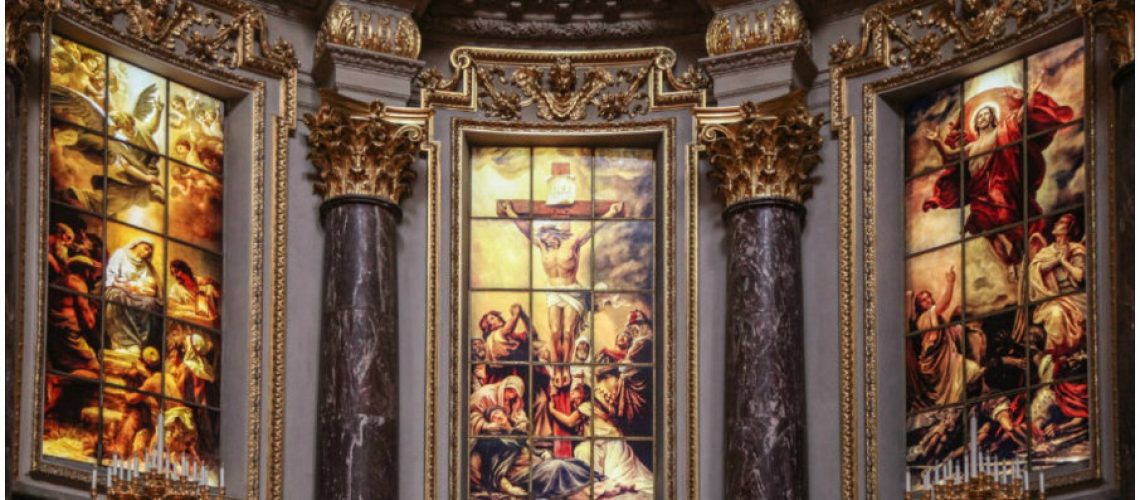
Beauty, today, is the bridge which can create a space in our society to have meaningful dialogue and exchange without the polemics and polarization of our politics. We have been raised to believe ‘beauty is in the eye of the beholder,’ but few will not stand gobsmacked in either a high Gothic or Baroque cathedral. Walk through an art museum and actually see the fruit of the master’s craft; listen to, and hear, the sublime longing of heart in William Byrd’s recusant Mass settings. In each of these cases, there is something objectively other but simultaneously human in the art which was created for whatever myriad of motivations but ultimately as participation in what J.R.R. Tolkien called sub-creation.
Man was made for beauty because Man was made for the worship and glory of God, which necessitates a universal and eternal beauty. This doesn’t mean all beauty will be baroque or even ‘high art’, because there is a transcendent beauty in the smell of freshly baked bread and the laughter of children. The plowing of fields, the folding of napkins, and holding a dying parent’s hand are all moments of eternal beauty and participation in God’s mandate to steward creation. Like much else, these ordinary and human experiences are a foreshadowing of God’s Kingdom come, on earth as it is in heaven because on that eternal day, all will be transformed, renewed, hallowed, and beautified as all things are restored to the full and perfect service of their Creator.
In our half-light, as we fumble amid the gloaming fall of the West, we can yet see the beauty of poetry in lingering Faith, Hope, and Charity despite their seeming outward futility. Of course, this beauty is an eternal good, and the smallest kernels of these virtues in history have seen empires topple and despots repent in sackcloth and ashes – this is the Beauty of our story and is a deep and inspiring heritage.
That heritage includes figures of astounding beauty who shook the foundations of the World by unflinching holiness, which is itself a transforming beauty. Think of Saints Catherine of Sienna, or Joan of Arc, Isidore the Farmer, or Blessed Pier Frassati. Think of Saint Therese of Lisieux, her parents Saints Louis and Zelie Martin, or of Saint Mother Theresa. There are countless examples, but each shares the common thread of a life devoted to that holy union with God which spurred them on to a life of conspicuous holiness.
While saints are not always recognized in life for their holiness, they act as a prism of the holiness of God in a world of pale, muted gray, shattering the notion that God wants to leave us in the sorry state He finds us. Rather, the transforming effect is not unlike the image so powerfully represented in the sacrament of Baptism. There is a transition from darkness to light – from life to death – which transcends the best of our metaphors and leaves us in those all-to-rare moments of awareness as slack-jawed and undone.
Beauty, as the Church understands it, will indeed save the world precisely because it is not an affection nor mere affectation nor even that which stimulates a flood of pleasant feelings. Beauty is a participation in the very nature of God, inherent in His creation and native to the soul of Man. We have considered creative work to some extent, though much more could be said of the artist’s role in the vocation of sub-creation and the high calling to lead others deeper into the mystery of God’s nature.
To turn to another, perhaps shocking example, we need to consider the Passion of Christ and, by a masterful twist of poetry, the Eucharist which is our deep and sustaining participation in those graces.
The Passion of Christ is of course a grotesque and hideous event to consider. The physical violence, injustice, and the sense of guilt-induced through rightful introspection may be painful to even consider, but Christ’s Passion is also, in a deeply transformative way, the most beautiful moment in human history. The heavens stared on in wonder, the angels and all creation with them, as God-made-man submitted himself after a life of perfect holiness to the humiliation of Calvary, and allowed himself even to die. The poetry of Calvary is made acute in light of the story God had been writing in the history of the world, from Adam to the Blessed Virgin, and still writes in us today.
At each and every Mass, we are brought back to that moment where Christ offered Himself as the perfect, eternal sacrifice on the cross. When the priest elevates the sacred species, we gaze upon the one whom Pilate paraded, wounded unto death for the very love of his most favored creation. We hear in our hearts his words, meant in derision but proclaiming the truth nevertheless, “behold, the man!” and our mind leaps to the words inscribed upon the cross, “Jesus Christ, the King of the Jews.”
Here, at last, is the long-awaited Messiah, come to set His people free, and who proclaimed that except we eat his flesh and drink his blood there can be no life in us. Here, at last, we are offered manna infinitely superior to the saving bread cast down in the wilderness for God’s chosen people, and here again, do we find a better, everlasting drink from the Rock from whom life-giving water flowed, that same Rock whom Saint Paul proclaimed to his Corinthian flock is Christ.
We are drawn through the mystery of the liturgy to the foot of Calvary and therefore to the eternal, perfect, heavenly temple where angels, archangels, saints, and all the hosts of heaven worship in the Beauty of a Holiness so far transcendent of our understanding that the only reason we survive the encounter is that we behold the Lamb veiled yet perfectly, truly and fully present before us. In that timeless instant, we taste in our souls and bodies the faintest glory of true beauty and the beatific vision our entire being longs after.
This, and a life-oriented, always and every way towards divine beauty is the antidote for a poisoned age, palsied by its own wretched counterfeit joys. It must not be false, and it must be costly, whatever we spend upon it. Magnificent cathedrals were not spread across Europe because people had no other use for their time or money, but perhaps because they believed there was no better use for them. If in our day, we entered into the small and ordinary tasks with an awareness of the beauty of life, we would see an impact.
If we saw the staggering romance and sublime beauty of a single Holy Mass offered, perhaps we would honor it all the more with deeper devotion, framing it in a fittingly noble and reverent setting. Most important of all, we would then adorn the temples of our very souls with the lavish, opulent splendor of virtue, and so see the hearts of all around us (dry stubble as they are in a rainless waste) set ablaze. May God open our eyes to the beauty of His holiness, and may He enkindle in us an insatiable passion to share that beauty with the world.




3 thoughts on ““Beauty Will Save the World””
I think if you’re there for the “romance and sublime beauty” of the mass, you’re there for the wrong reason. And if that is why most people are there, we’ve built our church on sand.
Pingback: VVEDNESDAY EDITION – Big Pulpit
Excellent article. We’re on the same page for sure. I addressed this same topic in three articles: https://sacredwindows.com/is-beauty-really-in-the-eye-of-the-beholder-part-1/ Parts 2 and 3 are linked. Keep writing! All the best, Peter D.