

As an educator for over three decades, I know the power and transcendence of questions. They can reveal much about the one answering them.
For example, if I ask four students the same questions their answers will generate tons of information about each student. Both the content of the answers and the manner in which each student responds provides the information.
However, questions can also reveal something about the one asking them. Questions can be based on sincere interest and a desire to clarify. But they can also be founded in doubt or even sarcasm.
Questions as Windows to The Heart, Mind, and Soul
We know that the Pharisees asked Christ questions revealing their desire to trap Him (Mark 8:11-12). The Pharisees demonstrated that questions can be used with evil intentions, as weapons.
The apostles also asked a question about Jesus in the wake of the storm at sea (Mathew 8:23-27). The question showed their lack of faith in His divinity. We also see Moses questioning God regarding his (Moses’) own ability and qualification to do God’s Will (Exodus 3:11).
So questions themselves are not the problem or necessarily offensive or wrong to God. What makes the difference is the root or source of each question.
If the question comes from a place of humility and a sincere desire for clarification, God will welcome and favor that question as an opportunity to bring about truth and revelation. However, questions that come from a place of doubt, a lack of faith, or a challenge to provide proof, are another matter. They are indicators that pride and vanity reigns over humility and trust in God.
The bottom line is that a question can be a humble, sincere desire to clear things up to better serve God. Or they can be a proud, presumptuous, mistrusting challenge by a mere creature that proof be provided from the Creator of the Universe!
Ultimately, all questions are windows to the heart, mind, and soul. They can reveal where the one asking the question is at within. Remember that God knows us better than we know ourselves (Psalms 139). Therefore we cannot hide the motivation and root of our questions. What seems nearly identical to our mere human minds can be, in fact, coming from totally different places.
Who’s Asking?
A con artist asks questions in an attempt to deceive. A teacher, however, asks questions to instruct and get students to think. Students ask questions out of a desire to know and understand. But adults sometimes ask questions in an attempt to belittle or denigrate.
One would also not expect the same questions from elementary school children and doctoral graduate students. And we would also hold recent doctoral theology graduates to different standards than established theologians with decades of experience.
Questions are not asked in a vacuum. One needs to interpret and respond to them in the context of circumstances, tone, intention, motivation, and qualification of the one asking.
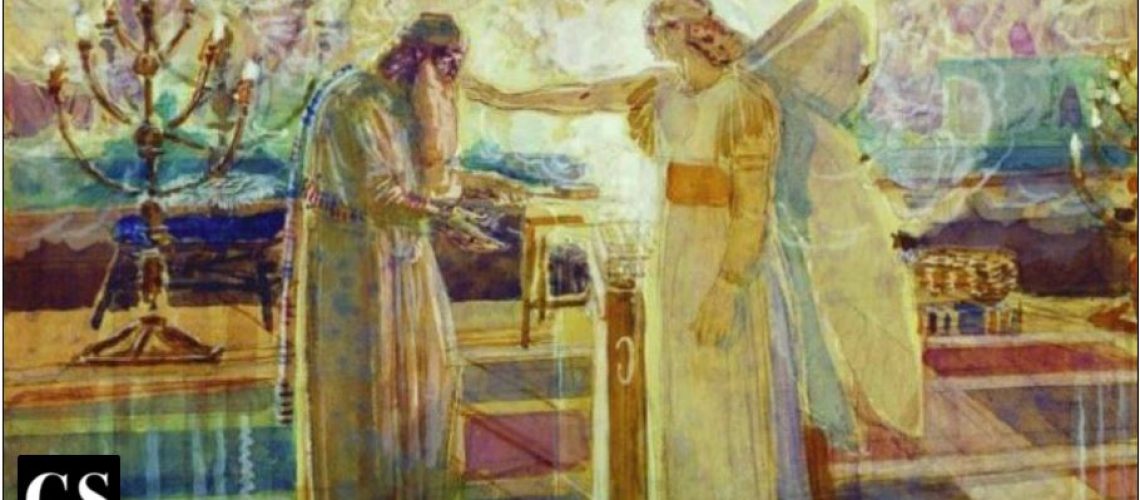
Scripture gives us two powerful examples of questions asked to the angel Gabriel. The Blessed Virgin Mary asks one of the questions. The second question comes from Zachariah, husband to Elizabeth and father of John the Baptist. The questions beautifully and powerfully illustrate the concept of sincere interest and a desire to clarify versus the concept of doubt.
Mary’s Question
Although a young girl of great faith and deep, sincere love of the Lord, Mary was still a young teenager who clearly had already promised herself in a vow of celibacy to God (“All Generations Shall Call Me Blessed,” by Fr. Stefano Manelli, pages 137-140). St. Augustine and St. Lawrence have written that Mary’s response to the angel “How can this be, since I have no relations with a man?” (Luke 1:34) only makes sense if she has already committed herself to God in total celibacy.
Mary fully understands that she can conceive and become a mother. But she does not understand how such a thing could possibly happen since she has already promised to remain celibate. So Mary’s question does not come from a lack of faith or trust in God. Rather it comes from a place of sincerely trying to understand how she can conceive a child after taking a vow of chastity and celibacy before God.
In short, she is humbly, innocently, sincerely seeking clarification. St. Augustine notes that Mary was trying to reconcile an apparently unsolvable dilemma. How could she keep her virginal pledge to God with the request of maternity on the part of God Himself. In what way could she become a mother without betraying her promise of virginal consecration to God?
If we analyze Mary’s question at its core, it is an honest attempt to reconcile two seemingly opposing promises: virginal consecration and accepting God’s request of motherhood.
Mary’s response comes from the same place as that offered by Abraham. Although Abraham did not fully understand how his wife could bear a child, he trusted and embraced God’s Will and power to make it happen (Genesis 15:1-6). Furthermore, Abraham was willing to sacrifice his only son in obedience to God (Genesis 22:1-6) which would contradict the promise of many descendants.
Neither Mary nor Abraham wanted proof; they just sought clarification so they could obediently and humbly follow God’s Will. In both cases, God made a seemingly impossible and illogical request given the circumstances with which He was intimately involved. But Mary and Abraham humbly and obediently trusted themselves to His Will, purpose, and power.
Zachariah’s Question
Zachariah’s question, however, comes from a completely different place (Luke 1:5-20). Unlike Mary, he did not face a dilemma between any promise to God and any present request by God. He never promised to God that he would not seek to father a child as a vow to God. Likewise, God was technically not asking anything of him other than belief.
Mary seemingly also had a lot more to lose by becoming pregnant before marriage and even by becoming so despite having made a vow to God to never do so. Zachariah did not face any such issues. He would not be ridiculed, excluded, much less be potentially killed for becoming a father in his old age.
With an infinitely lot less to lose and being asked an infinitely lot less from God, Zachariah responded with doubt, mistrust, and even sought some sort of proof. Told by the angel Gabriel that he would have a son who would “turn many of the children of Israel to the Lord their God” Zachariah responded, “How shall I know this? For I am an old man, and my wife is advanced in years.”
Rather than obedience and trust, Zachariah’s response to the angel demonstrated a lack of faith and perhaps even a level of insolence before Almighty God.
The Lessons from These Two Questions
Meditating on the differences between Mary’s and Zachariah’s responses to the angel Gabriel, we see that there is nothing inherently wrong with questioning God. If our questions come from a place of a sincere, innocent, humble attempt for clarification and seeking to obey and respect God’s Will, God will certainly provide us with answers in His time and place. Certainly, our faithfulness, humility, and trust in God will be rewarded many times over as has been shown endless times in scripture.
However, if our questions come from disbelief, mistrust, arrogance, vanity, pride, and an insolent challenge that God provide us with proof, God will be offended. Let us pray that we cultivate the kind of humility and trust that Mary and Abraham demonstrated and avoid the kind of question Zachariah asked.




3 thoughts on “A Tale of Two Questions”
Pingback: From Sloth to Sanctity, Beginning of Mystical Prayer, 7 Behaviors That Feed Demons, and More Great Links!| National Catholic Register – Catholic Mass Online Search
Pingback: Od ledenja do svetosti, početka mistične molitve, 7 ponašanja koja hrane demone i više sjajnih veza! - Katoličke vijesti
Pingback: MONDAY MID-DAY EDITION | BIG PULPIT