
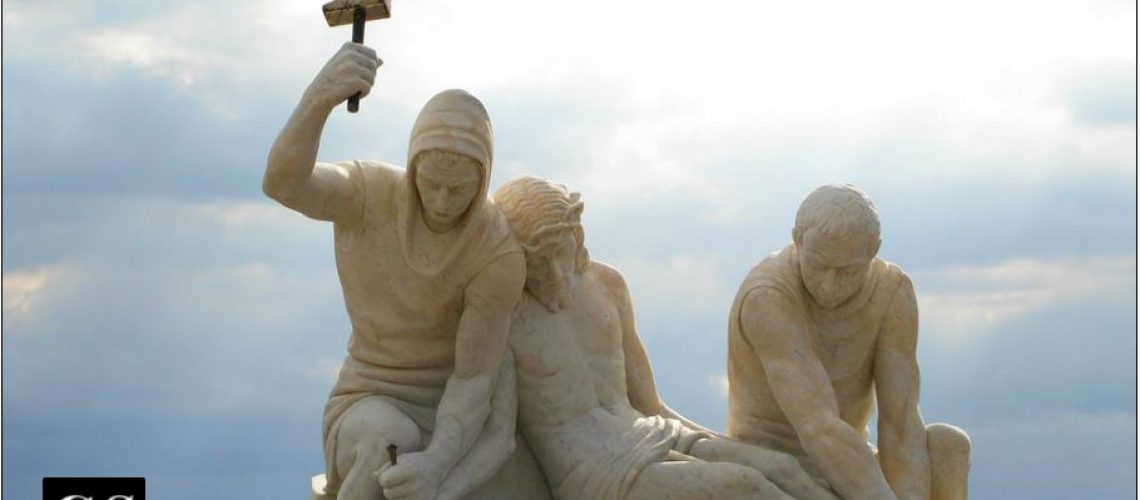
When we look upon a crucifix we see a sterilized version of Our Lord’s physical condition at the moment of His death. Generally what is depicted is His five wounds and a crown of thorns. This depiction is devoid of His Precious Blood strewn over His Body along with His torn and mutilated Flesh.
St Bridget, a 14th century Swedish mystic, once asked Our Lord how many wounds were inflicted upon His Body during His Passion. She did not ask this out of a sense of curiosity, but rather out of a desire to honor each of those wounds.
After repeated requests, her persistence paid off and Our Lord responded by telling St Bridget that He endured 5,480 wounds during His Passion. Jesus taught St Bridget 15 beautiful prayers and told her if she recited these prayers every day for a year she would honor the 5,475 unknown wounds that He endured during His passion. These prayers are still in existence today and come with extraordinary promises of Jesus for those who will faithfully pray them.
If you have seen the movie, the Passion of the Christ, or viewed the image of the Shroud of Turin, believed by many to be the burial cloth of Jesus, you have a much better sense of those horrifying wounds. Not a square inch of His Body was spared from this brutality.
And yet these physical sufferings, as horrific as they were, did not embody the entirety of Our Lord’s suffering during His Passion. As the title of this article suggests, His sufferings were not limited simply to His physical wounds, great as they were. But encompassed the whole of His humanity as the God-Man. This included His emotional, psychological and spiritual states that suffered as well.
While in reality it is difficult to isolate these types of sufferings as they are so interconnected, let me nonetheless attempt to discuss each of them in turn.
Christ’s Emotional Sufferings
His emotional sufferings principally emanated from fear and stress at what awaited Him in His passion and death. Fear is a very powerful human emotion and Jesus in His human nature experienced it. As scripture teaches us “He was like us in all things but sin.”
And while this fear and stress began well before His Passion, it reached a climax in the Garden of Gethsemane when He sweat blood as revealed in the Gospel of Luke. This extremely rare medical condition is called hematidrosis. It occurs when capillary blood vessels that feed the sweat glands rupture, causing them to exude blood, which only happens under conditions of extreme physical and emotional stress.
Three times Jesus prayed to His Heavenly Father in the Garden pleading with Him as He said, “If this cup could pass me by, but not my will but thy will be done.” The cup symbolizes His impending passion and death.
Our Lord also suffered emotionally knowing His impending sufferings would soon inflict great sufferings upon His beloved mother as well, and with full knowledge that there was nothing He could do to temper it. In a way, she too was like a sheep led to the slaughter.
Christ’s Psychological Sufferings
Psychologically, Jesus would have experienced a sense of abandonment when His apostles and friends fled out of fear during His passion; even though He knew it would occur. Peter would go on to deny Him three times. Only His mother, His mother’s sister Mary Clopas, John, and Mary Magdalen would remain close at hand during His crucifixion.
Imagine His mental anguish when He saw many of the Jews, who proclaimed Him the Messiah during His triumphant entrance into Jerusalem on Palm Sunday, jeering at Him and calling for His crucifixion on Good Friday, a mere five days later.
Consider the sense of betrayal Jesus felt toward Judas, one of the twelve, who would go so far as to betray Him for thirty pieces of silver! The going rate for a bounty on a man’s head!
But the keenest sense of abandonment that Jesus experienced during His passion occurred when He was cut off from His Father. Recall the words of Psalm 22 that Jesus cried out from the cross. “My God, my God why has though abandoned me!”
Why would God the Father withdraw His loving presence from Jesus during His most difficult moments on this earth? I believe the answer lies in the required totality of Christ’s sufferings during His passion to atone for all sins committed or to be committed until the end of time.
This totality of suffering could not be mitigated in any manner. During His passion His divinity had to be passive while His humanity took to itself a pure oblation and served as a sin offering to God the Father, in atonement for the sin committed by our first parents whose fall from grace doomed all of humanity.
Christ’s Spiritual Sufferings
In a sense, Christ’s passion and death was a pyrrhic victory of sorts for Satan. By influencing the various people who partook of His torture and ultimate death, Satan had orchestrated Deicide. The killing of God! But a pyrrhic victory is defined as a victory gained at such a cost to the victor that it is tantamount to defeat.
Satan, realizing the pyrrhic victory that was at hand, tempted Jesus by revealing to Him, while in the Garden, all the souls that would be lost despite His sanctifying sacrifice, in the insidious hope that Jesus would reject the cross.
But Providence had deemed that this pyrrhic victory of Satan was to be the means by which Christ would conquer sin and death. Which, in point of fact, was an eternal crushing defeat for Satan.
Jesus had to submit Himself to those that fell under the insidious influences of Satan while carrying out His execution. All the while not wavering in His purpose, to lay down His life, in order to achieve His great victory. And therein lies the spiritual dimensions of His suffering.
Before this pyrrhic victory, Satan had all of humanity under a sentence of death by virtue of the fall of our first parents. But after this pyrrhic victory, Jesus by virtue of rising from the dead restored our life.
Conclusion
Jesus, by virtue of His passion, suffered in every way possible; including physically, emotionally, psychologically and spiritually to reconcile us to God our Heavenly Father! Oh, how precious is that gift of salvation that only Christ could have brought about.
It is thus fitting that, St Paul in his letter to the Philippians wrote:
“Because of this God highly exalted Him and bestowed on Him the name above every other name, so that at the name of Jesus every knee shall bend in the heavens, and upon earth and under the earth. And every tongue proclaim to the glory of God the Father “JESUS CHRIST IS LORD!”

