

How America’s Catholic Neighborhoods Disappeared—and What Comes Next
This is a story about a funeral, but not the one you think.
Across America, the Catholic neighborhoods that were once the heart of immigrant life are fading away. Parochial schools have closed, convents have emptied, and dioceses from Boston to St. Louis have consolidated parish communities that once seemed permanent. What was unimaginable only a generation ago has become almost routine.
Cleveland tells that story that story particularly well—not because its history is unique, but because it reveals something about nearly every urban diocese shaped by the great waves of European immigration.
In 2010, the Diocese of Cleveland shuttered or merged 50 parishes in a single stroke. Some of those churches had once packed the sidewalks with Corpus Christi processions and Angelus bells that echoed across entire neighborhoods because the Church held a claim on reality that the society couldn’t ignore. Now they sat abandoned or half-empty, surrounded by streets their own parishioners had long since left behind.
At first glance, it looked like a standard autopsy of a dying religion—another casualty of secularism or the post-Vatican II exodus. But those explanations miss the dark punchline of the situation: Cleveland’s ethnic parish system collapsed because it actually worked.
The Empire of the Neighborhood
Less than a century ago, the Cleveland skyline was a thicket of steeples. If you were a European immigrant, the city was an indifferent or openly hostile place. Between Nativist sentiment and a resurgent Ku Klux Klan in Ohio, the “American” parts of town didn’t feel welcoming. Consequently, the local church became the heartbeat of everything.
It was a total world. You didn’t just attend Mass at St. Stanislaus or Holy Rosary; you lived within its orbit. The parochial school educated your kids. The fraternal societies found you a job at a steel mill or machine shop. You could tell a man’s neighborhood by the consonants in his last name and the saint on his dashboard.
Catholicism was woven into ordinary life and was not meant as a private identity stored away until Sunday morning—and it wasn’t.
The Crucible of Devotion
We often make the mistake of calling their Catholicism “inherited,” as if it were a dining room set passed down in a will. It was anything but. For the men and women who built these communities, their religion was an anchor in an unpredictable world.
This generation saw their European villages bombed into rubble; they endured the humiliation of displacement from two World Wars and watched family members die in unimaginable ways. They arrived in Cleveland from Poland, Austria, Germany, Hungary, Italy, and Ireland, with empty pockets and a language spoken by few. With no social safety net to catch them, they leaned on Christ and on each other.
That is why you still see them today—the 90-year-olds clutching rosaries and prayer books in the back pews. They carried a kind of spiritual seriousness that only comes from living through genuine instability. And that unshakeable faith shaped what came next.
The Success Trap
That wave of immigrants had a singular goal of wanting their children to fully belong. These Catholics viewed the American Dream as a total conversion. They worked with a relentless focus on assimilation, using their ethnic social clubs as touchstones to a heritage they were forced from rather than barriers to their new identity. They wanted to be 100% American.
The parish network provided the stability and moral order to make that possible. But within two generations, the trap closed. By helping immigrant families become prosperous, educated, and on their way to becoming fully American, these Churches achieved the very success that would eventually empty them out. Once they had the financial means, many did exactly what successful Americans were supposed to do: buy the suburban dream.
They traded the hazy view of the smokestacks for the emerald lawns of Bay Village, Strongsville, and Mentor. They moved from a place where Catholicism was the very air you breathed—to a world of quiet cul-de-sacs. They didn’t leave the Church because it had outgrown its usefulness—not at all. They left the area because they finally had the money to move.
The system solved the immigrant problem so effectively that it eventually made itself unnecessary.
The Great Dispersal
By the 1970s and 80s, the old parish neighborhoods were thinning as suburban flight was in full effect. It was a victory for the blue-collar tradesman—but beneath the upward mobility lay a loss of social unity.
In neighborhoods like Slavic Village or Murray Hill, it was not unusual for three generations to live within walking distance of one another, if not in the same house. A grandfather worked at the plant, his daughter taught at the parish school, and the grandchildren served Mass beneath the same stained-glass windows their family had paid to install decades earlier.
By the 1980s, those same families became united more by highway exits than local street corners.
In the suburbs, the Faith stopped being a totally integrated way of life and became a weekend hobby, tucked between yard work and soccer games. For the kids of the 80s, the “struggle” shifted from being able to put food on the table to deciding which Atari game to play. The bond of shared hardship evaporated.
The parish transformed from a home base into a spiritual gas station. The family car would pull in for forty-five minutes of grace before returning to an irreligious world where they remained cordially anonymous. Instead of small, tight ethnic communities emotionally connected to their church, some suburban parishes now counted more than 3,000 families. When the Bishop’s pen hit the paper in 2010 sealing the fate of those once vibrant parishes, the fabric of the community had already unraveled.
The Myth of the Museum
It’s easy to fall into romanticism. We see the empty, majestic churches of the city and imagine that enough votive candles and a better choir could bring the 1950s back. But those times can’t be recreated. Life back then conformed to its conditions: home prices typically just twice the average annual salary, few cars, no internet; just a neighborhood that held you up when nothing else would.
The default Catholicism our grandparents handed down, is gone too. In this restless and frantic time we live, heritage isn’t enough to carry people through the doors. Whatever comes next will have to be built deliberately.
The Return to the Real
For decades, the institutional response to this decline was more “progressive engineering”—stripping away centuries of liturgical practice trying to look relevant to non-believers who will forever scorn it. But something exciting is happening. While the generic, modernist churches continue to wither, a new generation is being drawn toward the incense and communion rails.
Young people, exhausted by the profane emptiness of modern culture and the shallow performances of non-denominational megachurches, are rediscovering the One, Holy, Catholic, and Apostolic Church. They aren’t looking for PowerPoint presentations or a worship band with a tight rhythm section; they are seeking the Ancient and the true. They are drawn to the sacraments, the beauty of tradition, and a claim on reality that doesn’t shift upon the winds. They want the Real Presence.
Building the Intentional Enclave
The old ethnic neighborhoods were held together by external pressures. The world outside the church doors was unstable, suspicious, and often openly hostile. The Church was the place where people remembered who they were.
In a strange way, we are back there again.
The modern Catholic is no longer threatened by bigoted factory bosses or anti-immigrant street gangs. Today’s pressures are more subtle and pervasive. They come through perpetually glowing screens, collapsing families, endless distractions, and a society that treats Catholicism as either a private eccentricity or a political embarrassment. Our grandparents feared losing their language; we fear losing the very idea that truth exists at all.
That kind of world creates its own form of exile. It leaves us surrounded by convenience, bombarded with meaningless distractions, and a self-imposed distance from reality. The Church becomes a periodic retreat rather than the axis on which life should revolve. In this environment, true devotion cannot survive on the fumes of a Sunday obligation while remaining fully absorbed into the secular world. It must be purposefully chosen and nurtured.
The parishes that survive the next fifty years will become intentional communities again—not through ethnicity this time, but through shared conviction and deep faith.
You can already see signs of it emerging. Young families are reorganizing their lives around strong parishes. Homeschooling co-ops and classical schools are growing. People linger after Mass, attend processions, commit to Adoration, celebrate feast days, and form friendships that extend beyond Sunday morning.
The old system ran on proximity; the new one will run on conviction.
That may mean sacrifice: a longer commute, fewer luxuries, and choosing community over convenience. A living parish cannot be built by anonymous people arriving late and leaving early.
The irony is that the future may look surprisingly ancestral. Not because we can recreate 1952 Cleveland, but because all human beings still hunger for permanence, ritual, belonging, and a shared vision of reality. The world has changed completely. Human nature has not.
The Parish Reborn
The old neighborhood world is gone. All but a few factory whistles are silent, the parish baseball leagues are memories, and many of the great ethnic churches now stand surrounded by people who don’t care why they were built in the first place.
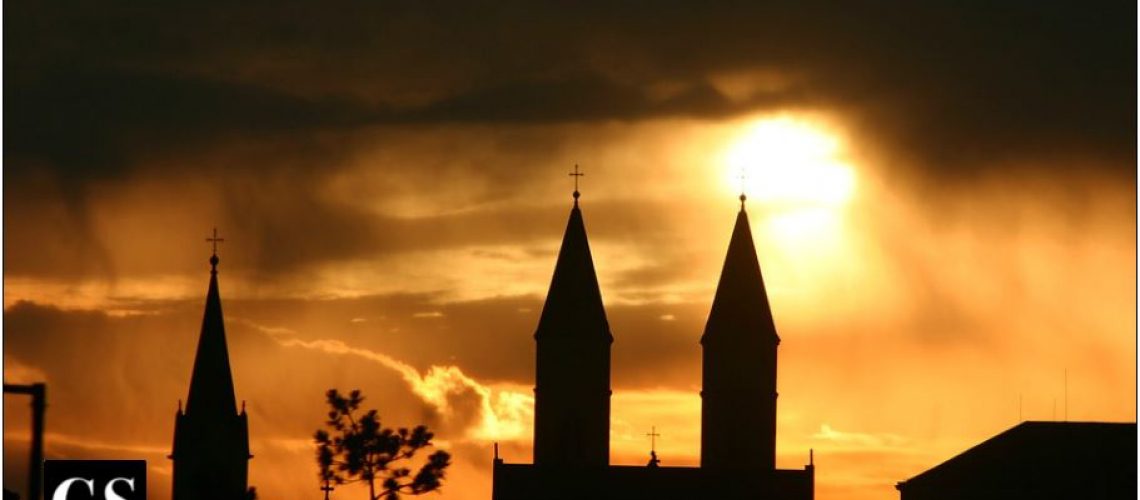
On certain streets in Cleveland, however, you can still see the steeples standing proud—built by immigrants who gave money they could barely spare to erect something permanent in a world that felt uncertain. For them, the church was always more than a building. It was a declaration that God always remained present.
In many ways, the collapse of Cleveland’s parish system was the final chapter of a great immigrant success story. The people who built those churches achieved what they set out to do. They became Americans. They prospered. They gave their children safety, education, and mobility. And in the process, the dense Catholic world that once sustained them slowly faded away.
But the real story was never about stone buildings or ethnic identity. It was about human beings trying to anchor themselves against chaos.
That need is no less urgent in our time.
Our grandparents lived through war, displacement, and poverty. We live in an impersonal, dehumanizing culture that dissolves meaning faster than it creates it. Different forces. Same divine pull on the soul.
Funerals are about more than dealing with grief. They are also about continuity and the stubborn refusal to abandon the dead. The Catholics who built Cleveland’s parishes left behind a blueprint for how human beings survive hostile worlds.
We cannot recreate their world. The church on every corner is gone, and it is not coming back. But wherever Catholics choose to build lives ordered around prayer, sacrifice, friendship, and truth, the old heartbeat returns. The future of Catholic life may look smaller than the world that existed in mid-century Cleveland, but that does not mean it will be weaker.
Not exactly as it was.
But alive again in the places where the bells still ring.

