
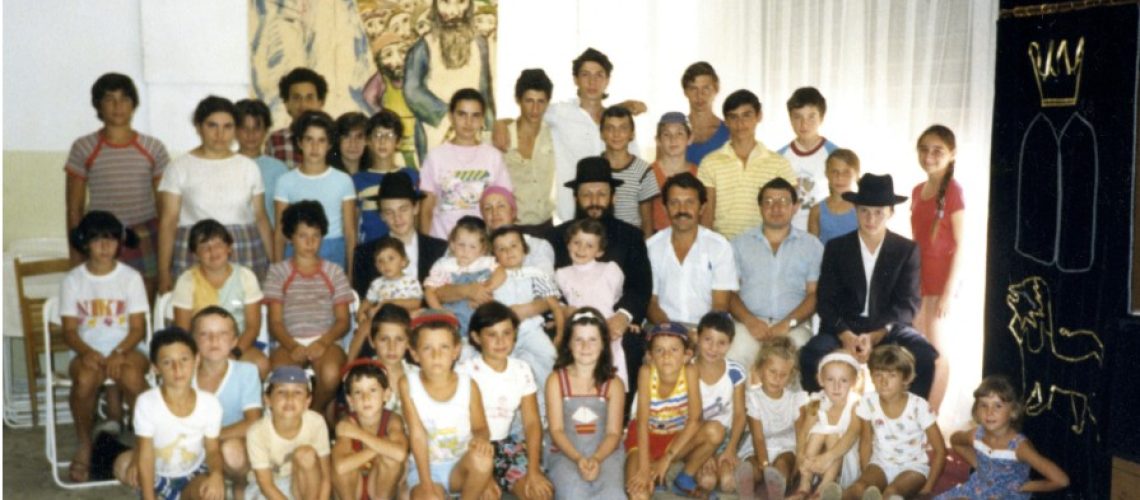
The feature image above is a beautiful photo of the Russian Jewish school in Ladispoli, Italy, with four professors sitting together in the second row between two young boys in hats; small students sitting in the first row, and older girls and boys sitting and standing in the second row and beyond. The school was organized by one family: the dame (director) and her husband (organizer), the man in the hat, together with their six children—four little ones and two boys in hats. It is a photo of one particular day in 1987–1988, but the school operated all year, from August 1987 until September 1988. It was always full.
The school was part of our voluntary Center for Russian Jewish emigrants in Ladispoli (waiting for permission to enter the US, Canada, Australia, or New Zealand), which existed for one year and, besides a hall for the school, had a large kitchen, a hall for meetings of adults, and a computer room.
In the years 1960 through 1970, only 4,000 Russian Jews legally emigrated from the USSR. In the following decade, the number rose to 250,000, but later Russian Jews were mostly forbidden to leave and became “refuzniks”—those who were refused permission to leave lost their jobs, sometimes received legal punishment, and were even sent to labor camps.
In 1987–88, a great number of them were finally permitted to go, sometimes after waiting more than ten years. This was the first year of the largest departure, and during the next two years the departure from Italy was completed—Russian Jews permitted to go to the four countries mentioned above were leaving Russia.
It was my tenth year after being expelled from the Soviet Union to Israel (see my article in Catholic Stand, “The Hamas-Israel War In Light of My Conversion From Judaism to Catholicism”, and I was now an Orthodox Jew and professor at University of Strasbourg. In my heart I deeply appreciated the Catholic faith (“From Ignorance, Atheism, and Anti-Catholicism to the Glory and Peace of the Catholic Church”, but our family’s external life was entirely Jewish; only my spouse, Eugenia, knew in detail about my search for the true faith.
After studying the political situation, as a scientific researcher, I arranged for myself a year of work in Italy at the university in Pisa, not far from Ladispoli. It was there, in Ladispoli, where Jews first sent from Moscow to Vienna found themselves after deciding not to go to Israel but instead to wait for visas to the countries they wished to enter. The Zurich Jewish community, and later others, supported my initiative.
We came to Ladispoli with our four children, aged two to five (our two older boys came during vacation), and rented an apartment and the free space of a former warehouse. The success was immediate: during that year more than a thousand Russian Jews passed through Ladispoli.
Here was the problem Russian Jews faced there: they were under the responsibility of two international Jewish organizations, one dealing with visas and another providing money for rent and food, but nobody was physically present on site. There was no medicine, no intellectual preparation, no language learning for their destination countries, and no occupation for children.
Most Jews expected to go to the US and waited about three months; the next group waited for Canada—six months; the next for Australia—nine months; and the last for New Zealand—about a year.
We began by looking for doctors among the emigrants. From the beginning we found about ten good doctors and formed a medical group that remained active throughout the year; the necessary medicines arrived over time from Strasbourg. During the year, a Jewish doctor from Strasbourg visited us for a few days and spoke to our staff. The medical group changed over time—older members left for different countries, while new ones arrived from Russia and joined the group.
The illnesses were varied, and injections were often required and administered. In one tragic case, an elderly woman died unattended because she had accompanied a young man with a congenital disease; he departed alone. Our service was much better than the regular Italian medical service, and some Italian patients also benefited from it.
During the year I was invited once to visit the mayor of Ladispoli. He tried to place limits on our activity for the Italian public. A communist, he attempted to frighten me with threats of prison. I answered that I would be happy to testify before a court that Ladispoli lacked adequate medical service.
Eventually, near the end of the year, Jewish organizations and Italian authorities formed a team of two doctors to serve the Russian emigrants, but we continued our work as well. After our departure from Ladispoli, this team slowly dissolved.
Two years later, when I was in Canada working at the Université du Québec à Montréal, I received an email from the central hospital in Melbourne requesting a recommendation for a woman who had worked with us as a doctor in Ladispoli. She had finally received permission to immigrate with her family to Australia and was seeking work there. I replied politely but honestly that she had been a very good worker—especially busy with injections—but that we had no official authority over her. I do not know the outcome.
Starting a school was a more delicate affair. But in time we offered English courses, music lessons with instruments brought by professional artists among the refuzniks, and several beautiful concerts. An Orthodox Jewish community lent us a Torah scroll for the year, and in the school photo you can see the cabinet containing the Torah on the right side. We encouraged those close to us to pray there in the mornings, and we celebrated the holy Jewish holidays with many people, including the elderly, who participated with great emotion.
In time we organized a kitchen in a small hall of our Center. To buy two stoves, I asked by email a wealthy Jew in the US to help us financially; he generously agreed. We bought stoves and computers for adults and older children.
The kosher kitchen was run by elderly women among the emigrants, after some instruction from us, with great dedication and excellent results.
That year an American Christian sect sent to Ladispoli a former Russian emigrant who had converted to Western Christianity. He was invited to live in an Italian Catholic parish and spoke daily to emigrants in the Catholic school. My spouse Eugenia and I went to hear him and were astonished by his poor Christian formation and his open desire to convert Jews. He was uneasy about our presence and did not approach us. After our visit he left Ladispoli. I wrote a polite letter to the Vatican asking that the local Catholic parish not be used by Christian sects, and I received a polite positive reply.
Near the end of the year, I had a serious difficulty with my assistant at the Center, an emigrant. He was the third assistant I had chosen; the first two had been serious and reliable and had already left Ladispoli. His duties included keeping the keys to our center, since I was sometimes absent, traveling to Pisa or Strasbourg. The assistant colluded with several other emigrants and refused to return the keys. This caused our Center to remain closed for a week, but in the end he gave in. This was the only case of arbitrary and malicious behavior among the emigrants I personally knew.
When we finished our work and returned in September 1988 to Strasbourg, I was deeply satisfied with the success of our improvisation. We had brought hope to thousands of emigrants, whether through direct participation in our activities or simply by their observing them. We remained in contact with many after they left Ladispoli.
We were grateful to the Zurich Orthodox Jewish community and other generous Jews for their support, and we were grateful for the international solidarity of important non-Jews, such as Ronald Reagan, who completed his second term in 1989 and established a new policy for Russian emigrants.
The one aspect that left us deeply unhappy was the Russian government and its treatment of Russian Jews. Time has shown that Russian Jews were never important to Russia—what remained important was the inhuman anger of a future Russian government, which now wages war against Ukraine.
The next year, 1989, would be my sabbatical year, and I decided that my family and I would travel to French Canada for my work. Perhaps there I would find the answer in my search for the true faith.
The answer came five years later—our family became Catholic. But as you have seen (“Jewish Catholic”, I never abandoned the Jews.


[…] Bicycling Novus Ordo! – Matthew JosephVideo: I-Hate-The-Novus-Ordo-Missæ-Part IV – T.C.A Story of Russian Jewish Emigrants – Dr. Edouard Belaga at Catholic Stand MagazineVideo: S.S.P.X. Excommunication Panic: Why […]
Trying to dilute each other’s religion would be like trying to squash the
abstract beauty in Van Gough’s ‘Starry Night’
It is not the first your response on what I had written here, and it is motivating me to answer you : there is nothing with «the squash the abstract beauty in Van Gough’s Starry Night» and with my dear remembrance here when I was REALLY TRYING to make ma faith work. I’m deeply grateful to the Main Editor for publishing my article — it serves to show my real commitment to Catholicism.
My spouse Eugenia and I went to hear him and were astonished by his poor Christian formation and his open desire to convert Jews.
In case there is any misunderstanding this is what motivated me
to remark as I did. It is a general statement formed by 12 years of parochial education which emphasized that ‘ only Catholics go to heaven’. Not anymore, of course. Trying to separate out ‘truth’ from any religion is tantamount to squashing the abstract.
Excellent write-up. this topic is becoming more important in 2026. Wishing you continued success with the blog.
Thank you, dear Albina Reucker, for your positive and encouraging response. See how I answer Mr. «an ordinary papist», to understand the difference of your response from his.