

This really is a fairy tale,
I sit in a pure, white house of gables
That is overgrown everywhere with gardens,
Among lovely … things,
In chambers that are filled with the mood
Of someone creating.
—Rainer Maria Rilke
The first time I met my husband I fell in love with his way of seeing the world. Seth Goepel manages to draw beauty out of all the hidden corners of the world. His relationship to beauty still fills me with awe. It’s not easy to interview your own husband. Obviously I’m biased. Seth has stood out to me as someone remarkable since that first meeting. Even now, after 18 years of marriage, he’s a consistent source of inspiration to me. So I can’t pass up the opportunity to sit down with him for a more formal conversation. In a way, this interview gave me a chance to reflect with him on the aspects of his creativity that tend to live unspoken in our life together.
His music was the first thing that stood out to me. He can sit down at a piano and play with a feeling and intensity I’ve never seen before. When he sings, it feels like the whole world glows with sound. His music always seems to me like his paintings – out loud. But when I asked if singing and playing, whether at home or in Phil Fournier’s choir, was a part of his art, he shook his head. “I think of it more as a craft … I don’t think it’s something that is my natural expression, artistically. I think I’m more the instrument than the player when it comes to music.”
Maine Roots
Painting is his natural expression as an artist. Seth’s childhood was filled with beautifully illustrated books, art books, opera records, folk music, Maine lakes, and long hikes. Homeschooled, he had the time and encouragement to explore his talents. He often spent hours just sketching with friends. While he did take some casual drawing lessons, his whole artistic education was “informal … and constantly available.” Seth emphasizes that “the biggest thing was just having exposure” and that exposure was constant. Art books were shelved beside family photo albums within easy reach and his parents prioritized children’s books with beautiful illustrations: Tomie dePaola, Trina Schart Hyman, Arthur Rackham, and others.
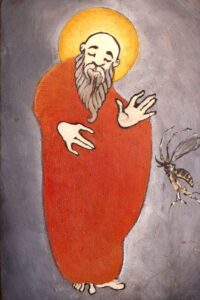
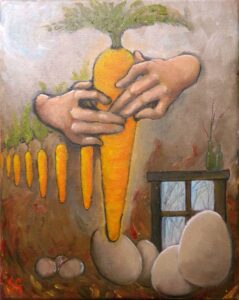
By the time he was 7, Seth knew he wanted to be an artist. In college, he knew he wanted to pursue drawing. But he never considered art school. Instead, he studied Biology and Anthropology – learning to see humanity – body and soul – to better represent the whole person. Even then, his figures were dominated by their wide, expressive eyes and graceful, revealing hands. Eyes and hands have been a major focus and it is easy to become absorbed in the flowing movements of his images.
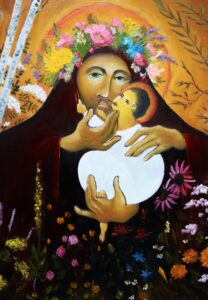
When he first transitioned into painting, Seth primarily produced iconographically inspired images – and a certain amount of Iconography continues to inspire his work. But in this “progression through a more strict medium into a wider” one he’s found that his pieces have become closer to the vision he’s trying to present. “Through his works, the artist speaks to others … Works of art speak of their authors; they enable us to know their inner life, and they reveal the original contribution which artists offer,” writes Pope St. John Paul II in his Letter to Artists. When Seth tells me his paintings “feel more real” in this wider medium, it’s because they’re a closer representation of his own artistic voice. It’s a movement towards a more vulnerable and open cooperation with beauty – a look deeper into the heart of the story he’s trying to tell.
Art as Story
There’s a link between the intellect and the urge to create in Seth’s artistic life. “All of my images are storytelling images,” he tells me. “I don’t think I’ve produced a piece that doesn’t tell a story.” That storytelling aspect in art is a huge part of the urge to create. It’s also a part of the heartache of creating – “not everyone will engage with it … and it will never attain what you meant it to. There’s an impossibility inherent in art.” The artist is “constantly yanked back and forth between the vision and those you present it to.”
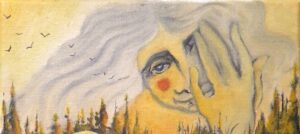 It’s interesting to see who responds to the stories in his paintings. I’m always surprised at the variety of people who respond to an image – whether it’s a painting of St. Francis, a bright flower, or one of his more folkloric images. Telling stories in colorful paints is, in many ways, like scattering seeds – and there’s no way of guessing who is “the rich soil … producing fruit” (Matthew 13:8). That’s why it’s important to avoid getting stagnant in life and in art. “I do think family life, or religious life, is a necessity in the modern art sphere in order to create something that is not so self-focused that all you’re doing is telling people what or how to think.”
What Is an Artist?
When I asked him what an artist is, he turned to Pope St. John Paul II. “I really like his concept that an artist apprehends a particular vision of Truth, Beauty, and Goodness – of the world as it is or should be – and has a driving need to present that to people.”
In that sense, he goes on to say, “Mary is kind of the anti-artist. Not because she didn’t have a vision of Beauty, Truth, and Goodness – she had a perfect vision of it – but because she ‘kept all these things in her heart’ and had no need to present it herself.” On the opposite end of the spectrum, Iconographers, who continue the tradition to remain anonymous, are pure artists, because even without any personal acknowledgement they still have the need to present their vision to the world. It’s the presentation of the vision that defines the artist, not the notoriety that often goes with it.
“Beauty is the vocation bestowed on him by the Creator,” wrote St. John Paul II in his Letter to Artists, and his words come back to me again and again in my conversation with my husband. He mentions J.R.R. Tolkien’s story, Smith of Wootton Major. The last story Tolkien ever published, Smith tells the story of a boy who swallows a star and travels to Faery. He has a life in his town as well. He has a family and daily work, but he also has a calling to go off in pursuit of beauty. The story is full of meanings, but it paints a lovely picture of the artist’s vocation to beauty as well. Particularly Seth’s, who’s art is full of warmth, color, and the vibrant natural word – seen through eyes that love even the most hidden things.


[…] – Fr. Z’s BlogHow Attached Am I to the World? – Mary Ann Kreitzer at Les FemmesEpiphanies of Beauty, n Interview with Seth Goepel – M. Goepel at Catholic Stand MagazineOn Staying Where You Were Raised – Kelly Garrison […]