
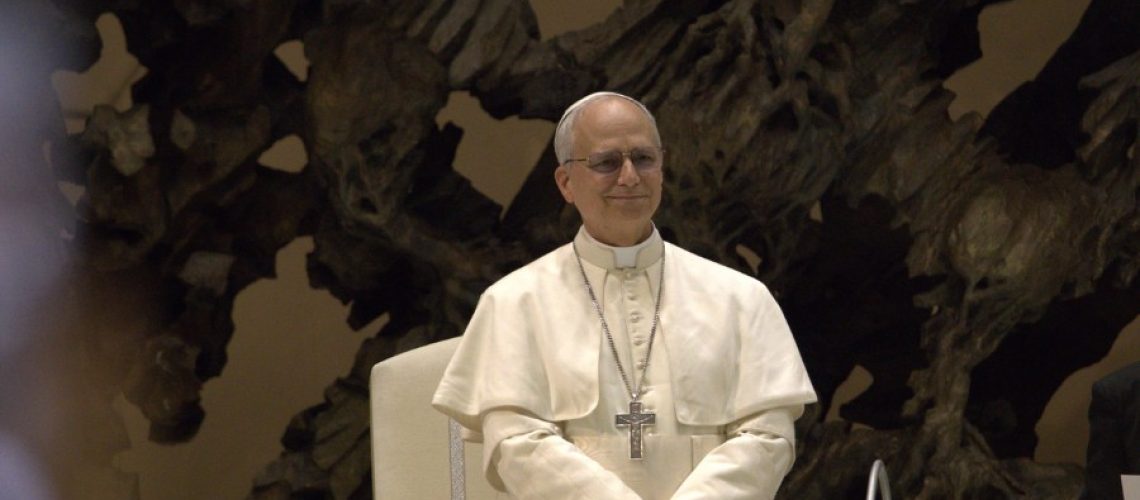
I was a bit shocked by Pope Leo’s Palm Sunday homily. He said “God does not listen to the prayers of those who wage war.”
A number of thoughts occurred to me when I read this. My first thought was, is Pope Leo trying to change Catholic teaching on war and Safeguarding Peace? If so, his homily could be a trial balloon. And if it is a trial balloon, woe to the Catholic Church. Given the confusion that resulted regarding Catholic teaching during Pope Francis’ papacy I can only hope we are not in for more of the same.
My next thoughts were of my father, a Marine who fought on Iwo Jima, and my uncle who was in Patton’s army in Europe during World War II. And I thought of one of my brothers-in-law and a cousin who fought in Viet Nam. They all prayed to God to keep them safe. Did God not listen to their prayers? They were, after all, waging war.
What Isaiah Says
Dr. Marcus Peter writes that the Holy Father “might have been evoking Isaiah 1:15” when he said those words. The pastor of my church, in his homily on Palm Sunday, offered the same opinion.
But Isaiah did not say that God does not listen to the prayers of those who wage war.
In Isaiah Chapter One, the prophet is chastising Israel. He says Israel has become a “Sinful nation, people laden with wickedness, evil offspring, corrupt children!” (1:4). Then he says, “When you spread out your hands, I will close my eyes to you; Though you pray the more, I will not listen. Your hands are full of blood!” (1:15).
Dr. Peter notes that the language in the official Vatican text is clear. “The Italian original reads, “non ascolta la preghiera di chi fa la guerra,” which closely means that God does not hear the prayer of those who make or wage war.”
Isaiah is saying, however, that God does not hear the prayers of the wicked, the evil, or the corrupt. And not everyone who wages war is evil, wicked or corrupt. I don’t think George Washington, our Founding Fathers, or Abraham Lincoln were evil, wicked or corrupt. And President Roosevelt cannot be considered evil or wicked for declaring war on a country that attacked the U.S. and on another country that was out to conquer the world.
So did God listen to the prayers of all those who waged war for American Independence and who fought to defend our country? I think He did. And I think He listens to all of the men and women who answer their country’s call and take up arms and wage war in defense of their county against evil, wicked and corrupt aggressors.
And therein may lie the key to what prayers God listens to and which ones He ignores.
The Catechism of the Catholic Church
In the Catechism, Part 4, “Christian Prayer,” it says, “2591 God tirelessly calls each person to this mysterious encounter with Himself.” It also says, “2725 Prayer is both a gift of grace and a determined response on our part. It always presupposes effort. [T]he great figures of prayer of the Old Covenant before Christ, as well as the Mother of God, the saints, and he himself, all teach us this: prayer is a battle. Against whom? Against ourselves and against the wiles of the tempter who does all he can to turn man away from prayer, away from union with God.”
So prayer is a gift of grace from God and He “tirelessly” calls us to prayer. But the Catechism echoes Isaiah as well. In 2562 we are told “If our heart is far from God, the words of prayer are in vain.” And God most certainly knows what is in our hearts.
God does not listen to the prayers of the wicked, the evil, and those corrupted by grievous sin. But good, virtuous, righteous men do wage war from time to time.
Wrong or Right?
St. Augustine spelled out what has become Catholic teaching – Just War Doctrine – in his magnificent book, “City of God.” He says, in a nutshell, war is allowed for legitimate reasons. And this has been Catholic teaching for 1,700 years.
Whether the Iran Conflict is a just war or not is the subject of much debate. CS writer Tom Colligwood, for instance, offered his thoughts in a recent article “The Iran Conflict: Debates About What Makes a Just War.” But I don’t think President Trump authorized the strikes on Iran with evil intent. Good intentions alone, however, do not provide justification.
Clarity is Key
I hope Pope Leo meant something other than what he said. I hope he meant that God does not listen to the prayers of leaders who wage war for evil, wicked or corrupt purposes. This would make sense because Isaiah is clearly chastising the wicked. But Pope Leo did not say this.
So we are now left to wonder what yet another Pope is trying to tell us. Dr. Peter gives Pope Leo the benefit of the doubt.
“I strongly doubt Leo intended a doctrinal rupture from the pulpit on Palm Sunday. The homily as a whole is a meditation on Christ entering Jerusalem as the meek King who renounces vengeance, rebukes the sword in Gethsemane, and embraces the Cross for the salvation of the world. His dominant register is spiritual and biblical.
“He is preaching Christ crucified. He is not issuing a technical revision of just war doctrine in his homiletic statement.”
I hope Dr. Peter is correct. But it would be nice if our Popes (and bishops) would speak more clearly and concisely, and give maybe a bit more thought to what they are saying. They might also give more thought to how what they say might be interpreted.


Sometimes the Holy See is blind in my opinion and to its own faults, one of which in my lifetime is the priest scandal that Benedict IV took on. Its favorable for the Pope to call for peace with unjust killings, rape, sex and human trafficking. Iran has been terrorizing the United States for 47 years and my President is ending it and I feel taking step by step diplomatic channels. It is not a war of agression but of survival and to bring peace to the Middle East. The Pope should be condemning or maybe he has the Iran regime for slaughtering 46,000 of their own people for standing up for their rights. I think Leaders pray for guidance from God too and many of the faithful are praying for this situation with Iran to end. I’ll not call it a war but a reckoning for bad and evil Iranian regime.
What is appalling is how everyone has forgotten the just war doctrine and that that doctrine does not excuse any indvidual into becoming uncharitable towards the enemy. The just war doctrine is for nations and polticial leaders, not a dispensation for bigotry.
Not to mention there is a disregard of the scriptural curses in Genesis 12, which Ishmael is protected by, along with Christians and Jews.
Let us destroy Iran is a curse and one curse already boomeranges. The coup of Mossaddegh turned aroundnin 1979 and it ended the Shah as monarch while the US and UK lost their oil.
How people forget the past and are surprised when it reappears in an ugly perhaps predictable form. Greed led to the overthrow in 1953 as did greed lead to the fall of the Shah. What might have been is now but an if only
In Hebrews it says Jesus is sam yesterday, now and forever.
His character is the same. Jesus said he brings a sword.
Of course he means spiritual evil.
Jesus also said you are with me or against me.
The Islamic terrorist, Iran’s regime is evil, not followers are Jesus.
HEZIKIAH KILLED 185,00 ASSYRIANS WHILE PRAYING.
MOSES HELD HIS STAFF UP TO THE HEAVENS, A CONTINUAL PRAYER AND HAD VICTORY.
SADLY THIS POPE IS FROM XHICAGO,ANITHER LIBERAL WITH OBAMA AND DAVD AXIELROD.
Good essay and questions. Many others are missing the fact that the actual full quote from Pope Leo’s Homily on 3/29 was:
“Brothers and sisters, this is our God: Jesus, King of Peace, who rejects war, whom no one can use to justify war. He does not listen to the prayers of those who wage war, but rejects them, saying: “Even though you make many prayers, I will not listen: your hands are full of blood” (Is 1:15).”
Notice the Pope leads with “whom no one can use to justify war.” He is clearly talking about Political leaders who make decisions to “wage war” and their invoking God to justify war, or as the Secretary of Defense prayed for “’overwhelming violence.” That makes it clearer the Pope is not referring to the soldier, sailor, or pilot who is praying for their safety. It is not just Dr. Peters invoking Isaiah but Pope Leo himself as noted in the text of the actual Homily on the Vatican website. https://www.vatican.va/content/leo-xiv/en/homilies/2026/documents/20260329-palme.html
Pope Leo’s full quote is included in the link in the first paragraph of the article. He may well have been talking about political leaders, but his words were not precise. And this is what I am faulting him for. Clarity is always preferable to vagueness, insinuation, and innuendo. The Church is still getting over 12 years of confusing statements. We do not need more confusion.
Did God listen to Joshua and David?
Anyone with ears to listen, not just hear, knows exactly what Pope Leo meant. Waging war is not self defense it is aggression and annihilating your enemy not because your enemy has attacked you but because they put up a fight to defend themselves.
So 46 plus years of our enemies calling for our annihilation and attacking us is not justification? If I understand what your saying, you need wisdom, knowledge, and understanding. Go do some research on world history.
Conversely, does God listen to those who pray for peace – it doesn’t seem to work that way.