
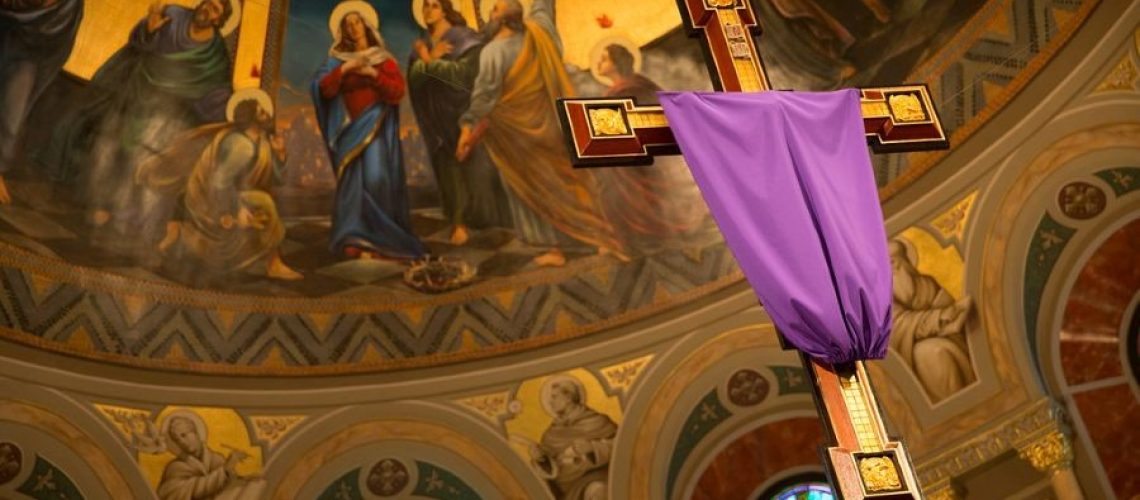
We live in a world shaped by a clear hierarchy of values, where kings are more significant than peasants, the educated excel over the unlearned, and the visible takes precedence over the invisible. It is a pyramid of importance so ingrained that we mistake it for an unchangeable rule. Yet, the Bible consistently challenges this view from Genesis to Revelation. It offers not just a gentle correction but a profound and fundamental reversal of worldly order. It reveals a divine logic where the last are first, the weak are strong, and the foolish confound the wise. In the Catholic tradition, this reversal is not merely a literary motif but a living, sacramental reality that influences doctrine, liturgy, and social teaching. It reaches its highest point in the scandal of the cross and becomes tangible in the Church’s liturgical life, particularly during Lent.
As we aim to deepen faith, self-discipline, and charity in preparation for Easter, we practice prayer as an act of justice towards God. We dedicate more time to conversing with God, meditating on Scripture, participating in the Sacraments (Confession and Communion), and attending the Stations of the Cross. We also undertake communal fasting as an act of justice towards ourselves. This self-denial opens space for God and unites our sacrifices with Christ’s suffering. Mother Church invites us to observe specific fasting and abstinence, especially on Ash Wednesday and Good Friday, and to refrain from luxuries throughout the season. We engage in almsgiving as an act of justice towards our neighbours by giving to those in need, thus embodying charity and service. We sacrifice money, time, or resources to help the poor, reflecting God’s mercy.
Lent’s solemn call to prayer, fasting, and almsgiving embodies the liturgical realisation of the Kingdom’s great inversion. It is the Church’s annual collective training in divine logic, where losing is gaining, emptying is filling, and dying leads to life. To truly observe Lent means consciously stepping outside the world’s pyramid of achievement and consumption and learning the upside-down economy of grace revealed in Scripture. This sacred season offers the faithful structure and time to practise what the Bible teaches: that God’s power is perfected in acknowledged weakness, and His abundance flows through a poverty of spirit.
The pattern of inversion is established in Israel’s election itself, a people chosen precisely for their lack of worldly prestige. It wasn’t due to any merit in them or because of them at all. It was because of Him. It was because the Lord set His love upon them (Deuteronomy 7:7-8). A love initiated and originated in God, with no reason for it in Israel. Saint Paul crystallises this principle in the first letter to the church in Corinth.
But God chose what is foolish in the world to shame the wise; God chose what is weak in the world to shame the strong; God chose what is low and despised in the world, things that are not, to reduce to nothing things that are, so that no one might boast in the presence of God (1 Corinthians 1:27-28).
The focal point of Christian faith offers the ultimate evidence –
For the message of the cross is foolishness to those who are perishing, but to us who are being saved it is the power of God (1 Corinthians 1:18).
In the Cross, the most shameful, weak, and insignificant instrument of Roman execution becomes the source of eternal life. For the Catholic faithful, this is the foundational hermeneutic of sacrifice that supports the Holy Mass, where the apparent insignificance of bread and wine is transformed into the very Body and Blood of Christ.
Lent begins with a stark inversion of Ash Wednesday. While the world seeks to hide decline and avoid the humiliation of dust, the Church boldly steps forward to have dust openly smeared on its foreheads with the words, “Remember that you are dust, and to dust you shall return.” This ritual is a direct confrontation with the world’s first and greatest lie—the promise to be like God on our own terms (cf. Genesis 3:5). When we accept the ashes, we acknowledge our creaturely insignificance and our fundamental dependence. It is a necessary first step on the inverted path, echoing the tax collector’s prayer, “God, be merciful to me, a sinner!” (Luke 18:13). All genuine Lenten practice arises from this humility.
The Three Pillars of Lent
Prayer in the inverted kingdom shifts from performance to presence, from eloquence to poverty of spirit. While the world values articulate, public, and impressive speech, the Kingdom cherishes the hidden, persistent, and simple cry of the heart. Lent invites us to the prayer of the unnamed slave girl—a prayer of confident intercession from a place of apparent powerlessness (2 Kings 5:3). It calls us to the prayer of the Canaanite woman, whose humble persistence despite apparent rejection Jesus praises as great faith (Matthew 15:21-28). This season encourages us to practise contemplative prayer, not to produce insights but to sit in silent receptivity. Like the boy who simply offered his loaves (John 6:9), we make our bare attention the gift we place in Christ’s hands.
Fasting in the inverted kingdom challenges the logic of consumption and control. While the world fasts for fitness, aesthetics, or self-mastery, the Kingdom fasts to make space for God and neighbour, turning our hunger for food into a tangible reminder of our deeper hunger for righteousness (Matthew 5:6). The true fast, as Isaiah proclaims, is not merely to abstain but to actively invert social relations.
Is it not to share your bread with the hungry, and bring the homeless poor into your house; when you see the naked, to cover them, and not to hide yourself from your own kin? (Isaiah 58:7).
Lenten fasting is thus closely connected with almsgiving. It involves a conscious act of embracing poverty so that another may be enriched, imitating Christ,
who, although he was rich, for our sake became poor, so that through his poverty we might become rich (2 Corinthians 8:9).
Almsgiving in the inverted kingdom redefines wealth and security. While the world measures generosity by the size of the surplus gift, the Kingdom gauges it by the depth of the sacrifice, as Jesus demonstrated with the widow’s mite offering (Mark 12:41-44). Lenten almsgiving is the practical discipline of rethinking our budget, making the needs of the least of these (Matthew 25:40) a priority rather than an afterthought. But it extends beyond money. It involves giving our time to the lonely, our respect to the despised, and our patience to the frustrating. It is seeing Christ in the distressing disguise of the poor, as St. Mother Teresa taught.
This divine logic manifests through a recurring cast of characters who embody the “insignificant” in human terms, and whom the Catholic tradition venerates as models of holiness. Consider the unnamed slave girl in Naaman’s house, the boy with five loaves and two fish, the Moabite widow Ruth, the Samaritan woman at the well, and, most notably, the Virgin Mary as she proclaims the essence of divine inversion in the Magnificat.
He has brought down the powerful from their thrones, and lifted up the lowly; he has filled the hungry with good things, and sent the rich away empty (Luke 1:52-53).
The “yes” of a young woman from the insignificant town of Nazareth is the crucial act of human cooperation that allows the Incarnation to proceed. The Church’s Preferential Option for the Poor, a foundational element of modern Catholic social teaching, is the institutional and moral obligation arising from this reversal. It calls for solidarity, compassion, and structural justice rather than just charity.
The culmination of this Lenten inversion is the Sacred Triduum. On Holy Thursday, Christ reverses the role of Master to Servant by washing His disciples’ feet. On Good Friday, the inversion reaches its peak when the Omnipotent God hangs powerless on a cross, and the Creator of Life submits to death. The veneration of the Cross is the ultimate act of worshipping the instrument of shame as the throne of glory. Finally, the Easter Vigil announces the great final inversion as the Exsultet sings, “O happy fault!” (O felix culpa!). Through God’s boundless mercy, the very cause of our loss (i.e., sin) becomes the occasion for the greater gain of redemption. Death itself is inverted into the gateway of everlasting life.
Theologically, this inversion is based on the nature of a God who perceives differently. Hagar’s declaration (“You are El-Roi” – Genesis 16:13) and the account of the Exodus (The Lord, who saw the suffering of His people in Egypt, heard their cry because of their oppressors, and indeed knew their hardships – Exodus 3:7) reveal a God who notices the overlooked. The Catholic practice of the Spiritual Works of Mercy offers a practical discipline in learning to see through this divine perspective, recognising the inherent dignity of both the spiritually and materially poor.
Ultimately, the inversion of the kingdom is personified in the Lord Jesus Christ Himself and is continually present in the Church’s liturgy and life. The Christ-hymn in Philippians offers the most radical interpretation of Christ’s self-emptying, which made Him into nothing.
who, though he was in the form of God, did not regard equality with God as something to be exploited, but emptied himself, taking the form of a slave, being born in human likeness (Philippians 2:7).
The Creator is executed as a state criminal. This mystery is not only commemorated but also re-presented in the Sacrifice of the Mass, where the glory of Calvary is made present under the humble appearances of bread and wine. The prayers of a bedridden widow, the offerings of a suffering soul, and the hidden penances of a cloistered nun are ‘insignificant’ contributions that are understood to build up the spiritual good of the entire Body of Christ.
Therefore, the “Inversion of the Kingdom” is much more than a comforting biblical motif for the Catholic faithful. It is a challenging, sacramental reality that calls for a reorientation of perception and values. Lent is the ideal season to practise this inversion, not to impoverish ourselves but to be filled with God. When we embrace the inverted kingdom, we learn to see with the eyes of El-Roi and to echo Mary’s Magnificat in our own lives. We find our significance not in climbing the world’s pyramid, but in descending, through the sacraments and works of mercy, into the humble, service-oriented love that characterises the true citizen of God’s upside-down kingdom. For it is in the conscious embrace of the “insignificant” that God’s power and grace are most powerfully displayed and received.
Take-Home Message
As we journey through Lent and beyond, may we find the courage to be turned upside-down, so that at Easter, we may rise with Christ into the upright life of God’s grace. Wishing you a blessed and fruitful Lenten season!
*NB: Unless specifically stated, all Bible quotations are from the NRSVCE.

