
By: Ralph A. Capone
Dear Shepherds,
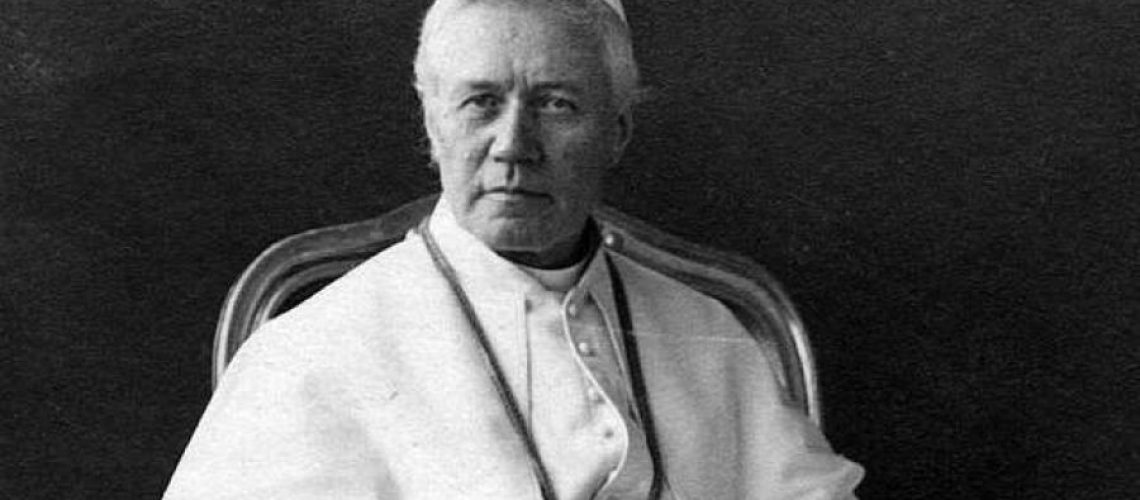
Pascendi Dominici Gregis was written in 1907 by Pope Saint Pius X. Our love for the Church prompts me to write about this encyclical and “eternal Rome”, the Church, the Bride of Christ. The Roman Catholic Church is more than a pilgrim Church which we hear so much about today. It is the Mystical Body of Christ, Who as the Perfect Head, lives in the Church, His Body and which represents a divinely-instituted “perfect society” (Pope Leo XIII Immortale Dei -1885). The Church is also a “pilgrim” Church in her faithful who in their human frailty are on the way to their heavenly home. It is the Church, sanctified through the Perfect Sacrifice and Blood of Christ, which accompanies and empowers them to grow in holiness, by God’s grace, to become more conformed to her Head, Jesus Christ.
Pope Saint Pius X wrote this encyclical to warn the faithful of the dangers of modernism and the threat it poses to souls and to the Church. The modernists much like their rationalist predecessors reject the supernatural and deny religion informed by divine revelation. They disaffirm that God can ever be known by human reason. Thus, the Pope summarized their philosophy as agnosticism. They believe religion is purely personal, an experience of God solely interior and immanent. These fundamental principles have profound and nefarious implications for the Catholic religion. God is knowable by our reason and further, He has revealed Himself to us in history. Saint Pope Pius X was especially worried about the modernists who infiltrated the Church, both in “the Catholic laity, and, what is much more sad,(in) to the ranks of the priesthood, itself” (no. 2).
His forewarning to the Church and the faithful has gradually come to pass. These grave and soul-murdering errors of the modernists have been sown like weeds among the wheat in the very bosom of the Church. They have taken root and are choking out the wheat. Several examples are given using this great confessor Pope’s own words to describe what we are witnessing today.
At the cost of religious indifference and the loss of souls the Church has placed her authority in the service of human fraternity championing it as a goal above all others (“the pluralism and the diversity of religions …. are willed by God in His wisdom” – Abu Dhabi, Feb. 4, 2019). Pope Saint Pius X understood well the modernists beliefs about religion and warned the Church. Religion for them is nothing more than a personal experience through which individuals acquire faith and therefore “given this doctrine of (personal) experience united with symbolism, every religion, even that of paganism, must be held to be true” and indeed many today in the Church maintain that all religions are true. (no.14)
The Church lately promotes human dignity of a kind that extends far beyond that found in our creatureliness and as adopted children of God made in His image. (Human dignity is defined as “infinite”. (Dignitatis Infinita, 2019). In quoting his predecessor, Pope Pius IX Qui Pluribus, Saint Pope Pius X wrote
These enemies of divine revelation extol human progress to the skies, and with rash and sacrilegious daring would have it introduced in the Catholic religion, as if this religion were not the work of God but of man, or some kind of philosophical discovery susceptible of perfection by human efforts (no 28).
Modernists also have succeeded where liberals in the Church have failed. Where liberals denied doctrine modernists have learned from that mistake. Instead, they simply ignore it carrying on their subterfuge but without any effort to overthrow doctrine. The tension between the Church’s teaching authority and personal liberty is solved by modernists similar to the Protestants – by giving primacy of the individual and his conscience over the Church’s doctrines. This is most insidious, to affirm but to ignore doctrine, and is a reason that traditional Catholics, long-suffering and tolerant, have endured modernists so long in their midst. The pope describes these evil teachers in the Church who tell their flock “to proclaim publicly his profound respect for authority (of the Church and her teaching) while never ceasing to follow his own (personal) judgment.” (no 25)
The false synodality promoted in the Church by many of her hierarchs is a modernist project. Pope Saint Pius X saw the foundations of this and the attempt to democratize the Church when he wrote this important encyclical. By positing a man-centered religion, experiential and devoid of divine revelation and objective truth, the modernists
lay down the general principle that in a living religion everything is subject to change, and must in fact be changed. In this way they pass to what is practically their principal doctrine, namely, evolution (no 26).
This is how the modernists solve the tension between many personal opinions, what they call ‘individual consciences’, and the teaching authority, the Magisterium, of the Church.
They (the modernists in the Church) avow it and say, ‘as this magisterium springs, in its last analysis, from the individual consciences, and possesses its mandate of public utility for their benefit, it necessarily follows that the ecclesiastical magisterium must be dependent upon them, and should be therefore made to bow to the popular ideals (no. 25).
There it is – pure and simple, synodality and democracy, and the subordination of the Church’s teaching authority to the judgment of its members. And according to the modernists, the Pope wrote, this is
their conception of the magisterium of the Church : No religious society…can be a real unit unless the religious conscience of the members be one, and also the formula which they adopt…requires a kind of common mind… and it must have, moreover, an authority sufficient to impose on the community the formula which has been decided upon (no. 25).
This is the synodal church forewarned by Pope Saint Pius X and presently under development.
Finally, the Pope wrote that modernism insists
(t)he state must, therefore, be separated from the Church, and the Catholic from the citizen. Every Catholic, from the fact that he is also a citizen, has the right and duty to work for the common good in the way he thinks best, without paying any heed to its (the Catholic Church) wishes, its counsels, its orders – nay, even in spite of its rebukes (no. 24).
It’s clear why Pope Saint Pius X understood the grave threat of modernism to souls and the Catholic religion and why he called it the synthesis of all heresies. His warnings that the Church is at even greater risk from Catholic heretics who desire precisely to deform her from within into an anthropocentric world religion have gone unheeded. We are witnessing the deflation of the supernatural, the promotion of religious indifferentism and false ecumenism.
A man-centered cult is being erected along with a religion of false mercy as sinful and fallen man is denied objective reality and divine truths. We have arrived at the threshold of the modernist dystopia, the very place that Pope Saint Pius X cautioned the faithful to be wary of and attentive to its impending signs. The irony is contained in the very title of this encyclical from our saintly Pope Pius X that those who should have protected the flock are the ones that have participated in promoting this assualt of our religion.
One of the primary obligations assigned by Christ to the office divinely committed to Us of feeding the Lord’s flock is that of guarding with the greatest vigilance the deposit of the faith delivered to the saints, rejecting the profane novelties of words and gainsaying of knowledge falsely so-called. There has never been a time when this watchfulness of the Supreme Pastor was not necessary to the Catholic body; for, owing to the efforts of the enemy of the human race, there have never been lacking ‘men speaking perverse things’ (Acts 20:30), ‘vain talkers and seducers’ (Titus 1:10), ‘erring and driving into error’ (2 Timothy 3:13). It must, however, be confessed that these latter days have witnessed a notable increase in the number of the enemies of the Cross of Christ…… (no 1).
Ending with a plea to our spiritual fathers, our shepherds, against the pernicious philosophy of modernism, that may the few good and faithful ones, following the Good Shepherd,
in the midst of this great danger to souls” protect the faithful from “the insidious invasions of error…and labor to …” feed the flock of the Lord on the Way, in the Truth, and through the Life of Jesus Christ “…with all your strength and courage (no 57).


[…] The InscapistWhy It’s Important to Practice the Hidden Virtues – Philip Kosloski at AleteiaA Letter to Our Shepherds: Remembering Pascendi Dominic Gregis – Catholic StandJesus Condemns ‘Vain Repetition’ In Prayer, But Catholics Have The Rosary […]
Every new day is modern.