
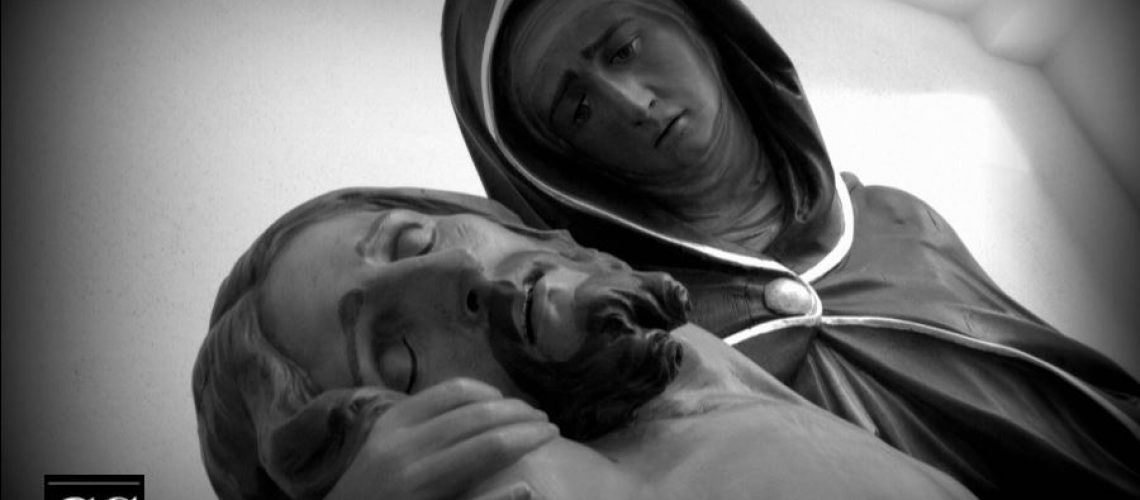
September is traditionally the month dedicated to Our Lady of Sorrows. We remember the moments in Our Lady’s life when she lovingly and willingly united herself to her Son’s sacrifice on the Cross and shared in His self-giving for our redemption. Through this inspiring devotion and reflection, Mother Church guides us to pray and meditate on Mary’s deep sorrow experienced at the crucifixion of her Son.
Luke’s gospel describes it as her soul being pierced by a sword (Luke 2:35) as she stood powerless at the foot of the cross and helplessly watched Him die. Mary endured the agony of witnessing Jesus’ brutal and painful death on the cross, after experiencing the public humiliation that preceded His death. Although present, she was unable to intervene. She was a powerless, helpless witness to every wound and taunt inflicted upon her Son. But this was Simeon’s prophecy becoming a reality for Mary as she experienced this profound sorrow (Luke 2:35).
Mary’s grief holds theological and spiritual significance as it highlights God’s deep compassion for human suffering. Still, she was the one to experience the ultimate pain of seeing her divine son die. This emphasises a shared sorrow between mother and son, with her empathy for humanity's pain stemming from her own experience of loss. The devotion to Our Lady of Sorrows provides a structured way for us to reflect on her suffering and connect with her grief. While acknowledging the temporary nature of sorrow, Mary’s grief also points to the ultimate hope found in Jesus' resurrection and the redemption of the world.
The Prophesy of Simeon (Luke 2:34-35)
Simeon’s prophecy warned of the suffering Mary would endure throughout Jesus’ life and ministry, climaxing in witnessing his crucifixion, which symbolised deep, soul-wrenching grief. His words indicated that Mary herself would not be spared from the varied reactions to Jesus’ role in causing the fall of many and the rise of others in Israel, and that this would be a sign men would refuse to accept. However, the piercing sword would uncover the thoughts of many hearts. Mary’s sorrow over the rejection and murder of her only son reflects (both then and now) the feelings of many regarding Christ’s crucifixion: Jesus’ life and ministry are spoken against. His presence exposes people’s true hearts, forcing them to choose sides and causing a crisis where no one can remain neutral.
Mary’s deep personal sorrow, caused by the sword is linked to this revelation of hearts, reflecting the
effect of her son’s rejection. The prophecy highlights the ultimate victory and reward of salvation that come from following Christ, even through suffering. Mary exemplifies what it means to be charitable. Her love for humanity is so great that she fulfils Christ’s affirming words:
No one has greater love than this, to lay down one’s life for one’s friends (John 15:13).
Popes have taught that she was so completely united with her suffering and dying Son that she suffered and nearly died. She did so for the sake of humanity’s salvation, relinquishing her maternal rights over her Son and, as far as possible, offering him up to satisfy God’s justice. Therefore, it can rightly be said that she redeemed humanity together with Christ (Benedict XV, Letter Inter sodalicia, 22 March 1918). We shall never tire of contemplating Mary Co-Redemptrix, standing near the cross of Jesus (John 19:25).
The Flight into Egypt
Herod’s murderous rage forced the holy family to become refugees fleeing political persecution (cf.
Matthew 2:13-15). However, their flight to Egypt and subsequent return link Jesus' experience to the prophecy of Israel’s liberation from Egypt through Moses, casting Jesus as a leader of a new
exodus. Joseph and Mary’s faith was challenged as they had to trust God’s guidance and follow His
instructions despite the difficulties of seeking refuge in a foreign land. This escape into Egypt shows that Jesus’ persecution and opposition to Him and His kingdom began early in his life. Yet, God’s sovereign plan was revealed when Egypt, a land historically of bondage for Israel, became a place of refuge for the Christ Child. After this, there are thirty years of a humble, ordinary life in a small village in Galilee.
Mary teaches us to trust in faith. She treasured all these words and pondered them in her heart (Luke
2:19). We can try to imitate her talking to Our Lord and conversing like two lovers, about everything that happens to us, even the most minor incidents. But we must not forget to weigh them, consider their worth, and see them with the eyes of faith, to discover the Will of God. If our faith is weak, we should turn to Mary, at whose bidding the Lord Jesus performed the first miraculous sign and his disciples believed in Him (John 2:11). Our Mother constantly intercedes with her Son so that He may attend to our needs and reveal Himself to us so that we can recognise His Sonship (Matthew 16:16).
The Loss of the Child Jesus in the Temple
Some pilgrimages are annual events that draw thousands of pilgrims from both nearby and distant places (cf. Luke 2:41-50). Imagine attending such an event with your child, and at the end of a day’s trip, you realise that the child is missing from your group, with none claiming to have seen the child. After searching in vain, you return to the last place where you saw the child. Yet, it takes you three days to finally find the child. Considering Mary (and Joseph) in that moment, how would you react? What would you say to the child when you finally meet them?
How often do we lose the Lord Jesus? When we do, how much do we weep and search for Him? Do we cry for the times we lost Him through our own fault and did not mourn? Do we know where to look when we somehow lose Him? Can we understand His response to our anguished hearts when He asks, “Why wereyou searching for me? Did you not know that I must be in my Father’s house?” (Luke 2:49-50). Here we are united in misfortune and grief, just as we are united in sin. But the moans of heartfelt sorrow and burning phrases coming from the depths of our being bring us to Him. The joy of finding Jesus in the temple, sitting among the teachers, listening to them and asking questions (Luke 2:46) surely consoles us. We pray that we never lose Him again.
The Meeting on the Way to Calvary
St. John reports that Jesus went out carrying the cross himself to the Place of the Skull, which in Hebrew is called Golgotha (John 19:17). In the fourth station of the Way of the Cross, we meditate on Jesus meeting his mother on his way to Calvary. Having just risen from the first fall, Jesus looked up and saw his mother standing by the roadside as he passed. This was a meeting of great love as Mary gazed at Jesus, and Jesus looked at his mother. Mary’s bitter grief was the grief of the Lord Jesus Christ. As Jeremiah put it,
Is it nothing to you, all you who pass by? Look and see if there is any sorrow like my sorrow, which was brought upon me, which the Lord inflicted on the day of His fierce anger (Lamentations 1:12).
Their eyes met in a silent exchange, conveying deep sorrow between them. Those nearby were unaware; only Jesus sensed Mary’s grief, fulfilling Simeon’s prophecy that a sword will pierce your own soul too (Luke 2:35). In the dark solitude of the Passion, Mary offered her Son a comforting balm of tenderness, union, faithfulness, and an unwavering “yes” to the divine will. You and I can walk hand in hand with Mary to also console Jesus by always accepting the Will of God, our Father. In this way, we can taste the sweetness of Christ’s Cross, embracing it with all the strength of love and triumphantly carrying it along the paths of the earth.
The Crucifixion and Death of Jesus
At the crucifixion, Mary stood nearby the cross of Jesus, hearing with sadness how passers-by hurled
insults at Him, shaking their heads, and taunting Him to come down from that cross if He was the Son of God (Matthew 27:39-40). Even the chief priests, the teachers of the law, and the elders mocked Him, saying, “He saved others, but He cannot save Himself” (Matthew 27:41-42). Unable to do anything, Mary listened to the words of her Son, united to Him in His suffering. At three o’clock, Jesus cried out with a loud voice, “Eloi, Eloi, lema sabachthani?” which means, “My God, my God, why have you forsaken me?” Mark 15:34
She was fully united with the redemptive love of her Son, her pure Heart pierced with immense sorrow like a sharp-edged sword. In silence, she offered it up to God, the Father. Jesus was again comforted by the quiet, loving presence of His mother. He looked and saw his mother and the disciple whom he loved standing beside her, and said, “Woman, here is your son.” To the beloved disciple (to you and me), “Here is your mother” (John 19:26-27). In the person of John, all (especially His disciples who believe in him) are entrusted to his Mother.
At Easter, the Church sings Felix culpa in celebration of a joyful fault that brought us a magnificent
Redeemer and granted us the privilege of receiving Mary as our Mother. Now we are safe, with nothing to fear because our Lady is Queen of Heaven and Earth and is all-powerful in her intercession before our Father God. We know that Jesus cannot refuse anything to Mary, nor to us, who are children of His own Mother (John 2:1-11).
Jesus Taken Down from the Cross
After Jesus died, there was no sign of His glorious triumph. Those who had witnessed the crucifixion, some observing from a distance (Mark 15:40), went away beating their breasts (Luke 23:48). In the evening, a good and upright man (Luke 23:50), a respected member of the council (Mark 15:43), a wealthy man from Arimathea (Matthew 27:57), a secret follower of Jesus (John 19:38), a man named Joseph, boldly approached Pilate and requested Jesus' body. Pilate allowed him to take Jesus’ body. When they removed Jesus’ body from the cross, they placed Him in Mary’s arms (13 th station of the Cross). Grief-stricken, Mary received her son with great tenderness and pressed Him to her bosom, powerfully illustrating Mary’s sorrow and the human bond between a mother and her child, even in death.
This is a perfect moment to reflect on how faithfully we live a holy Christian life and respond to our
weaknesses with acts of faith. We can trust in God and dedicate ourselves to incorporating love into our daily actions. Our experience of sin should cause us sorrow. Our decision to remain faithful should be genuine and profound, truly aligning us with Christ, persevering, regardless of the cost, in the priestly mission He has entrusted to each of His disciples – to be the salt and light of the world (Matthew 5:13-14).
The Burial of Jesus
Joseph of Arimathea, along with Nicodemus, who first visited Jesus by night (John 3:1-2), buried Jesus according to Jewish customs in a new tomb hewn out in the nearby garden (Luke 23:53; John 19:41-42). Sitting opposite the tomb (Matthew 27:61), Mary Magdalene and Mary, the mother of Joses, observed where the body was laid (Luke 23:55, Mark 15:47). The moment of conversation we have had with the Lord should enable us to say, like St. Paul,
No, in all these things we are more than conquerors through him who loved us. For I am convinced that neither death, nor life, nor angels, nor rulers, nor things present, nor things to come, nor powers, nor height, nor depth, nor anything else in all creation, will be able to separate us from the love of God in Christ Jesus our Lord (Romans 8:37-39).
This love deserves to be honoured with passionate words. Mary demonstrates the strength of love. As
Scripture states, “Many waters cannot quench love, neither can floods drown it. If one offered for love all the wealth of one’s house, it would be utterly scorned” (Song of Solomon 8:7). This is the love that so completely filled Mary’s heart and enriched her to become Mother of all humanity. Her love for God is one with her concern for all her children. Her tender heart, sensitive to even the tiniest details – ‘they have no wine’ (John 2:3) – must have suffered greatly witnessing the collective cruelty and ferocity of Jesus’ executioners. Yet, she did not utter a word. Mary is like her Son – she loves, remains silent, and forgives.
TAKE-HOME MESSAGE
We honour Our Lady under the title of OUR LADY OF SORROWS, recalling the sacrifice Christ made for us, and we are united with His Holy Mother in her grief for the sins of the world that led to the crucifixion of her Son. As pilgrims of hope, we know that sorrow is temporary, and remember that the necessary death of Our Lord led to His miraculous resurrection and the redemption of all.
NB: This article was inspired by The Seven Sorrows of Mary: Reflections from St. Josemaria Escriva.
Unless specifically stated, all Bible quotations are from the New Revised


[…] at Aleteia7 of the Most Amazing Miracles Performed by the Great St. Benedict – Church PopConnecting With Mary’s Grief – Pamela Mandela at Catholic Stand MagazineI Will Remain with You – St. Teresa […]