
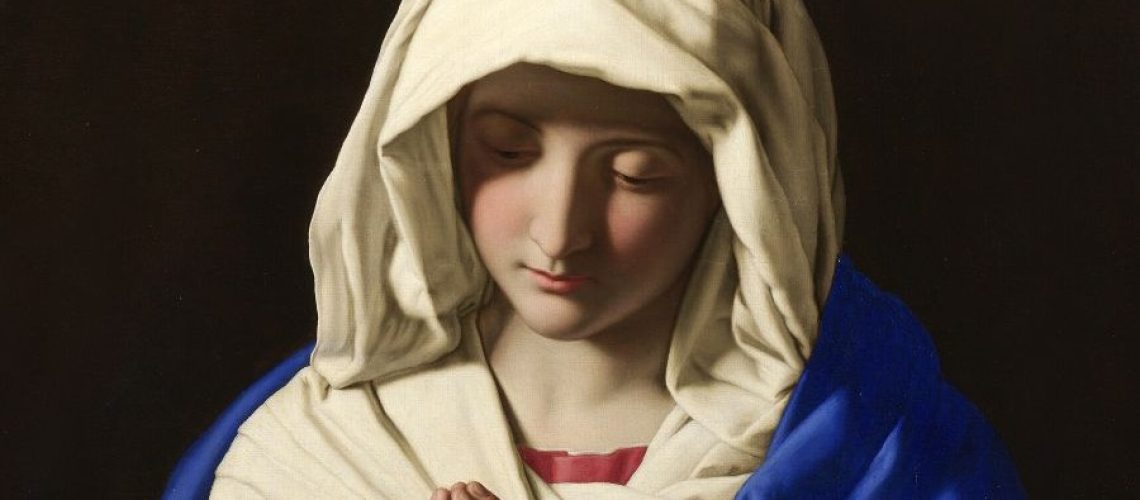
In what sense does the Blessed Virgin Mary’s soul magnify the Lord? Does this imply that Our Lady’s soul in some way overshadows God Himself?
As a transitive verb, the word magnify is defined in three different senses:
‘to enlarge in fact or appearance’ ; ‘to increase in significance: intensify’ ; or ‘to cause to be held in greater esteem or respect: extol.’[1]
Surely, Our Lady is not expressing the first two definitions of the word magnify, that is, that her soul in some way enlarges in appearance, or increases in significance, the essence of God Himself. That would be to ascribe to oneself the ability to increase or enlarge the essence of God – Who “cannot be subject either to growth or to diminution.”[2]
“In the beginning God created the heavens and the Earth” (cf. Gen 1:1). Holy Scripture begins with these solemn words. The profession of faith takes them up when it confesses that God the Father almighty is “Creator of heaven and earth” (Apostles’ Creed), “of all things visible and invisible” (Nicene Creed). We shall speak first of the Creator, then of creation, and finally of the fall into sin from which Jesus Christ, the Son of God, came to raise us up again.[3]
Further, this would be quite contrary to the reality of Blessed Virgin Mary, the fact that her whole being exudes – a fullness of the virtue of humility:
Although there is little recorded in the Gospels of the virtues of Mary in particular, yet, when they tell us that she was full of grace, it is given us to understand that she had all the virtues, and all in the heroic degree.
…And Mary, as she was the first and most perfect disciple of Jesus Christ in all the virtues, was so in that of humility, by which she merited to be exalted above all creatures. It was revealed to St. Matilda that the first virtue which the blessed mother especially practiced from childhood, was humility. The first act of humility of heart is to have a humble opinion of ourselves; and Mary always thought so lowly of herself, as was revealed to the same St. Matilda, that although she saw so many more graces bestowed upon her than upon others, she preferred all others before herself.[4]
The magnificence of the Blessed Mother’s example resides in the fullness of her humility before God and all mankind. She wholeheartedly understands that: “Whoever exalts himself will be humbled; but whoever humbles himself will be exalted.”[5] And, because the Blessed Virgin Mary is pure and humble, purer, and humbler than any creature ever was, or ever will be, she emits with intensity all the light she receives from the Godhead:
For he has looked upon his handmaid’s lowliness; behold, from now on will all ages call me blessed. The Mighty One has done great things for me, and holy is his name.[6]
Thus, how is it that the Blessed Mother’s soul magnifies the Lord? Surely, it is through an abundance of grace, the gift of her Immaculate Conception:
The most Blessed Virgin Mary was, from the first moment of her conception, by a singular grace and privilege of almighty God and by virtue of the merits of Jesus Christ, Savior of the human race, preserved immune from all stain of original sin (cf. Pius IX, Ineffabilis Deus, 1854: DS 2803).[7]
Through her faithful example and unwavering efforts to proclaim God in every thought, word, and deed:
That, the One True God be regarded by all mankind – with greater reverence, esteem, and respect.
The purer and more emptied of self is a heart, the more it will be filled with charity towards God. Most holy Mary, because she was all humility, and entirely emptied of self, was entirely filled with the divine love, so that she surpassed all men and all angels in love to God, as St. Bernardine teaches. Therefore St. Francis of Sales has justly called her: The queen of love. The Lord indeed has given to men the precept to love him with their whole heart: “Thou shalt love the Lord thy God with thy whole heart….[8]
Consequently,
Mary loves her God so much, she certainly requires from her servants nothing else so much as that they should love God as much as they can. And precisely this she said to the blessed Angela de Foligno one day after communion: “Angela, may you be blessed by my Son; seek to love him as much as you can.”[9]
Our Lady infuses every thought, word, and deed with the fullness of grace she received, and through her intercession, she leads all the faithful along the path to grace – the grace required that men and women maintain fidelity to God.
St. Paul speaks of Christ being magnified in his body – by life or by death:
My eager expectation and hope is that I shall not be put to shame in any way, but that with all boldness, now as always, Christ will be magnified in my body, whether by life or by death. For to me life is Christ, and death is gain. If I go on living in the flesh, that means fruitful labor for me. And I do not know which I shall choose. I am caught between the two. I long to depart this life and be with Christ, (for) that is far better. Yet that I remain (in) the flesh is more necessary for your benefit.[10]
Magnified in the sense that St. Paul proclaims Christ that He be “extolled,” held in greater esteem or respect, strengthened through His grace, and empowered to declare the Lord in thought, word, and deed. And, if he be called to the eventuality of martyrdom, to offer the supreme witness of sacrificing his life for the truth of the faith.
That God be magnified in this sense, or made known through one’s actions, ultimately speaks of the greatness of the Godhead:
A work may be called great in two ways: first, on the part of the mode of action, and thus the work of creation is the greatest work, wherein something is made from nothing; secondly, a work may be called great on account of what is made, and thus the justification of the ungodly, which terminates at the eternal good of a share in the Godhead, is greater than the creation of heaven and earth, which terminates at the good of mutable nature. Hence, Augustine, after saying that for a just man to be made from a sinner is greater than to create heaven and earth, adds, for heaven and earth shall pass away, but the justification of the ungodly shall endure.[11]
According to the mode of action, God’s act of creation is the greater act, because God creates ex nihilo, (out of nothing) – inanimate and living beings are brought into existence through His act of creation. However, this act is mutable, what was created by God (heaven and earth) is subject to change.
Conversely, a work may be called great on account of what was made – a just man rendered from him who was previously a sinner. Through grace, the ungodly are justified, and granted the Eternal good of a share in the Godhead – He Who is not subject to change. This is surely the greater act, because it endures for Eternal life: “Heaven and earth will pass away, but my words will not pass away.”[12]
God chose to save mankind by sending His Only Begotten Son to take on flesh in the womb of the Blessed Virgin Mary. Through her fiat, her yes to conceive and bear the Christ, Mary becomes a central figure in the Mystery of Salvation.
Therefore, all who seek Eternal life, must pursue the grace Christ merited, not only by modeling oneself after the example of the Blessed Virgin Mary, but by having recourse to her who has received a fullness of grace:
44. It is Mary alone who has found grace before God (cf. Luk 1:30) without the aid of any other mere creature; it is only through her that all those who have since found grace before God have found it at all; and it is only through her that all those who shall come afterward shall find it. She was full of grace when she was greeted by the Archangel Gabriel (cf. Luk 1:28), and she was superabundantly filled with grace by the Holy Ghost when He covered her with His unspeakable shadow (cf. Luk 1:35); and she has so augmented this double plenitude from day to day and from moment to moment that she has reached a point of grace immense and inconceivable—in such wise that the Most High has made her the sole treasurer of His treasures and the sole dispenser of His graces to ennoble, to exalt and to enrich whom she wishes; to give entry to whom she wills into the narrow way of Heaven; to bring whom she wills, and in spite of all obstacles, through the narrow gate of life; and to give the throne, the scepter and the crown of king to whom she wills, Jesus is everywhere and always the Fruit and the Son of Mary; and Mary is everywhere the veritable tree who bears the Fruit of life, and the true Mother who produces it (cf. 170).[13]
[1] Merriam-Webster.com Dictionary, s.v. “magnify,” accessed May 23, 2025, https://www.merriam-webster.com/dictionary/magnify
[2] Gambero, Luigi. 1999. Mary and the Fathers of the Church : The Blessed Virgin Mary in Patristic Thought. Translated by Thomas Buffer. San Francisco: Ignatius Press., as quoting Origen, Homilies on Luke 8, 1-4: PG 13, 1820-21., pg. 79.
[3] Catholic Church. Catechism of the Catholic Church : Revised in Accordance with the Official Latin Text Promulgated by Pope John Paul II. 2nd ed. Vatican City
Washington, DC: Libreria Editrice Vaticana ;
United States Catholic Conference, 1997., para. 279., (Hereafter cited as CCC).
[4] Alphonsus Liguori, The Glories of Mary, New Revised Edition (New York: P. J. Kenedy & Sons, 1888), pg. 593–595., (Hereafter cited as Liguori).
[5] Confraternity of Christian Doctrine, Catholic Church, Saint Joseph Edition of the New American Bible (Washington, D.C. United States Conference of Catholic Bishops, and Totowa, NJ: Catholic Book Publishing Co. 2011)., Mat 23:12., (Hereafter cited as NAB).
[6] Ibid., Luk 1:48-49.
[7] CCC, 491.
[8] Liguori, pg. 603.
[9] Ibid., pg. 609-610.
[10] NAB, Php 1:20-24.
[11] Thomas. 1920. Summa Theologica. Volume Two, 1a IIaeQQ. 1-114. Translated by Dominicans English Province. Notre Dame, Indiana: Christian Classics., Ia IIae., q. 113., a. 9.
[12] NAB., Mat 24:35.
[13] Grignion de Montfort, Louis-Marie, and Company of Mary. 1941. True Devotion to Mary. Rockford, Ill.: Tan Books., pg. 25.


[…] Magnificat: Poboljšajte ili extul? – Otac Kenneth M. Dos Santos, Mic, u časopisu Catholic Stand […]
[…] Magnificat: Enhance or Extol? – Father Kenneth M. Dos Santos, M.I.C., at Catholic Stand Magazine […]
[…] and Punditry:Magnificat: Enhance or Extol? – Fr. Kenneth M. Dos Santos, M.I.C., at Catholic StandFrom the Prayer of Quiet to the […]