
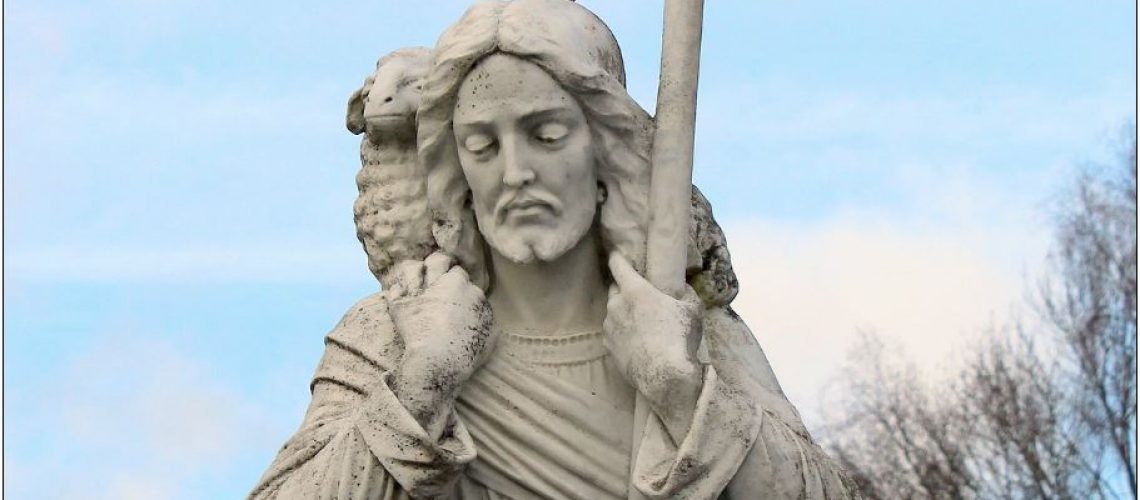
Our salvation and that of loved ones, friends, those near to us, and even enemies should be the first thought in our minds on this sojourn here on Earth. Nothing Christ did while he walked Earth did not point to salvation. Everything was a salvific parable or redemptive thought or action; such as in the first Sunday of this month’s reading of Peter’s mother-in-law being healed by Christ. Jesus, as we know, was desirous to heal her malady but more desirous to drive home that He heals all of us of the feverishness of sin and vice, through Holy Communion. Putting the theological and salvific hat aside we can look at the ordinary side of each act He did and see that Our Lord Jesus embraced all we do in everyday experiences. He leaves us amazed at His humanness.
Jesus wept bitterly at the death of His friend Lazarus. He wept that Lazarus’ two sisters were weeping. His Sacred Heart was not yet painted and hung on a wall but beat within His chest. How many parents, policemen, firemen, and the military, lose a child or a friend “on the field” and hold their corpse or dying friend in their arms, like Michaelangelo’s Pieta? How many funerals do we see in a lifetime, and we sense Jesus commiserating, weeping bitterly with us? Just imagine the deep, sadness experienced by Christ at Lazarus’ funeral. This sadness was amplified by eternity as Jesus experienced in the Garden of Gethsemane the eternal loss of His beloved children who turned away from Him. Truly He was a Man of sorrows, accustomed to infirmity, who bore our agonies as well as our sins. As He declared, “My soul is sorrowful, even unto death”.
Christ, who finalizes our eternity upon death, calls us to “come” to his eternal Paradise, or to “depart!” into eternal Hellfire, has empathy like none other. Many complain that if God were truly loving, He would allow everyone into Heaven.
 That cannot be. How could there be a paradise of kindness and charity if you had a troublemaker, a murderer lurking around, or a cheating heart with wandering eyes? An affluent man who willfully uses the poor as stepping stones for his ambitious desires cannot be in Heaven, nor the envious with secret barbs of jealousy in his heart. Those who are welcome in Heaven are the murderer, the cheater, the thief and the jealous who repented and approached the priest for absolution, and daily conformed their lives to God’s will.
The same Christ who tells us to fear His Father more than any man, tells us that we are (allegorically) better off cutting off our hand or removing our eye if we lust, and sternly warns as well on the high-rolling risk of Hellfire if we hold grudges, and especially if we hold someone in contempt. This is the same God that melts in His heart when an oppressed person loves their pet to shreds, with tenderness and gentleness:
The LORD sent Nathan to David. When he came to him, he said, “There were two men in a certain town, one rich and the other poor. The rich man had a very large number of sheep and cattle, but the poor man had nothing except one little ewe lamb he had bought. He raised it, and it grew up with him and his children. It shared his food, drank from his cup and even slept in his arms. It was like a daughter to him (2 Samuel 12: 1-3).
Yep, the kind of story that moves the Sacred Heart and God the Father to unspeakable tenderness, to reposition themselves on the Great White Throne in Heaven, to reach down, to protect the widow, the orphan, the stranger – those to whom God does indeed have partiality.
God is close to the brokenhearted, those who are crushed in spirit He saves. The smoldering wick He will not quench, the broken reed He will not snap. God is not a dictator who gets His kicks with sadistic or passive-aggressive behavior and He also gave us the present Catechism, exalted by Popes John Paul II and Benedict, as a spring of justice, mercy and compassion for present-day mankind.
God “gets” our pleas, questions, and whys to our sometimes-undiscernible emotions. Charity and compassion are under the umbrella of justice, we are called to look at everyone through that lens and make judgments through that lens by The Lord; however, sometimes punishment is an act of compassion, as the same Catechism points out, punishment can have a remedial effect on the criminal, when administered by legitimate authority. As St. Padre Pio said, “sometimes a dutiful slap is more in order than a kindly reminder.” CCC 2266
Mercy, however, is charity without boundaries upon our asking – possibly one reason Jesus gave us His mother as our advocate with Him. A good woman tends to have reckless type of emotions at times towards loved ones and even “bad eggs,” and God in His providence abandoned us to the reckless compassion and mercy of Our Lady. Thank God for our connection to our heavenly “mom,” by grasping onto her Rosary, like a child onto their mother’s apron strings in the kitchen.

