
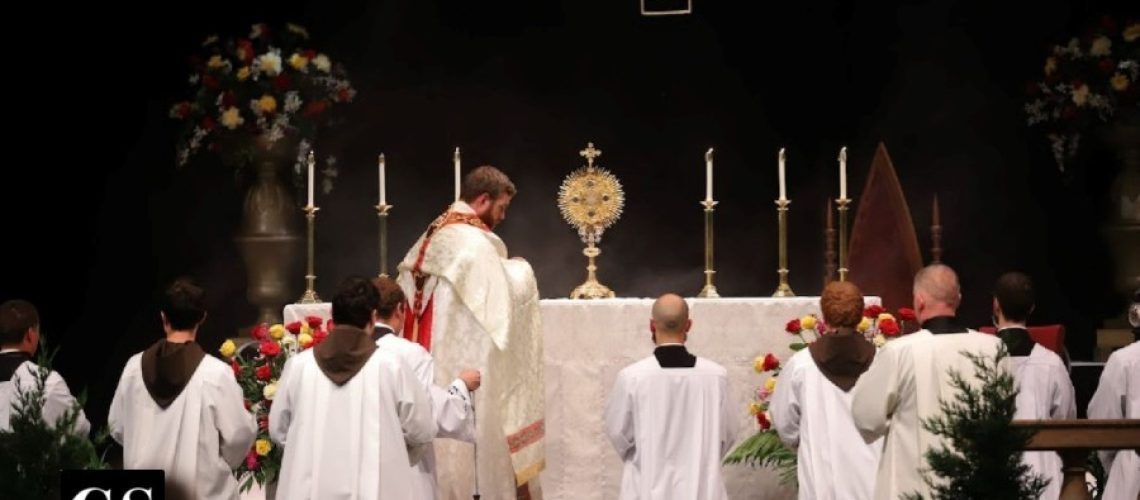
As part of the Eucharistic Revival mentioned in my previous post, our Archdiocese initiated a nine-day prayer and reflection vigil to prepare our hearts for revival. Each day’s action contains three elements: a reflection on a topic, a related prayer, and a challenge activity.
The first day’s challenge activity was to spend 15 minutes in silence asking the Holy Spirit to bring a faith revival to oneself. To be honest, it is difficult for me to sit still, to make my mind blank, and then wait for some thought to enter my consciousness. My mind wanders.
On that first day’s challenge, my mind wandered and finally wondered about the means by which I initially came to believe and how that faith is sustained. My thoughts gravitated toward reflecting on a book I wrote over 15 years ago.
Spirit, Mind and Body Domains
The book is titled Spirit, Mind and Body: A Christian Foundation for Fitness. It lays out a physical, mental and spiritual rationale for why we need to be physically fit and active. It struck me that each of those three core areas of our human essence can also be viewed as avenues or roads for coming to and sustaining our faith.
I have always believed that faith is an ongoing journey. For some, it may be predominately a physical journey. For others it is a mental or cognitive one. And for others it is an intense spiritual awakening. For most, I am sure, it’s a combination of traveling on all three roads toward belief.
The Physical Road
The physical road can be viewed as one where we are following the tenets and physical practices of the faith on a consistent basis. Examples are attending Mass, receiving the sacraments, practicing the virtues and performing the corporal and spiritual works of mercy. These actions can help to keep us in touch with what we believe.
I would suggest that this is the faith road that many “cradle Catholics” have traveled all their life. From the day they are born, they are physically a part of the Church community. From an early age, they are introduced to all the physical practices of the faith that can facilitate an automatic habit of belief.
The Cognitive or Mental Road
The mental road is one whereby we spend time cognitively thinking and pondering about Christ and our faith. It involves reading, studying, attending lectures and the like. It is about developing a logic about the faith that satisfies our curiosity for a rational and orderly belief system.
I would suggest that this is the road many adult converts have traveled, including me. For many of us who tend to be “doubting Thomases” and skeptics, we read and study ourselves into belief. Studying Scripture, reading the Catechism and Church history can provide guideposts to belief. As Cardinal John Henry Newman (an Anglican bishop convert to Catholicism) stated, ”To understand history is to cease being Protestant.”
The Spiritual Road
We ourselves, or others, initiate the traveling on the physical and mental roads. The spiritual road, I believe, is different. The Holy Spirit seems to come more into play as the initiator. Classic examples from Holy Scripture are the coming of the Holy Spirt at Pentecost and Saint Paul’s conversion.
Spirituality can mean a variety of things to different people, but it seems the common denominator is a sense or presence of God in their lives or in an experience. The mystics and saints like St. Faustina illustrate how one can have an intense spiritual experience leading to belief.
Traveling the three roads
As mentioned, my exploration of these three roads grew out of a 15-minute moment of silence. Going beyond that to thinking about how we should travel those roads would appear to be basically about how we maintain God on our radar screens.
We can initiate physical and cognitive actions that set the stage for thinking about God on a regular basis. These actions can enable us to know more about God. In turn, the spiritual domain, I believe, requires a willingness to be open to God’s desire to come to us.
First and foremost we have the Eucharist. Receiving communion and practicing adoration can serve as doorways to the spiritual road. Secondly is prayer. I would add a special activity of ‘prayer walking.’ In this activity, we can also experience Gods creation in nature which speaks of his presence.
Pope St. John Paul II alluded to this in his 1998 Encyclical “Fidas Et Ratio” (#19) –
“. . . recognize as a first stage of divine Revelation the marvellous “book of nature,” which, when read with the proper tools of human reason, can lead to knowledge of the Creator.”


[…] a past essay, I reflected on the fact that I think faith is a physical, mental and spiritual journey. It […]
Tom I’m glad you mention the great Polish Mystic Saint Maria
Faustina Kowalska. Read her Divine Mercy Diary. Next to the
Bible I personally believe it’s one of the most important books
ever written. It’s a must read for all Catholics! Pope John Paul II
called her the Apostle of Divine Mercy for the New Millennium.
[…] Three Roads to Belief – Tom Collingwood at Catholic Stand […]
[…] Creative Minority Report Porter Saints – Donald R. McClarey, J.D., at The American Catholic Three Roads to Belief – Tom Collingwood at Catholic Stand Bishop Unconcerned with Crisis in Catholicism but […]