
In this article, I reflect on my experiences with the Catholic Mass over the past half century. I also advocate for communication accommodations, especially for deaf parishioners.
Good Bye Latin, Hello Latin
I was as an altar boy for the first time on December 26, 1969 – two months shy of turning eleven years old. My then fifty-seven-year-old father trudged back and forth with me for that early morning Mass. A heavy snow had blanketed Brooklyn, and we did not own a car.
With movement to celebrate the Mass exclusively in the vernacular, I was among the first altar boys who did not learn a word of Latin. We saw dramatic changes in the Mass during the pontificate of Saint Pope Paul VI, which many believed to be for the better (cf, National Catholic Register, 11/13/2021). While my late mother was not prone to complaining about those changes, I do recall her speaking of one aspect of the Latin Mass with great affection: Wherever you were in the world (and she rarely journeyed beyond Greater New York City!), you could enter a Roman Catholic church and Mass would be unchanged!
Unintended Consequences
Per #282 of the Compendium of the Catechism of the Catholic Church:
Jesus Christ is present in the Eucharist in a unique and incomparable way. He is present in a true, real and substantial way, with His Body and His Blood, with His Soul and His Divinity. In the Eucharist, therefore, there is present in a sacramental way, that is, under the Eucharistic species of bread and wine, Christ whole and entire, God and Man.
With questions about how well this indispensable teaching is understood by Catholics, we are in “The National Eucharistic Revival…to restore understanding and devotion to this great mystery here in the United States by helping us renew our worship of Jesus Christ in the Eucharist.” One priest has suggested that some earlier (well-intentioned) changes may have contributed to our current need for restoration:
- lack of Latin,
- tabernacles not in the center,
- lack of altar rails,
- de-emphasized fast before Communion,
- lack of kneeling for Communion,
- lack of Ad Orientem,
- unnecessary use of ExtraordinaryMinisters of Holy Communion,
- Communion in the hand (cf, Peter M.J. Stravinskas, 10/25/22)
TLM and Novus Ordo
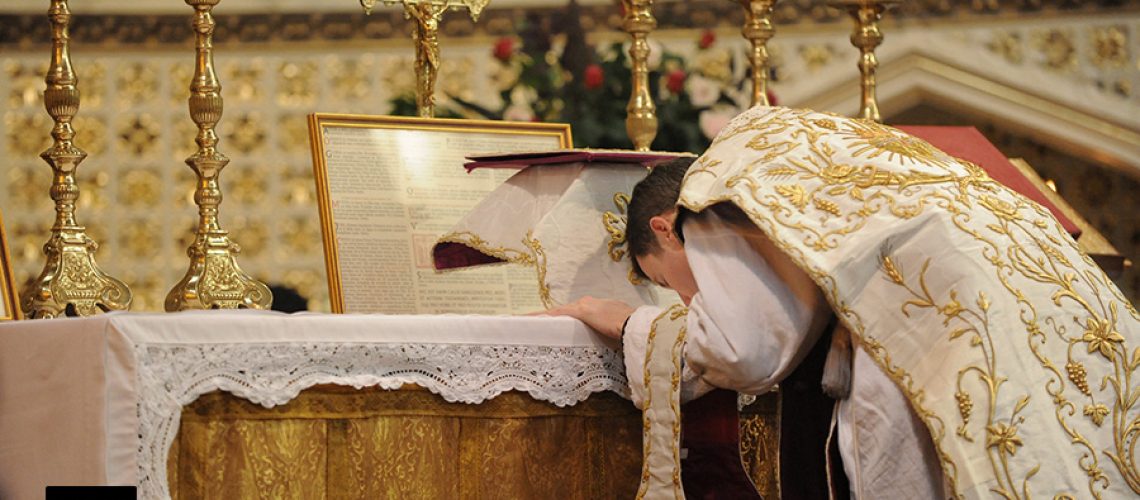
I recently started to attend a Traditional Latin Mass (TLM) on Wednesday evenings and to study the TLM. In addition to the Latin, Father Stravinkas should be pleased by the centered tabernacle, as well as the reception of the Holy Eucharist on the tongue from the celebrant or deacon, while kneeling at the altar rail.
At those weekday TLMs, men wear slacks and collared shirts – if not sports jackets and ties (never denim jeans, shorts, and tee shirts). Women wear dresses/skirts and chapel veils. Compared to weekday Novus Ordo Masses, the congregations appear much younger.
An undeniable sense of reverence is in the air at the TLM Mass, transcending language.
Hello ASL….
Five years after serving my first Mass, I took my first American Sign Language (ASL) class and have remained a student of ASL. While some take to second languages like sponges to water, my own acquisition of fluency was a great challenge. In the past half century, I have been an advocate for making the Mass more understandable to ASL users.
A question frequently coming to my mind is how ASL users fared before the changes in the Mass, when the Church celebrated Mass in Latin. On the rare occasion that an ASL-fluent priest celebrated Mass, my best guess was that the priest may have signed homilies.
Masses Celebrated in ASL or Interpreted
ASL is not a method of encoding English. It is a language unto itself with its own grammar and syntax. Also, ASL does not follow English order. So, an ASL-fluent celebrant is not able to simultaneously sign ASL and speak English (Questions as to how the Church approves current celebrants’ ASL translations would likely surface more were it not for the paucity of ASL-fluent priests.).
ASL dependent people are usually the only deaf child of hearing parents and later have hearing children themselves. Perhaps surprisingly, most who lack the ability to hear/understand speech do not know ASL (i.e., Most people with hearing loss actually acquire the loss as the result of aging and so were not raised with ASL). To fully accommodate the communication needs of all deaf and hard-of-hearing people (and their families), ASL-fluent celebrants could not possibly suffice.
Deaf Versus Not Listening
Before changes in the Mass AFTER Vatican II, hearing people and ASL users would have largely been on a level playing field.
While the Church now emphasizes hearing/understanding at Mass, my experience is that parishes rarely accommodate those with hearing losses properly.
As spoken parts of the Mass are often so hurried as to be incomprehensible, how could an ASL interpreter possibly do an adequate job of conveying accurate understandings?
One of the foremost difficulties in trying to convey to a deaf person what is happening in a Novus Ordo Mass is that most priests, deacons, lectors, and leaders of song are not listening to those who know what needs to be done.
Accommodating Deaf People at TLMs
I cannot properly explain why so many people seem attracted to TLMs, while attendance at Novus Ordo Masses has long been on the downside. This is true for both hearing people and ASL users.
As someone who has long been passionate about accommodations for people with hearing losses, I would like to see our Church do more to welcome them at TLMs. If God is calling you to learn ASL, please consider it. Our Church needs more ASL-fluent Catholics to help our brothers and sisters who suffer with hearing loss.


[…] Deaf Versus Not Listening – Joe Tevington at Catholic Stand […]
[…] Deaf Versus Not Listening – Joe Tevington at Catholic Stand […]
[…] Deaf Versus Not Listening – Joe Tevington at Catholic Stand […]
Joe:
Thanks for your work with the deaf/hard-of-hearing.
It has to be extremely challenging.
Jesus, as we know, was (and is) fully human, yet
omnipotent deity. But when he healed the deaf man,
“he groaned.”
Again, thanks for your efforts on behalf
of the deaf and the Church.
Bob,
Thank you for your kind words.
I believe that your last article was in the same day, and I have very much been looking forward to reading it.
Joe
Wherever I go in the world, I can enter a Roman Catholic church and Mass is unchanged! This is because I have never heard a word of any homily, and I still don’t to this day. As a matter of fact, four months ago I was in the Philippines celebrating Mass just as I would in America. I obviously took no notice of those surrounding me wearing flip-flops and donated t-shirts. I do, however, agree with Pope Francis that the TLM needs to be restricted. Isn’t it funny how much attention was given to a “tainted” vaccine, yet these same voices are silent when a liturgy is being promoted by disobedient and/or excommunicated charlatans?
Thanks for your comment Christopher.
Yes, people may very well dress differently because of climate.
You are mixing issues and have some inaccurate information.
The TLM that I have been attending is in the Diocese of Trenton, and they have been scrupulously following Vatican directives.
I apologize for reading too quickly (i.e., “four months ago I was in the Philippines celebrating Mass just as I would in America”) and failing to address you as “Father Christopher.” Sorry about that.
[…] at Ignitum Today USAID Engages in Ideological Imperialism with LGBT Policy – Robert Semonsen Deaf Versus Not Listening – Joe Tevington at Catholic Stand Gender Dysphoria is Real; Being ‘Trans’ is Not – […]
I have progressive hearing loss and asthma. I am also a convert who loves the TLM. I sit in the 3rd pew from the alter. My hearing aids need to be replaced, but at 2000 each, sometimes I have to work with then a bit past their expiration date. I sit as the edge of the pew near the windows due to my reaction to smoke and the heavenly incense. I love incense, but should sit further back in the church…but for the hearing loss. I still cup my ears to hear even with the aids. Our priest send out a meditation the day before Sunday Mass. It is his homily. I am also given the Latin-English Booklet Missal for praying the Traditional Mass. It is red and has explanations and pictures to allow full participation in the Mass (I truly believe this is what many of the Vatican II Council members had in mind when the asked for more participation of the laity in the Mass). I am well prepared for the Mass as a convert (the 1962 Missal for me was like teaching Calculus to a 3rd grader) because of the priest providing the Sunday meditation/homily the day before (I signed up on email) and these INSPIRED little red books that translate and explain the Mass for a hard-of-hearing convert.
Thank you Ms White for your beautiful, inspiring, and pragmatic reflection. This morning, I had been obsessing about my last sentence, as many ASL users view their manual language as a great gift and may object to the notion of hearing loss as a cause for suffering. Your comments were truly edifying.