
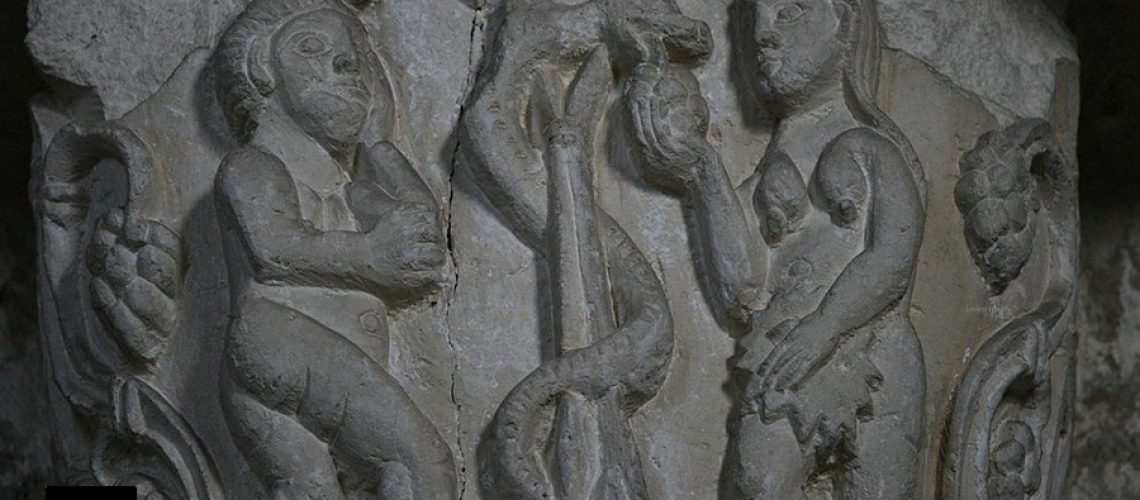
Catholic poet Dana Gioia once wrote, “Catholic writers tend to see humanity struggling in a fallen world.” The statement applies perfectly to writer/director Martin McDonagh’s latest acclaimed film: The Banshees of Inisherin.
McDonagh is not a practicing Catholic, but growing up, he was taught in Catholic schools, and Catholicism saturates much of his work, including Banshees. As I watched the film with my wife, I noticed that it perfectly encapsulated the Catholic doctrine of Original Sin. Even if Original Sin’s cure, Grace, is absent, the film provides an opportunity for movie-loving Catholics to discuss with other people the often-misunderstood doctrine of Original Sin as well as its remedy in Christ.
Brief Film Synopsis:
The Banshees of Inisherin centers on the fragile friendship of two men: Colm, played by Brendan Gleeson, and Padraic, played by Colin Farrell. They live in an agrarian village on a small island, Inisherin, just off the coast of Ireland in the year 1923. The film immediately begins with a broken relationship. Padraic, who is seemingly naïve and innocent at the start, seeks out Colm for their daily two o’clock ritual of pints at the pub. However, on this day, Colm informs Padraic that he does not want to be friends anymore. The reason: he admits to Padraic that he doesn’t like him.
That honest and seemingly harmless confession is the catalyst for the movie’s growing dysfunction, culminating in disturbing violence. Like the stories of Catholic author Flannery O’Connor, Banshees mixes the comedic and the grotesque to form a memorable tale. Still, a potential viewer should be warned: the violence can be too much for some.
What Is Original Sin?
However, the violence is not gratuitous. It serves the story, especially the story’s keen understanding of man’s fallen nature, which Catholic doctrine clarifies with its teaching of Original Sin. That term is often misunderstood, so let’s briefly unpack its meaning with the help of Pope Benedict XVI, The Catholic Catechism, and René Girard.
In his book In The Beginning, Benedict argues that Original Sin is a “misleading and imprecise term.” Indeed, he acknowledges the opposition to this doctrine when he writes that “nothing seems … more absurd than to insist upon Original Sin, since guilt can only be something very personal,” not something we inherit from the decision of persons we’ve never met (Adam and Eve).
Benedict responds to that opposing argument by clarifying Original Sin’s meaning. He argues that “human beings are relational … but sin means the damaging of relationality.” We are not islands unto ourselves; instead, we depend on other people from birth until death. However, “each of us enters into a situation in which relationality has been hurt.”
In the Catechism of the Catholic Church, that “hurt relationality” is discussed as a “deprivation of original holiness” and that deprivation is “a state, not an act” (CCC 404). We are not all guilty of committing the first sin, but all humans enter the world in a state of being where our “original holiness” and perfect “relationality” to God and neighbor are damaged. The damage can be repaired through Grace, but unless Grace repairs, sin thrives.
Today, many people object to this teaching. People commonly say that all people are naturally good, innocent creatures. That is fine to believe if one chooses to ignore reality.
As the great Catholic writer René Girard points out, “Our planet is threatened by three things, all of which are the creation of man: the nuclear threat, the ecological threat, and the biological manipulation of the human species” (Conversations with René Girard). Essentially, in a world of broken human relationships, where our deprivation of “original holiness” inclines us to direct our love anywhere but to where it belongs, God, sinful human beings are capable at this moment more than any other of destroying each other.
Amazingly, The Banshees of Inisherin recognizes that this possible global catastrophe begins with our dysfunctional relationships with each other, even between two seemingly regular fellows like Colm and Padraic.
Original Sin in The Banshees of Inisherin
The film opens with a bird’s-eye view of the beautifully verdant island of Inisherin while the soundtrack plays sacred music sung by an angelic-like choir. Clearly, the director wants to evoke Paradise. However, the bird’s-eye view swoops down to the world of people, where Eden will eventually become Dante’s Inferno.
Again, the escalating dysfunction begins with a seemingly harmless confession: Colm does not like Padraic anymore and wants to be left alone. Padraic’s pride is injured. Why does his former friend not like him anymore? Padraic, a simple man, desperately wants an answer. He seeks and asks everyone. Colm, an artist and musician, finally tells Padraic that he’s dull. Colm would rather spend his remaining years creating art instead of listening to Padraic’s boring daily talk over pints at the local pub.
Padraic, however, cannot accept that answer. He becomes obsessed, to Colm’s growing frustration, with regaining their old way of life together. Colm finally tells Padraic an ultimatum. If Padraic does not leave him alone, Colm, who plays the fiddle beautifully with a bow and his fingers, will cut his index finger off with his enormous garden shears. I don’t want to divulge too much. Still, the reader should know that Colm’s ultimatum is the first threat of violence in a film that, while often humorous, escalates to devastating violence brought on by this dysfunctional relationship between Colm and Padraic.
How does all this relate to Original Sin? Padraic’s sister, Siobhan, and the civil war on the mainland of Ireland offer the viewer clues. Siobhan, played by Kerry Condon, is the voice of reason in the film. She continuously provides Padraic and Colm quality advice on how to stop the growing madness, but neither listens. The viewer sympathizes with her growing horror, and the viewer understands why, at the end of the film, before the horror reaches its climax, she leaves the island for a new job on the mainland.
Also, throughout the film, the characters from the island hear gunshots and artillery firing on the mainland.
Remember that the year is 1923. During that time, a civil war occurred in Ireland between the Provisional Government of Ireland and the Irish Republican Army (IRA). The viewer never sees the battle, but we hear it happening at various points throughout the film. At one point, Colm, upon hearing the artillery fire, stops and says, “Good luck to ye, whatever it is you’re fighting for.” The irony, of course, is that Colm is complaining about the madness of large-scale war without recognizing the madness of his small battle with Padraic.
Think now of man’s state of entering the world with the taint of Original Sin.
Our relationships with God and each other can only be repaired through Grace. Without Grace, our relationships with our fellow man can lead to dysfunction, manipulation, and violence. Again, some may argue the opposite. People are born innocent and good. In fact, throughout the film, a running joke incorporates the word “nice.” Characters complain about other characters not acting “nice,” but the joke is that clearly “nice” is not the word for the reciprocating violence that occurs between Colm and Padraic or between the Provisional Government of Ireland and the IRA.
At the end of the film, as viewers witness the devastation brought on by Colm and Padraic and we hear the gunfire on the mainland, we recognize with sadness that often something broken, mean, and cruel occurs in the world of human relations. Unfortunately, that is where the director leaves us: in a violent world of Original Sin with no hope for a cure.
Catholicism in The Banshees of Inisherin
As I mentioned at the beginning of the essay, Martin McDonagh was raised Catholic but no longer practices it. McDonagh, however, still saturates his films with Catholicism. In Banshees, Catholic artwork, like paintings of the Sacred Heart of Jesus, stone Crosses, and statues of the Virgin Mary, is prominent in many scenes. All the villagers attend Mass every Sunday.
But McDonagh portrays a lifeless Catholicism. When the villagers walk to Mass, they walk with no enthusiasm. They attend the drudgery of Mass because it’s a duty, not an opportunity for Grace. No one is ever seen praying in front of the statues or the artwork. Basically, in the world of The Banshees of Inisherin, one is reminded of Soren Kierkegaard’s complaint about 19th-century Copenhagen. In a world where everyone is a Christian by birth and by rote, few people understand or live by Christianity’s radical demand of love for God and neighbor.
McDonagh’s film shows a world where the Gospel message is spoken about but never acted out. It’s a world where violence, envy, and jealousy overshadow even a voice of reason like Siobhan’s. The director leaves the viewer with a bleak vision of Christianity and humanity.
Conclusion
How can a discerning Catholic respond? After the film, my wife and I discussed the truth of Original Sin, the truth of man’s capability of evil towards his fellow man. The movie gets that right. To portray Grace in the world of The Banshees of Inisherin might be difficult, but I suggested an idea to my wife that a Catholic or Christian might suggest to a secular lover of the film. Perhaps instead of concluding the film with just a bleak vision of sin without the opportunity for redemption, the camera could pan away from the despair and drift down the lanes of the village to the Catholic Church.
A daily Mass is taking place. The pews are practically empty, but a few parishioners are present. Some are reverently praying the rosary. Some are kneeling in devotion as the priest raises the Holy Eucharist. The camera watches as these few souls, sources of light in the darkness, receive the gift of Grace and, filled with love for God and neighbor, humbly leave the church to perform acts of Charity.


[…] Original Sin in The Banshees of Inisherin – Adam Seiler at Catholic Stand […]
[…] I will assume that you are either not concerned or that you’ve read Adam Seiler’s Feb 2 article “Original Sin in The Banshees of […]
I’ve not seen this film, but from your explanation, I understand the connection you make between the plot and original sin.
I especially appreciate your rewritten ending to the screenplay. It reflects the reality of a remnant of the faithful quietly seeking grace and bringing their light to the unseeing world.
[…] Film, T. V., & Streaming: Original Sin in The Banshees of Inisherin – Adam Seiler at Catholic […]
Original sin as theme is a big stretch when critiquing The Banshees of Inisherin The only sane character is Siobhan who leaves and moves on to a saner world even if it is an imperfect ‘garden’. Padraic reminds me of those who attempt to convince agnostics and atheists that they are right – as if you could be right for someone’s subjective thought process – and Coln is a profoundly impaired individual with few redeeming qualities who certainly deserves the fate he chose.